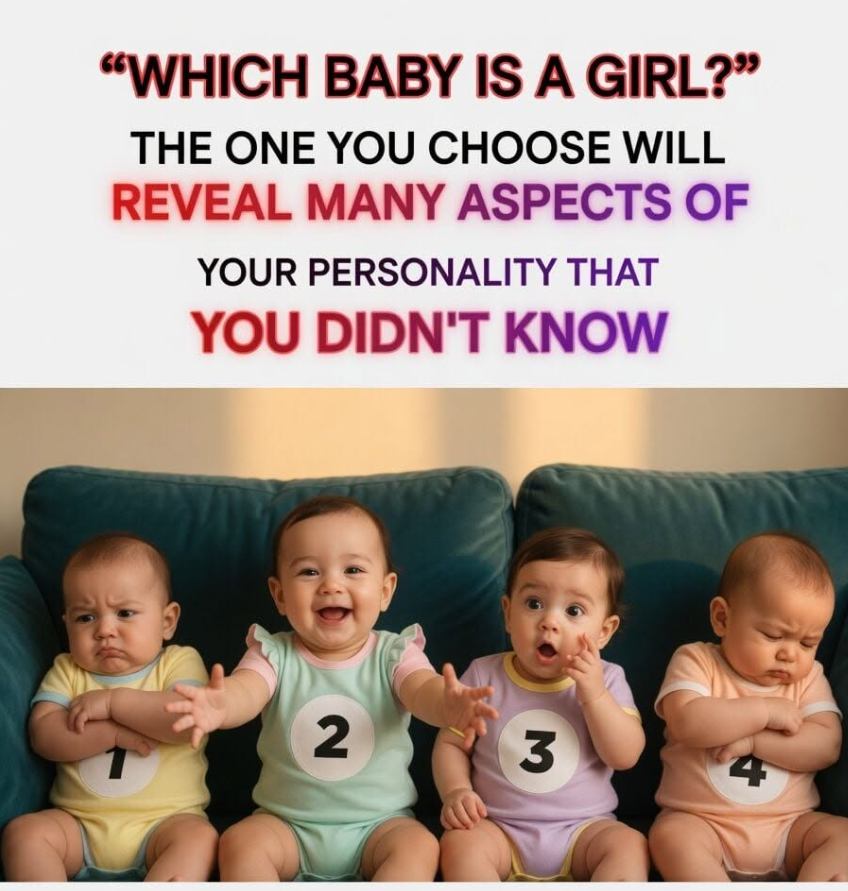
The photo looks harmless.
Four babies.
Four innocent faces.
One simple question:
“Which one is the girl?”
People answer within seconds.
Then something strange happens.
They start doubting themselves.
Millions of people have taken versions of this challenge online, convinced there must be a hidden clue, a secret detail, or a correct answer waiting to be discovered. Friends compare choices. Families argue. Comment sections explode with confidence, confusion, and surprisingly strong opinions.
Yet the real mystery isn’t hidden in the photograph.
It’s hidden in us.
Most people don’t realize how quickly the human brain creates stories from almost no information at all. Faced with four nearly identical babies, our minds immediately begin searching for patterns. A smile seems more gentle. A facial expression feels more confident. A certain gaze appears kinder or more curious.
Within seconds, we build entire personalities around a single photograph.
Baby number two often becomes the crowd favorite. People describe the child as warm, empathetic, cheerful, and emotionally intelligent. When they later discover that number two is supposedly the “correct” answer, many feel strangely validated, as if the choice revealed something meaningful about themselves.
But here’s the fascinating truth:
There is no reliable scientific evidence that you can accurately determine gender from tiny facial differences in infants.
The test itself has little scientific value.
The psychology behind it, however, is incredibly revealing.
What makes this challenge so powerful is that it taps into something deeply human: our desire to understand ourselves.
We want our choices to mean something.
We want our instincts to tell a story about who we are.
When someone says, “If you picked baby number two, you’re compassionate and caring,” part of us wants to believe it.
Not because it’s proven.
Because it feels good.
Because it offers a small moment of recognition.
A brief sense of being understood.
The challenge becomes less about babies and more about identity.
It exposes how quickly we form judgments.
How easily we trust first impressions.
How naturally we search for meaning, even when very little information exists.
Psychologists have long studied this tendency. Humans are pattern-seeking creatures. We connect dots, assign meanings, and create narratives, often within moments of seeing a face, hearing a voice, or reading a few words.
Most of the time, we aren’t even aware we’re doing it.
That’s why these personality-style tests continue to spread across social media.
Not because they’re accurate.
Because they’re engaging.
Because they’re personal.
Because they invite us to look inward, even when the question seems completely unrelated.
In the end, the photo isn’t really asking which baby is a girl.
It’s asking something far more interesting:
Why did you choose the one you chose?
And the answer to that question often reveals far more about the observer than the photograph itself.
That is the real reason people keep sharing it.
Not to prove who is right.
But to discover what their instincts might be trying to tell them.