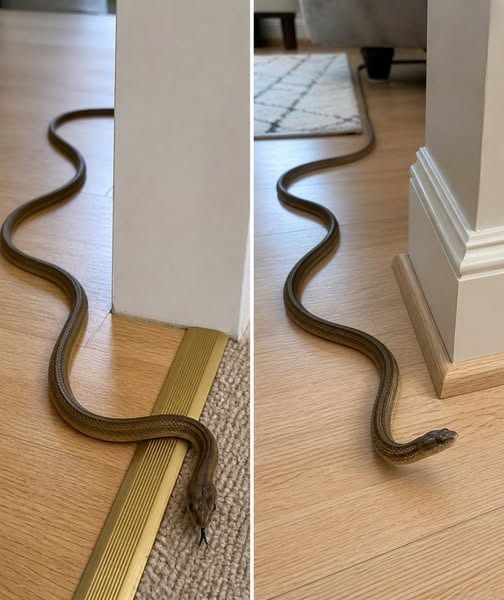
The movement lasted less than a second.
A faint shift across the floor.
A dark shape where no dark shape should have been.
At first, you tell yourself it’s a trick of the light.
A shadow.
A loose cable.
Your imagination.
Then it moves again.
And suddenly your entire body understands before your mind does.
A snake.
Your heart slams against your ribs.
The room that felt safe moments ago becomes unfamiliar territory.
Every corner looks dangerous.
Every sound seems louder.
Every instinct screams at you to get away.
Yet the snake isn’t stalking you.
It isn’t plotting an attack.
It didn’t crawl into your home because it wants a confrontation.
Most of the time, it came for something much simpler.
Food.
Water.
Shelter.
A warm place during cold weather.
A cool place during extreme heat.
Or a hidden rodent population you’ve never noticed.
To a snake, your home can look surprisingly attractive.
Tiny gaps beneath doors.
Cracks in foundations.
Open vents.
Pipes entering walls.
All provide potential entry points.
Once inside, cluttered basements, garages, laundry rooms, storage spaces, and crawl areas offer perfect hiding spots.
And where mice, rats, insects, or other prey exist, snakes often follow.
Understanding this doesn’t immediately calm the fear.
Few people remain relaxed when they unexpectedly encounter a snake in their hallway.
But understanding the reason helps replace panic with action.
The first rule is simple:
Keep your distance.
Do not attempt to touch it.
Do not corner it.
Do not try to capture it unless you are specifically trained to do so.
Most bites occur when people attempt to handle or kill snakes themselves.
Instead, slowly move away.
Keep children and pets out of the area.
If possible, close interior doors to limit where the animal can travel.
Then contact local animal control or a wildlife removal professional.
Trying to identify a snake from a distance can be difficult, and many harmless species are frequently mistaken for dangerous ones.
Professionals have the experience and equipment needed to remove it safely.
Once the immediate situation is resolved, attention should shift toward prevention.
Inspect the exterior of your home.
Seal cracks and openings.
Repair damaged screens.
Close gaps beneath doors.
Trim overgrown vegetation.
Remove piles of wood, debris, or clutter near foundations.
Most importantly, address any rodent problems.
A house that provides food for mice often provides food for snakes as well.
Many homeowners are surprised to discover that the snake itself wasn’t the original problem.
The real issue was the prey attracting it.
The truth is less frightening than the imagination.
A snake crossing your floor may feel like a scene from a nightmare.
But to the animal, it is usually nothing more than a search for survival.
It isn’t there to haunt your home.
It isn’t hunting people.
It is following instincts that have existed for millions of years.
And while you cannot prevent every wild creature from wandering nearby, you can make your home far less inviting.
Because the best way to deal with a snake indoors isn’t courage.
It’s preparation.