The day after my mother’s funeral, he disappeared.
No goodbye.
No explanation.
Just gone.
For most of my life, I believed I hated him.
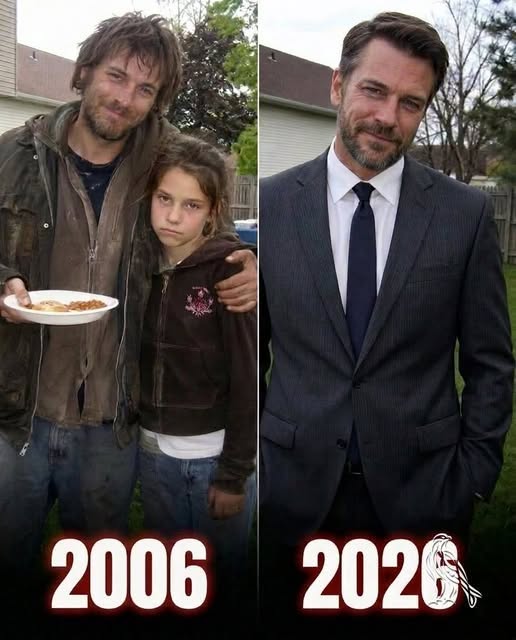
He was the man living behind our fence in a makeshift shelter covered with old tarps and broken boards. The man my mother secretly brought food to while our own bills piled up and the lights in our house sometimes flickered on the edge of being shut off.
As a child, I watched her carry bowls of soup and wrapped leftovers out the back door. Every time she returned, I felt the same sharp sting.
I thought she loved him more than she loved me.
I thought she was choosing a stranger over her own family.
I carried that resentment for years.
Then, after she died, everything changed.
While sorting through her belongings, I discovered a small blue box hidden among old photographs and faded documents. Inside was a collection of items that made no sense at first—a missing silver locket, yellowed letters, photographs with faces I didn’t recognize, and records connected to a relative I had been told died decades earlier.
The deeper I looked, the more impossible the story became.
And then I found the truth.
Victor wasn’t a stranger.
He wasn’t some homeless man my mother felt sorry for.
He was her brother.
My uncle.
The boy whose photograph she had carried close to her heart for decades.
The boy who walked her home when she was frightened.
The boy who protected her when no one else would.
The boy she had been ordered to forget.
Years earlier, family pressure, fear, and manipulation had torn them apart. My uncle Mark had convinced everyone that Victor should disappear from the family’s story entirely. Shame became a weapon. Silence became a rule. Over time, Victor was pushed further and further away until he effectively vanished from family history.
But my mother never stopped loving him.
She simply learned to love him in secret.
What I had mistaken for favoritism was actually sacrifice.
What I had seen as betrayal was protection.
Every meal she carried outside wasn’t proof that she loved me less.
It was proof that she refused to abandon the brother everyone else had abandoned.
She lived trapped between two impossible choices: protecting her family and protecting her brother.
For years, she carried that burden alone.
The realization shattered everything I thought I knew about her.
Suddenly, all the moments that once fueled my anger looked completely different.
The fear in her eyes.
The secrecy.
The silence.
None of it had been cruelty.
It had been survival.
When Uncle Mark attempted to dismiss the story yet again, the truth finally refused to stay buried. Documents, photographs, and letters revealed years of manipulation and control. Family members who had never questioned the past began seeing it for what it was.
Victor had not disappeared.
He had been erased.
There is a difference.
And once that difference became clear, there was no going back.
The next time I saw Victor, I didn’t see a stranger living outside.
I saw family.
I saw the brother my mother had spent twenty years trying to protect.
I brought him inside.
I sat him at my mother’s table.
I placed a bowl of soup in front of him and told him something no one had told him for far too long.
“You don’t belong outside anymore.”
For a moment, he simply stared at the table.
Then he cried.
And so did I.
That night, the story my mother had carried alone for decades finally came home.
Not hidden.
Not ashamed.
Not forgotten.
Home.
And for the first time in many years, Victor wasn’t a secret.
He was family.