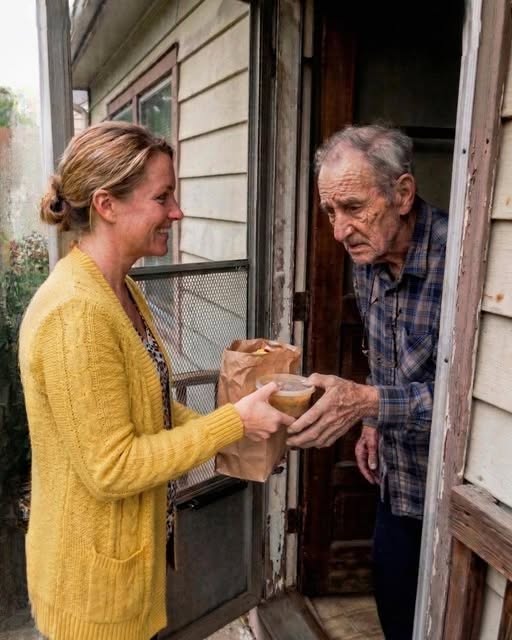
For seven years, I made one extra dinner every night for a man who rarely said thank you and often acted like he wished I would disappear.
His name was Arthur.
Everyone in our neighborhood knew him.
He was the grumpy old man in the faded white house at the end of the block. The one who barked at children for playing too loudly. The one who shut the door in people’s faces before they could finish saying hello. The one most neighbors avoided whenever possible.
Honestly, I understood why.
Life was already exhausting enough without volunteering for difficult people.
I was forty-five years old and raising seven children by myself. My husband had walked away years earlier, leaving debts, disappointment, and a thousand unanswered questions behind him.
Most days felt like survival.
I waited tables before sunrise, cleaned houses during the afternoon, and worked late-night laundry shifts at a small motel outside town. Every dollar mattered. Some weeks I stretched groceries so far that dinner became a creative exercise in making almost nothing feel like enough.
Yet somehow, every evening, I prepared one additional plate.
Not because Arthur asked.
Not because he earned it.
And certainly not because he was pleasant.
It started on a bitter winter morning.
I was walking home when I spotted something lying near Arthur’s front steps.
At first I thought it was a pile of coats.
Then I realized it was him.
He had fallen on the icy sidewalk.
He wasn’t moving.
I dropped my bags and rushed over.
After a few terrifying moments, his eyes opened.
The first words out of his mouth weren’t gratitude.
They were, “Stop making such a fuss.”
Typical Arthur.
I helped him stand anyway.
As I guided him toward his front door, he studied me with a strange expression.
“Why are you helping me?” he asked quietly.
The question surprised me.
I shrugged.
“Because nobody should have to face life completely alone.”
He stared at me for a second.
Then he disappeared inside and closed the door.
That should have been the end of it.
Instead, later that evening, I found myself carrying an extra plate of food to his porch.
When he opened the door, he frowned immediately.
“I don’t need charity.”
“Good,” I said. “Because this isn’t charity.”
He grumbled something under his breath.
Then he took the plate.
The next day it was sitting outside his door, washed clean.
And somehow, without either of us discussing it, a routine was born.
Every evening I brought food.
Every evening Arthur complained.
Every evening he accepted it anyway.
Years passed.
Nothing seemed to change.
Arthur remained stubborn, distant, and impossible.
He never became warm.
Never became friendly.
Never transformed into one of those sweet elderly men from heartwarming movies.
But occasionally tiny cracks appeared in the wall around him.
One afternoon, nearly five years after our routine began, he surprised me.
“You going to stand out there all day?” he called from inside. “Come in.”
It was the first invitation he’d ever offered.
The moment I stepped inside, I stopped.
The house was immaculate.
Every surface gleamed.
Everything sat perfectly in place.
But what captured my attention were the walls.
Photographs covered nearly every inch.
Family vacations.
Birthday parties.
School graduations.
Children smiling.
Grandchildren laughing.
An entire lifetime preserved in frames.
“Your family?” I asked.
Arthur nodded without turning around.
“Three children.”
“Do they visit?”
A long silence followed.
Then he answered.
“Not anymore.”
That was all he said.
No explanation.
No details.
Yet somehow it told me everything.
From that day forward, I stopped seeing only the angry old man everyone avoided.
I started seeing the lonely one.
The man sitting alone in a house full of memories.
The man whose family had slowly drifted away.
So I kept showing up.
Not because I expected anything.
Because it felt like the right thing to do.
Seven years went by.
Then one evening, his porch light stayed dark.
I noticed immediately.
When he didn’t answer my knock, worry settled into my stomach.
The door wasn’t locked.
Inside, the house was silent.
I found Arthur in bed.
Peaceful.
Still.
Gone.
The funeral was small.
Almost painfully small.
A handful of people attended.
Among them were his three children: Daniel, Claire, and Mark.
They looked successful.
Polished.
Detached.
Like visitors attending an obligation rather than mourning a father.
Nobody spoke to me.
I assumed that would be the last chapter of the story.
I was wrong.
After the service, a man in a dark suit approached me.
“Are you Kylie?”
I nodded.
“Arthur requested your presence for the reading of his will.”
The invitation made no sense.
Still, I went.
A few days later, we gathered in a lawyer’s office.
Arthur’s children sat together on one side.
I sat alone on the other.
The atmosphere felt tense before anything even began.
Then the lawyer pressed a button.
Arthur’s recorded voice filled the room.
“I didn’t choose Kylie because she was kind.”
Everyone looked at me.
“I chose her years before she ever brought me a meal.”
My heart started pounding.
“I watched her after her husband left. Seven children. Barely enough money. Every reason in the world to quit.”
I remembered those nights.
The fear.
The exhaustion.
The uncertainty.
Arthur continued.
“Most people would have broken. She didn’t.”
The room remained silent.
“So I paid attention.”
Daniel rolled his eyes.
Claire crossed her arms.
Arthur kept talking.
“She never knew I was watching. But year after year, she kept going. She kept fighting. She kept showing up.”
My throat tightened.
“And when she started bringing me dinner, I knew I was right.”
Then came the shock.
“My children intend to sell my house after I’m gone. Unfortunately for them, they can’t.”
The lawyer glanced around the room.
“Because I already transferred ownership.”
Everyone froze.
“To Kylie.”
The silence lasted exactly two seconds.
Then chaos erupted.
“You can’t be serious!”
“This is ridiculous!”
“She’s not family!”
I sat speechless.
Arthur’s voice continued over the arguments.
“She is exactly the kind of person this house belongs to.”
Over the next several days, his children pressured me constantly.
Sell the property.
Take the money.
Walk away.
And honestly?
The temptation was real.
I had debts.
Bills.
Children.
A thousand practical reasons to accept.
Then I brought my kids to visit the house.
The moment they stepped inside, laughter filled the rooms.
The silence that had haunted the place for years disappeared.
For the first time since Arthur died, the house felt alive.
That’s when I made my decision.
Back in the lawyer’s office, I looked everyone in the eye.
“I’m keeping it.”
The room exploded again.
Then the lawyer raised his hand.
“There’s one more recording.”
Arthur’s voice returned.
“If Kylie keeps the house, then she understood what I was trying to build.”
Everyone fell silent.
“Which means the remainder of my estate belongs to her as well.”
The room looked like it had been struck by lightning.
Because Arthur wasn’t merely comfortable.
He was wealthy.
Far wealthier than anyone realized.
His children left furious.
One by one.
And my life changed forever.
I paid off every debt.
Moved my children into a safer home.
Created stability we’d never known before.
But I never sold Arthur’s house.
Instead, I honored his final wish.
I transformed it into a community home.
Every evening, the doors open.
Anyone can come.
Neighbors.
Strangers.
Families.
People with nowhere else to go.
No one eats alone.
Months later, something unexpected happened.
Mark showed up first.
Then Claire.
Then Daniel.
At first they stayed only a few minutes.
Then longer.
Eventually they started helping.
Cooking.
Serving.
Talking.
Healing.
One evening, I looked around the dining room.
My children were laughing with Arthur’s children.
Neighbors shared stories.
Plates were being passed.
The house buzzed with warmth.
And suddenly I understood what Arthur had truly left behind.
It wasn’t money.
It wasn’t property.
It wasn’t inheritance.
He gave us a second chance.
A chance to create the family he lost.
A chance to build something larger than ourselves.
And somehow, in the end, the lonely old man everyone avoided managed to bring everyone back home.