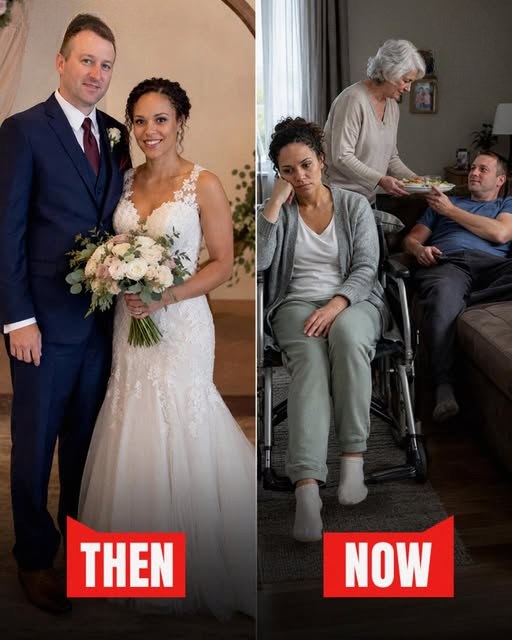
The front door swung open before anyone could say another word.
My eyes immediately shifted toward the hallway.
Denise stepped inside carrying several shopping bags, but the moment she noticed Mrs. Greene standing in the living room, her expression changed completely.
“What is she doing here?” Denise demanded.
Mrs. Greene didn’t answer.
Instead, she folded her arms and nodded toward the folder resting in my lap.
Denise’s eyes widened.
For the first time since moving into my apartment, she looked genuinely nervous.
“Alan,” she said sharply.
“What have you done?”
“I didn’t do anything,” he replied.
The response sounded weak even to him.
I looked back down at the papers.
Apartment applications.
Lease inquiries.
Moving company estimates.
Utility transfer forms.
Everything had been prepared weeks before my operation.
Some documents were dated nearly a month before I entered the hospital.
A cold realization settled over me.
This wasn’t a plan created after my complications.
This had been arranged long before the surgery ever happened.
“You knew,” I whispered.
Neither of them answered.
“You knew I was giving up a kidney for you.”
Alan looked away.
“You knew there was a chance something could go wrong.”
Still silence.
“And while I was preparing to risk my health…”
My voice cracked.
“You were preparing to leave.”
The room became painfully quiet.
Mrs. Greene remained motionless beside the doorway.
Denise suddenly stepped forward.
“It wasn’t supposed to happen like this.”
I stared at her.
Those words were somehow worse than a denial.
Because they weren’t denying anything.
They were admitting everything.
My stomach twisted.
“How long?” I asked.
Alan rubbed both hands across his face.
“Clara…”
“How long?”
His shoulders sagged.
“About six months.”
Six months.
For half a year, my husband had been planning a future without me while still accepting one of my organs.
The realization hit harder than any physical pain I had endured after surgery.
I felt humiliated.
Used.
Disposable.
Mrs. Greene spoke before I could.
“You let this woman risk her life for you.”
Neither Alan nor Denise responded.
“You watched her struggle every day.”
Still nothing.
“You stopped her therapy.”
Alan finally lifted his head.
“I was trying to make things easier.”
“No,” Mrs. Greene snapped.
“You were making it easier for yourself.”
The truth landed heavily in the room.
Because deep down, everyone knew she was right.
Alan wasn’t helping me recover.
He was waiting.
Waiting for me to become someone else’s responsibility.
Waiting for enough time to pass that leaving wouldn’t make him look like a monster.
Waiting until his health was secure.
I suddenly remembered every small moment after the operation.
Every sigh.
Every annoyed glance.
Every ignored request.
Every dinner prepared only for him.
None of it had been frustration.
It had been detachment.
He had already emotionally left the marriage.
I was simply the last person to realize it.
Tears filled my eyes, but something unexpected happened.
For the first time in months, I wasn’t crying because I felt abandoned.
I was crying because I finally understood the truth.
And somehow the truth felt lighter than the confusion.
Mrs. Greene gently placed her hand on my shoulder.
“You don’t need these people.”
Denise immediately scoffed.
“Oh please.”
But her confidence was gone.
Mrs. Greene turned toward her.
“No. What she doesn’t need is a husband who takes from her until there’s nothing left.”
Denise’s face reddened.
“You don’t know anything about our family.”
“I know enough.”
The older woman pointed directly at the folder.
“Those papers tell me everything.”
For several minutes nobody spoke.
Finally, I closed the folder.
Slowly.
Carefully.
Then I looked directly at Alan.
The man I once believed would never let me face life alone.
The man who promised I was safe with him.
And suddenly he looked like a stranger.
“Leave,” I said quietly.
Alan blinked.
“What?”
“Leave.”
“Clara, let’s talk.”
“No.”
I surprised even myself with how calm I sounded.
“You’ve had months to talk.”
“Please.”
“No.”
I pointed toward the door.
“You wanted another apartment.”
My voice remained steady.
“Go live in it.”
Denise immediately started protesting.
“Clara, don’t be ridiculous—”
“Both of you.”
I interrupted her.
“Get out.”
For a moment, neither moved.
Then Mrs. Greene stepped forward and tapped her cane against the floor.
The sound echoed through the room.
Neither Alan nor Denise argued after that.
Within twenty minutes, they were gone.
The apartment felt impossibly quiet.
Yet somehow it felt larger too.
Lighter.
As though something toxic had finally been removed.
I expected to feel devastated.
Instead, I felt exhausted.
Mrs. Greene stayed with me that evening.
She made tea.
Ordered takeout.
And listened while I cried.
Not because I missed Alan.
But because I was mourning the version of him I thought existed.
The version who would have stayed.
The version who would have cared.
The version who would never have asked me to sacrifice everything while secretly planning an exit.
Over the following weeks, my recovery slowly improved.
Mrs. Greene drove me to therapy appointments.
Friends I hadn’t spoken to in months began visiting.
People I thought had forgotten me showed up in ways I never expected.
And little by little, I began healing.
Not just physically.
Emotionally too.
Months later, I finally walked into my apartment without assistance.
No wheelchair.
No walker.
Just my own strength.
I stood in the middle of the living room and cried again.
This time for a different reason.
I had survived.
Not because Alan saved me.
Not because Denise helped me.
But because I finally stopped depending on people who had already abandoned me.
The operation took a kidney.
The betrayal took a marriage.
But losing those things gave me something unexpected in return.
The ability to see clearly.
And sometimes clarity is worth more than anything we lose getting there.