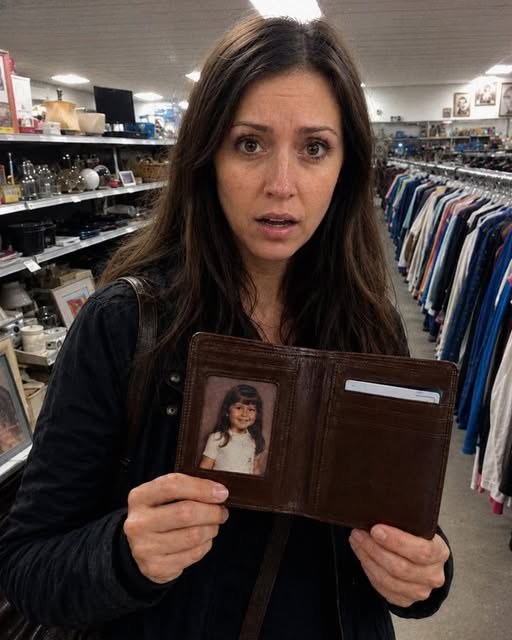
I thought I was simply shopping for secondhand furniture when my husband uncovered an old wallet containing a photograph of me as a child. Tucked behind the picture was a handwritten note that suggested someone had been quietly following my life for years. What began as a confusing discovery inside a dusty thrift store soon unraveled a family secret that completely changed how I understood my past, my parents, and the people who loved me.
The morning sunlight streamed through the dusty windows of Millbrook Thrift, illuminating shelves crowded with forgotten possessions and fragments of other people’s histories.
I had not set foot in this town for fifteen years.
Even after all that time, every familiar street felt like a bruise that never fully healed.
Moving back had not been part of the plan. Financial struggles had left Daniel and me with few options, and returning to my hometown felt more like surrender than a fresh start.
Daniel was browsing through a box of old wallets and belts a few aisles away.
“You really think we’re going to find a coffee table here?” I asked.
He looked over his shoulder and grinned.
“Maybe not a coffee table. But definitely character.”
I laughed softly and ran my hand along a shelf filled with chipped dishes.
“My dad used to bring me here when I was little.”
“Really?”
“Every Saturday. He’d let me choose one thing as long as it cost less than a dollar.”
“What did you usually pick?”
“Books mostly. Sometimes stuffed animals nobody else wanted.”
Daniel smiled.
But the nostalgia didn’t feel comforting.
Something about being back in Millbrook unsettled me.
Maybe it was the smell of old fabric and dust.
Maybe it was the familiar songs playing through the speakers.
Or maybe it was the memories I had spent years trying to leave behind.
My mother, Linda, died when I was six.
After that, life became quiet.
It was just me and my father, Frank, trying to survive on a modest paycheck and a lot of sacrifice.
Everything we owned had already belonged to someone else first.
“Has your dad called you back?” Daniel asked.
I shook my head.
“No.”
“He’s probably overwhelmed having you back in town.”
“Maybe.”
But deep down I didn’t believe that.
Lately my father seemed nervous whenever I asked about the past.
Especially when I asked about my mother’s family.
Every conversation ended the same way.
A change of subject.
A distraction.
An excuse.
Something felt hidden.
I just didn’t know what.
A few moments later, I heard Daniel stop rummaging.
The silence caught my attention.
When I looked over, he was staring at a brown leather wallet.
“Emma,” he said carefully.
“There’s something you need to see.”
I walked over.
“What is it?”
He turned the wallet toward me.
My breath caught immediately.
Inside was a photograph.
My photograph.
A little girl with missing front teeth wearing a yellow dress.
A dress I remembered.
A dress my mother had made before she died.
“That’s me,” I whispered.
Daniel frowned.
“What do you mean?”
“I mean that’s literally me.”
I took the photograph from his hand.
My pulse quickened.
The wallet itself was expensive.
Far nicer than anything my father had ever owned.
Stamped near the edge were two initials:
W.H.
I didn’t recognize them.
Then Daniel pointed toward the back of the photograph.
“There’s something written there.”
My fingers trembled as I turned it over.
Seven words.
Just seven.
**Forgive me, Emma. I never stopped watching.**
The room suddenly felt smaller.
Colder.
“Who would write this?”
“I don’t know,” Daniel said quietly.
“But whoever did kept your picture for a very long time.”
I carried the wallet directly to the front counter.
The elderly cashier smiled politely.
“Finding treasures today?”
“Where did this wallet come from?”
Her smile faded slightly.
“That old thing?”
“Yes.”
The woman studied it.
Then she looked at me.
Then at the photograph.
Something changed in her expression.
“It came in last week.”
“From who?”
“An older gentleman.”
“Do you know his name?”
She hesitated.
“He didn’t leave one.”
“Please.”
My voice cracked.
“This picture is me.”
The woman glanced around before lowering her voice.
“He lives on Birch Lane.”
My stomach tightened instantly.
Birch Lane.
Only a few streets away from the house where I grew up.
Only a few streets away from my father.
The cashier continued.
“Blue house. Porch swing.”
That was all she would say.
Outside, the air suddenly felt heavier.
Daniel followed me into the parking lot.
“Talk to me.”
“Birch Lane is right near my dad’s house.”
“So?”
“So how did someone live that close to me my entire childhood without me knowing?”
Daniel considered that.
Then quietly asked,
“Do you want to call your father?”
I thought about it.
About the nervousness.
The evasions.
The way he avoided talking about my mother.
“No.”
I looked down at the wallet.
“Not yet.”
Twenty minutes later, we stood outside a small blue house with a porch swing moving gently in the wind.
I climbed the steps.
Knocked.
And waited.
The door opened.
An elderly man stood before me.
The moment he saw my face, tears filled his eyes.
“My name is Walter,” he whispered.
Then he started crying.
Inside his home sat a wooden box overflowing with items that should not have existed.
Photographs of me at different ages.
School pictures.
Birthday cards.
Locks of baby hair tied with ribbon.
Memories nobody should have possessed.
I felt physically ill.
“This is insane.”
I stepped backward.
“Who are you?”
Walter’s voice trembled.
“Please sit down.”
“No.”
“Emma—”
“Don’t use my name.”
Then he said something that stopped me completely.
“Ladybug.”
The word hit me like lightning.
That was what my mother called me.
Nobody knew that.
Nobody.
“The yellow dress,” Walter continued.
“Your mother made it before you were born.”
My knees nearly gave out.
“How do you know that?”
His eyes filled with tears again.
“Because Linda was my sister.”
Everything went silent.
The world seemed to tilt sideways.
“My mother’s brother?”
Walter nodded.
I could barely process it.
My father had always insisted my mother had no family left.
No siblings.
No relatives.
No one.
Yet here sat a man claiming to be my uncle.
Walter explained everything.
Years before I was born, a bitter conflict had erupted between him and my father.
After my mother died, the situation worsened.
According to Walter, my father blamed him for old arguments involving money and pride.
Eventually Frank cut him out completely.
And when Walter tried to stay connected to me, my father threatened to make sure he never saw me again.
“So you watched from a distance?”
Walter lowered his head.
“Yes.”
His voice broke.
“I kept every promise I made.”
I looked around the room.
At the photographs.
The cards.
The evidence of years lost.
Then Walter revealed something else.
The scholarship that paid for my college education.
The scholarship that changed my life.
The scholarship that allowed me to leave Millbrook.
He funded it.
For me.
Without ever taking credit.
I left immediately.
Not because I hated him.
Because I needed answers.
Real answers.
And those answers waited at my father’s house.
When Frank opened the door and saw the wallet in my hands, all color disappeared from his face.
“Dad.”
My voice shook.
“Tell me the truth.”
For the first time in my life, he did.
He admitted everything.
The money he borrowed.
The lies he told.
The shame he carried.
And the resentment that grew until he convinced himself Walter was the villain.
“I couldn’t face what I’d done,” he confessed.
“So I made him the bad guy instead.”
The words hurt.
But they also explained years of silence.
Then my father told me something else.
Walter was dying.
That was why he finally broke his promise.
That was why he left the wallet.
That was why he wanted me to know his name before it was too late.
Later that afternoon, my father and I drove together to Birch Lane.
For the first time in decades, he stood face-to-face with the man he had spent years avoiding.
Neither looked angry.
Only tired.
Walter reached for his hand.
“Come inside.”
My father’s eyes filled with tears.
“I owe you more apologies than I can count.”
Walter smiled sadly.
“Then let’s stop wasting time.”
Over the following weeks, Walter told me everything.
Every school performance he quietly attended.
Every graduation ceremony.
Every birthday he watched from afar.
Every moment he wished he could simply walk over and say hello.
I listened to every story.
Because after losing so many years, I wanted every piece of him that remained.
Three weeks later, I sat beside his bed and held his hand as he passed away peacefully.
He left me the wallet.
The photographs.
The letters.
And one final message.
In it, he wrote that although he never had children of his own, loving me had always made him feel like he did.
At his memorial service, my father stood beside me.
For the first time, the weight he had carried for decades seemed lighter.
Not gone.
But lighter.
“I don’t deserve forgiveness,” he admitted afterward.
Maybe he was right.
But I gave him another chance anyway.
Today, the old wallet sits on a shelf in my home.
Inside is the photograph of a little girl wearing a yellow dress.
Whenever I see it, I think about the different ways people love.
Some love loudly.
Others love quietly from a distance.
And after all those years, I finally understood the difference.