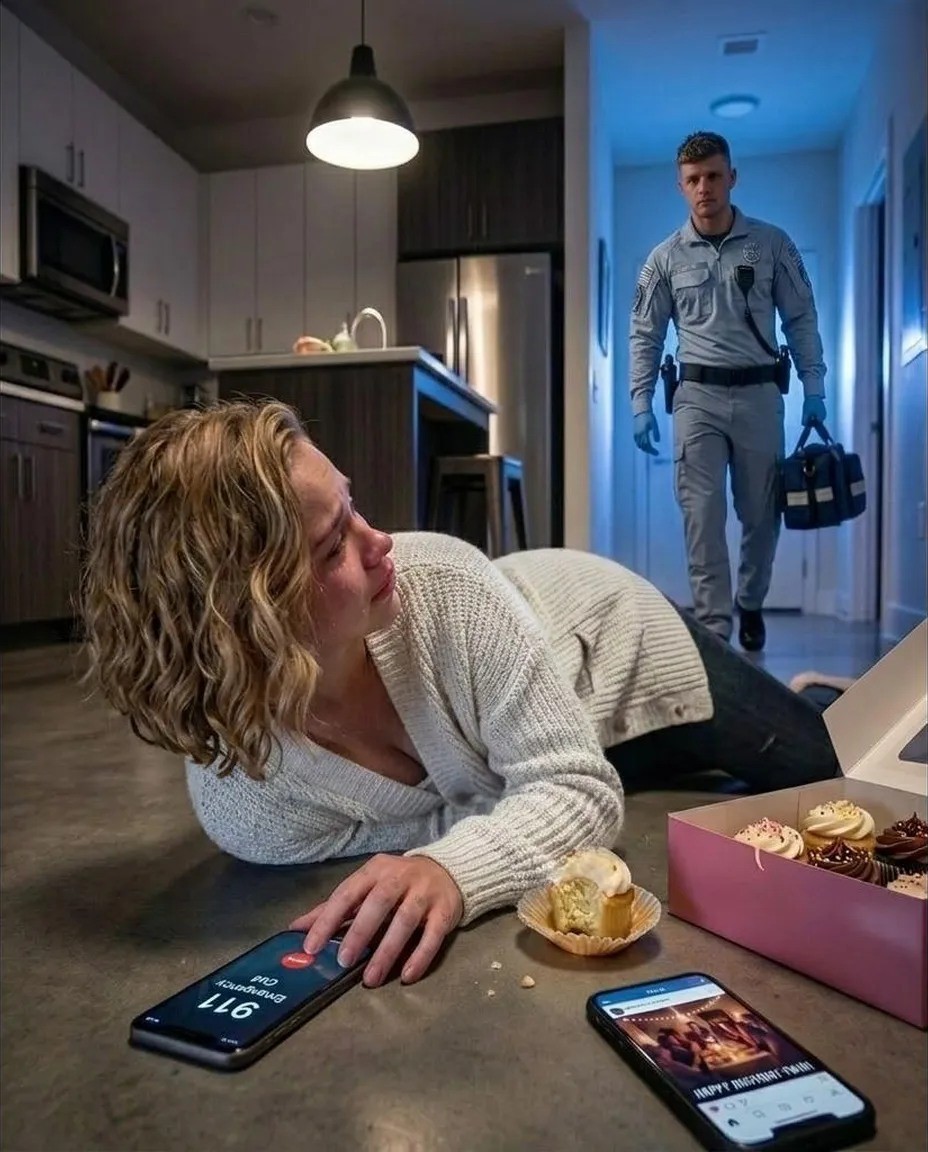
When I dialed emergency services, I was collapsed on the cold kitchen floor, struggling desperately to breathe. Every breath felt smaller than the last. My throat seemed to be tightening shut, my vision was fading, and the half-eaten cupcake sitting nearby no longer looked like a harmless birthday treat. In that terrifying moment, it felt like the source of a mistake that might cost me my life. The cupcake had arrived earlier that day as a supposed peace offering after I had been excluded from a family gathering, but nothing about the situation felt right anymore.
As I fought to explain my condition to the dispatcher, I expected urgency and reassurance. Instead, there was hesitation. Then came a statement that left me stunned. The operator informed me that my twin sister had already contacted emergency services earlier that evening. According to the information she provided, I supposedly had a history of overstating allergic reactions and creating unnecessary drama to gain attention. Because of that report, questions were being raised about whether my symptoms were truly medical or simply the result of panic.
I barely had enough strength to respond.
Deep inside, however, I knew the truth.
This was not anxiety.
This was not an exaggeration.
Something was happening to my body, and it was happening fast.
By the time paramedics arrived, I was drifting in and out of awareness. The sounds of rushed footsteps, medical equipment, and urgent voices blended together as emergency personnel worked to stabilize me. The injection of lifesaving medication and the rapid transport to the hospital eventually brought my condition under control, but the emotional shock remained long after my breathing improved.
While recovering in the ambulance, I learned how serious the situation had actually been. Doctors later confirmed that I had suffered a severe anaphylactic reaction caused by an allergen hidden within the cupcake’s frosting. My condition had become life-threatening in a matter of minutes. Yet what haunted me most was learning that the earlier phone call had influenced how my emergency was initially perceived, potentially delaying the urgency of the response.
Recovery gave me far too much time to think.
Lying in a hospital bed, I began replaying recent events over and over again.
The story had not started with the allergic reaction.
It started days earlier.
My twin sister had celebrated her birthday surrounded by family and friends, yet I had been intentionally left out. Everyone attended except me. Calls went unanswered. Messages were ignored. The exclusion hurt, but it was only one piece of a much larger pattern that had been unfolding for months.
At the same time, our grandmother’s health had been rapidly declining. While I spent long hours caring for her, helping with appointments, and keeping her company, other family members appeared focused on entirely different priorities. Discussions often centered on financial matters, legal paperwork, and future inheritances rather than her comfort and well-being. The difference in priorities became impossible to ignore.
Then there was the cupcake.
Presented as a gesture of kindness, it seemed innocent enough.
Yet after what happened, I could no longer look at it the same way.
As I reflected on the details, uncomfortable questions began to surface. Why had my sister contacted emergency services before my reaction became severe? How did she know I would be alone? Why had she described my medical history in a way that minimized the seriousness of my symptoms?
At first, I had no answers.
What I did gain was clarity.
For the first time, I understood that the people closest to me were not necessarily the people I could trust. Whether their actions were intentional or reckless, the result was the same: my safety had been placed at risk.
That realization changed everything.
After leaving the hospital, I committed myself to healing in every sense of the word. Physical recovery was only part of the process. The emotional wounds left by betrayal required just as much attention. I began establishing boundaries where none had previously existed. I stopped seeking approval from people who repeatedly disregarded my well-being. I sought professional guidance and took practical steps to ensure that my health and safety would never again depend on the choices of others.
Eventually, difficult conversations became unavoidable.
When I confronted family members about the events surrounding the emergency call and the cupcake, many reacted defensively. Rather than providing reassurance, their responses deepened my concerns. Some relationships fractured beyond repair. Others became distant.
Surprisingly, that distance brought peace.
Without the constant tension, manipulation, and disappointment, I found room to rebuild my life on healthier foundations. I stopped focusing on proving myself to people unwilling to listen. Instead, I focused on protecting my peace, strengthening my confidence, and creating a future that did not depend on their approval.
The experience taught me a lesson I will never forget: true strength is not found in endless arguments or dramatic confrontations. It is found in recognizing when something is harmful, stepping away from it, and choosing yourself. Sometimes the bravest thing a person can do is quietly walk toward a safer, healthier life and never look back.
And that is exactly what I did.