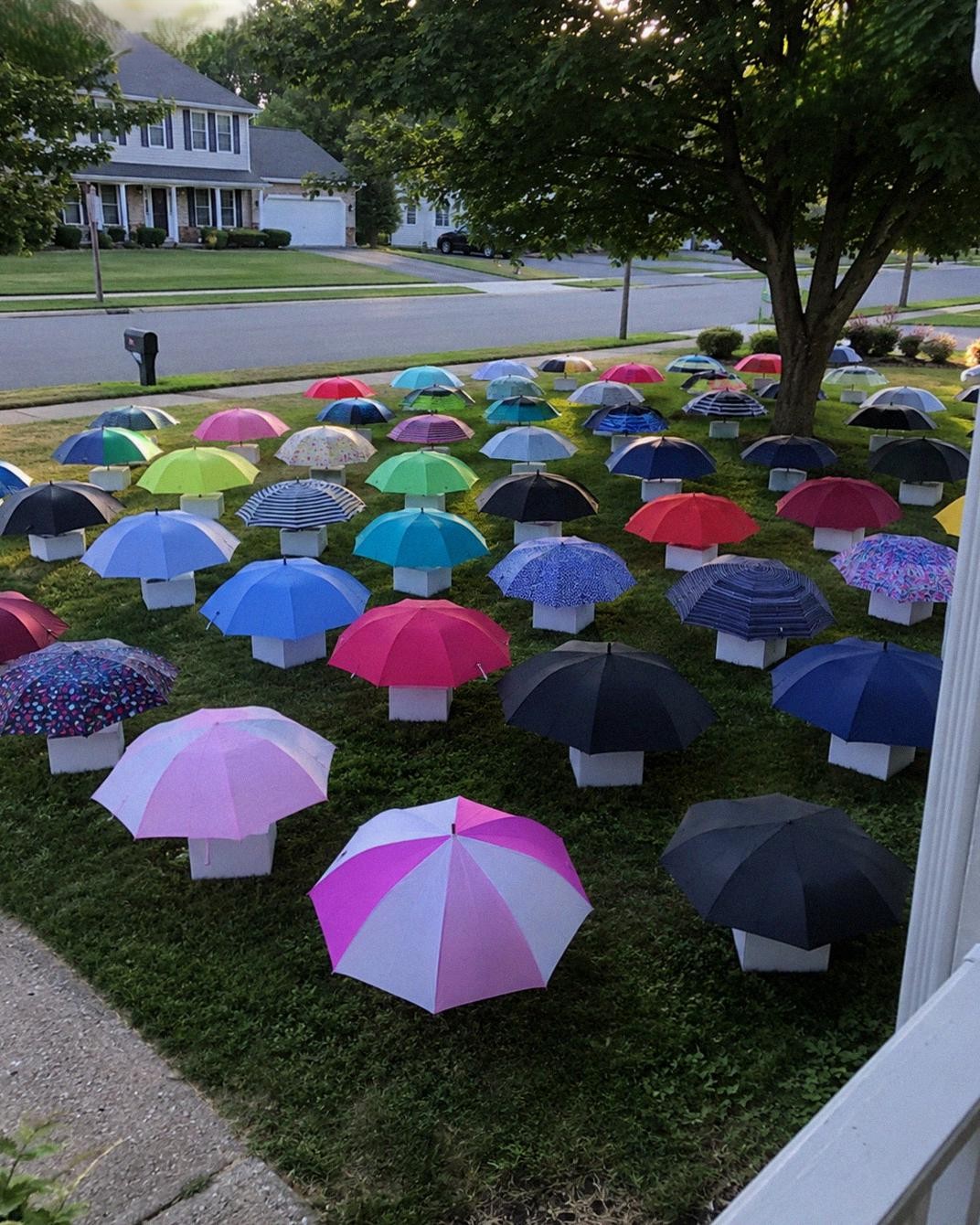
The coffee mug slipped from my hand and shattered across the front porch the moment I opened the door.
The crash echoed through the quiet morning, ceramic fragments scattering across the steps and driveway. A sharp piece sliced across my ankle, but I barely noticed. My attention had already locked onto the impossible scene spread across our front lawn.
Umbrellas.
Dozens of them.
Open umbrellas of every color imaginable.
Red.
Yellow.
Green.
Purple.
Polka-dotted.
Striped.
Floral.
Plain.
Forty-seven of them standing upright in the grass as if they had bloomed overnight.
For a moment, I honestly wondered if I was dreaming.
The sight was surreal, almost magical. The umbrellas swayed gently in the morning breeze, transforming our ordinary yard into a sea of color.
And every single one seemed to be waiting for us.
Three days earlier, I couldn’t have imagined anything like this.
Three days earlier, my twelve-year-old son had walked through our front door drenched from head to toe.
His clothes clung to him.
His shoes squished against the floor.
His hands shook from the cold.
And the first thing I noticed was what he wasn’t carrying.
The blue umbrella.
The umbrella.
The last gift his father had ever given him.
The realization hit me immediately.
“Where is it?” I asked.
Eli froze.
The look on his face told me everything before he even spoke.
His eyes filled with guilt.
And suddenly I felt my stomach drop.
After Darren died, ordinary objects had become extraordinary.
His watch.
His jacket.
A few handwritten notes tucked into drawers.
The coffee mug he always used.
Tiny pieces of a life that had ended far too soon.
Among those possessions was a simple blue umbrella.
It wasn’t expensive.
It wasn’t rare.
But it was the last thing Darren bought for Eli.
Just a few weeks before the accident, they’d been shopping together when a sudden rainstorm rolled through town. Darren bought the umbrella, joked about how every man needed one, and handed it to Eli with a dramatic flourish.
They laughed about it all the way home.
After Darren passed away, that umbrella became something else.
A memory.
A connection.
A thread.
Perhaps an irrational one, but grief rarely follows logic.
In my mind, that blue umbrella represented one of the last tangible links between father and son.
So when Eli told me he’d given it away, I struggled to understand.
At first, I thought I’d misheard him.
“You what?”
His voice was barely above a whisper.
“There was a lady at the bus stop.”
I sat down.
Slowly, he explained.
The rain had been relentless that afternoon. Wind drove sheets of water across the street while people huddled beneath awnings and bus shelters.
At one stop, Eli noticed a woman sitting alone.
She had no umbrella.
No coat.
No protection from the storm.
She was soaked and visibly distressed.
When he approached, he realized she was crying.
Not loudly.
Not dramatically.
Just quietly.
The kind of crying people do when they think nobody is paying attention.
She explained that her car had broken down. She was trying to get home after an awful day and had no way to avoid the weather.
Without thinking much about it, Eli handed her his umbrella.
His blue umbrella.
Darren’s umbrella.
The one I had treated almost like a family heirloom.
The woman initially refused.
Eli insisted.
She accepted.
And then the bus arrived.
By the time she realized she wanted to return it, he was gone.
“So you just gave it away?”
The question came out harsher than I intended.
Eli looked down.
“It seemed like she needed it more.”
Those words haunted me.
Part of me felt proud.
Another part felt heartbroken.
I wanted to celebrate his kindness while simultaneously mourning the loss of something I had convinced myself was irreplaceable.
That night, I cried after he went to bed.
Not because of the umbrella itself.
Because losing it felt like losing Darren all over again.
Grief has a strange way of attaching itself to objects.
Sometimes we convince ourselves that if we can hold onto enough things, we can somehow hold onto the people too.
The next morning, life continued.
Then the internet got involved.
Apparently, the woman from the bus stop—her name was Jenelle—couldn’t stop thinking about the boy who had given away his only protection from the rain.
She knew nothing about him except his first name and what he had done.
Wanting to thank him, she posted a message online.
The post was simple.
A photograph of the blue umbrella.
A description of a kind stranger.
A heartfelt attempt to find the boy who had helped her.
She expected a few shares.
Maybe a local connection.
Nothing more.
Instead, the story exploded.
People shared it thousands of times.
Then tens of thousands.
Comments flooded in.
News outlets noticed.
Strangers became invested.
The story traveled far beyond our town.
Everyone seemed moved by the image of a young boy giving away his only umbrella to help someone having a difficult day.
Especially after they learned the umbrella had belonged to his late father.
The response became overwhelming.
Then came the umbrellas.
Forty-seven of them.
Along with forty-seven small boxes carefully arranged across our lawn.
Each one represented someone touched by Eli’s story.
Inside the boxes were handwritten notes.
Gift cards.
Letters.
Photographs.
Drawings.
Stories from people who had experienced similar losses.
Messages from parents.
Messages from widows.
Messages from strangers who simply wanted Eli to know his kindness mattered.
Many apologized for intruding.
Many thanked him for restoring their faith in people.
Some shared memories of loved ones they missed.
Others described moments when strangers had helped them through difficult times.
As we opened the boxes, tears became unavoidable.
Not because of the gifts.
Because of the humanity inside them.
Again and again, complete strangers had taken time to write thoughtful words to a boy they had never met.
Words of encouragement.
Words of admiration.
Words of understanding.
The experience was beautiful.
And overwhelming.
Very overwhelming.
For a while, it felt as though our private grief had suddenly become public property.
People wanted interviews.
Photographs.
Updates.
Appearances.
Everyone meant well.
But attention can become its own burden.
Especially for a child.
So we established boundaries.
We declined interviews.
Turned down appearances.
Ignored most media requests.
We thanked people for their kindness while protecting the quiet space our family still needed.
Then we asked ourselves an important question.
What should we do with all this generosity?
The answer arrived unexpectedly during a conversation between Eli, Jenelle, and Mr. Collins—the bus driver who had witnessed the original exchange.
Together they imagined something simple.
Practical.
Useful.
Something that could honor the kindness behind the story rather than the attention surrounding it.
That idea became the Route 47 Rain Rack.
A sturdy blue stand placed near the bus stop where everything began.
We stocked it with umbrellas.
Ponchos.
Gloves.
Bus passes.
Rain gear.
Items anyone could borrow or take if they needed help.
No questions.
No paperwork.
No conditions.
Just neighbors helping neighbors.
Exactly the way Eli had helped Jenelle.
Over time, the rack became something special.
People donated supplies.
Volunteers helped maintain it.
Passengers used it during storms.
Children added drawings.
Someone painted a small blue umbrella on the side.
The project grew quietly, becoming part of the community rather than a headline.
And somewhere in the middle of all that, the original blue umbrella found its way home.
Jenelle had carefully preserved it.
When she finally returned it to Eli, the moment felt surprisingly emotional.
He held it like an old friend.
The fabric was worn.
The handle slightly scratched.
But it was still there.
Still carrying memories.
Still carrying meaning.
Today, a new blue umbrella hangs on the Route 47 Rain Rack.
It waits for whoever needs it next.
The original remains with Eli.
Not because he’s afraid to share it.
Not because he’s clinging to the past.
But because some objects tell stories.
And this one tells a story worth remembering.
For a long time, I believed Darren’s final gift to our son was that umbrella.
A physical object connecting them across an impossible distance.
I understand now that I was wrong.
The umbrella was never the gift.
The gift was what it taught.
The gift was the compassion Darren modeled every day.
The generosity.
The instinct to help.
The belief that other people matter.
Those qualities survived long after he was gone.
They lived inside our son.
And the day Eli handed that umbrella to a stranger in the rain, he proved it.
The object could be lost and found.
Broken and replaced.
Shared and returned.
But the lesson remained.
When I watch Eli now, I see pieces of Darren everywhere.
Not in possessions.
Not in keepsakes.
Not in relics preserved on shelves.
I see him in the way our son notices people.
In the way he steps forward when someone needs help.
In the way he is willing to get soaked so someone else can stay dry.
And suddenly, that feels like the greatest inheritance a father could ever leave behind.