The first time you notice them, it can be genuinely unsettling.
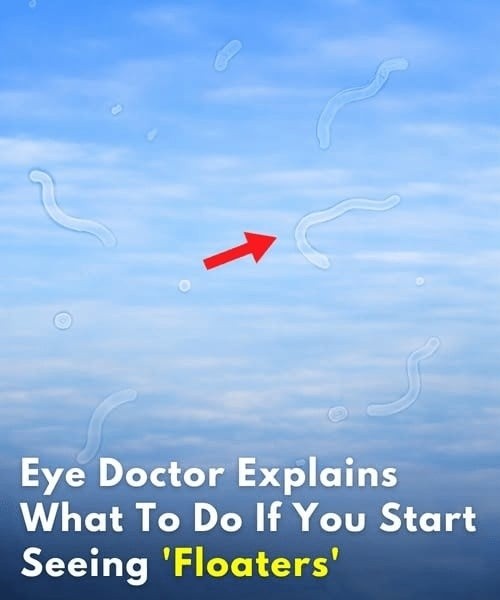
Tiny shadows drift across your field of vision without warning. They seem to move when you move your eyes, yet disappear when you try to focus directly on them. Some look like specks of dust. Others resemble cobwebs, threads, transparent rings, or tiny insects floating just out of reach. For a moment, you wonder whether something is actually in front of you.
Then you blink.
They’re still there.
You glance toward a bright window, a white wall, or the open sky, and suddenly the shapes become even more visible. They drift lazily through your sight like silent ghosts, impossible to catch and impossible to ignore. A strange sensation of unease begins to grow.
What are they?
Are they harmless?
Or are they the first warning signs of something far more serious?
The uncertainty alone can be frightening.
Most people try to reassure themselves. Perhaps it’s just fatigue. Maybe it’s stress. Maybe they’ve been staring at a screen for too long. Yet once you notice them, it becomes difficult not to keep looking for them. Every flash of light, every unusual shadow, every strange movement inside your vision starts to demand attention.
Then imagine something even more alarming.
A sudden burst of new floaters appears.
Bright flashes of light streak across your peripheral vision like distant lightning. A dark shadow begins creeping into one corner of your sight. Suddenly, what seemed like a minor annoyance feels much more threatening.
Your heart begins to race.
You tell yourself not to panic.
You hope it will disappear.
You convince yourself that waiting another day won’t matter.
But a quiet voice inside your mind wonders whether your eyes are trying to tell you something important.
The truth is that eye floaters are incredibly common, especially as people grow older.
Inside every eye is a clear, gel-like substance known as the vitreous. During youth, this gel remains relatively smooth and uniform. Over time, however, natural aging causes it to slowly shrink, change consistency, and develop tiny clumps or strands. These small fragments can cast shadows on the retina, creating the floating shapes that people see drifting through their vision.
For many individuals, these floaters are simply a normal part of aging.
They may become noticeable while looking at bright backgrounds such as clouds, computer screens, or white walls. In most cases, they cause no permanent harm and gradually become less distracting as the brain learns to ignore them.
Many people live with floaters for years without experiencing any significant vision problems.
Eventually, they fade into the background of daily life.
Yet the challenge lies in knowing when they are harmless and when they are not.
Because while many floaters are completely benign, certain changes can signal a much more urgent problem developing inside the eye.
That distinction is critically important.
A sudden increase in floaters can sometimes occur when the vitreous pulls on the retina, the delicate layer of tissue lining the back of the eye that allows us to see. In some cases, this pulling creates a retinal tear. If fluid passes through that tear, the retina can begin separating from the underlying tissue that nourishes it.
This condition is known as retinal detachment.
And it is a true medical emergency.
The difficulty is that retinal tears often do not cause pain.
There may be no obvious injury.
No dramatic warning.
Instead, the eye quietly sends signals that can easily be dismissed.
A sudden shower of floaters.
Bright flashes of light.
A shadow or curtain appearing in part of your vision.
Blurred or distorted sight.
These symptoms may seem subtle at first, but they should never be ignored.
When a retinal tear or detachment is discovered early, treatment can often preserve vision and prevent more serious damage. However, if the condition progresses without treatment, vision loss can become permanent.
That is why eye specialists consistently emphasize the importance of rapid evaluation whenever these warning signs appear.
The moment you experience a sudden storm of new floaters, repeated flashes of light, or the sensation that a dark curtain is moving across your field of vision is not the time to wait and see what happens.
It is not the time to spend hours searching symptoms online.
It is not the time to hope the problem simply disappears on its own.
It is the time to seek professional care.
A comprehensive eye examination can determine whether the retina remains healthy and securely attached or whether a hidden problem requires immediate attention.
Most of the time, the news may be reassuring.
Many patients discover that their symptoms are related to normal age-related changes within the eye and do not require emergency treatment.
But when a retinal tear is present, early detection can make an enormous difference.
In some situations, it can mean the difference between preserving vision and losing it.
Our eyes often communicate important information long before serious damage occurs.
The challenge is learning to listen.
The floating specks that drift through your vision may be nothing more than harmless reminders of time passing. They may simply reflect the natural changes that occur as the structures inside the eye age and evolve.
Yet they can also serve as warning signals that deserve immediate attention.
Because sight is precious.
It shapes every part of daily life, from reading and driving to recognizing faces and enjoying the world around us. Most people never fully appreciate how valuable vision is until they are confronted with the possibility of losing it.
That is why paying attention to changes in your eyesight matters so much.
A few moments spent getting an eye examination may reveal that everything is perfectly fine.
Or it may uncover a problem while there is still time to treat it.
Either outcome is worth knowing.
The next time you notice floaters drifting through your vision, remember that they are often harmless companions of aging. But also remember that sudden changes, bright flashes, or creeping shadows should never be ignored.
Sometimes the signals your eyes send are merely a passing scare.
Other times, they are a call for help.
Recognizing the difference—and acting quickly when necessary—can mean the difference between a story you eventually forget and vision you keep for the rest of your life.