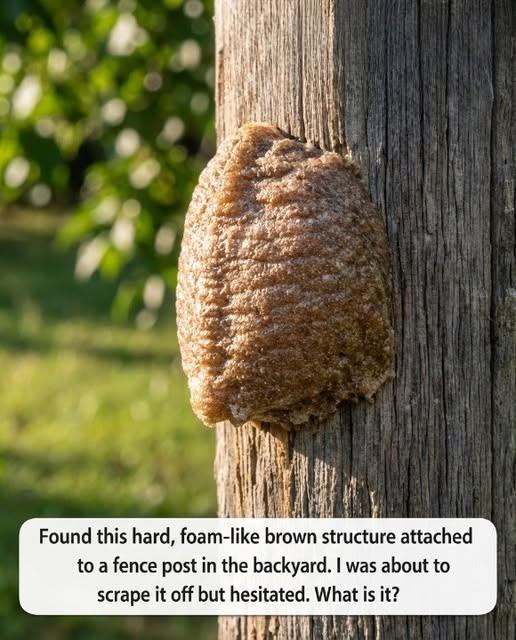
If you’ve noticed a strange brown object attached to a fence, shrub, tree branch, or garden structure, don’t rush to remove it. What may look like dried foam, hardened mud, or even some kind of insect nest is often something far more fascinating: the egg case of a praying mantis, known as an ootheca.
### What Exactly Is an Ootheca?
During late summer and autumn, female praying mantises lay their eggs inside a protective structure called an ootheca. To create it, the mantis deposits a frothy substance onto a solid surface such as a branch, fence post, wall, railing, or garden decoration. Once exposed to air, the foam hardens into a durable shell that shields the eggs from harsh weather and predators throughout the colder months.
Although it may appear artificial at first glance, this unusual structure is one of nature’s most effective methods of protecting future generations.
### What Is Hidden Inside?
Depending on the mantis species, a single ootheca can contain anywhere from 50 to more than 200 eggs. Inside the casing, the eggs are neatly organized in rows and separated by protective layers that help insulate them from freezing temperatures.
Throughout winter, the developing mantises remain dormant in a state known as diapause, safely waiting for warmer conditions to arrive.
### The Amazing Spring Transformation
When spring temperatures become consistently mild, the ootheca begins to open along a natural seam. Within a short period, dozens—or sometimes even hundreds—of tiny mantis nymphs emerge.
These young mantises already resemble miniature adults. They possess the characteristic triangular head, folded grasping forelegs, and the hunting instincts that make mantises such effective predators. After their bodies harden, they immediately begin searching for small insects to eat.
### Why You Should Leave It Alone
Praying mantises are considered highly beneficial insects in gardens and landscapes. They help reduce populations of many common pests, including aphids, flies, moths, leafhoppers, and grasshoppers.
Finding an ootheca in your yard is usually a sign of a healthy and balanced ecosystem. Removing or destroying it means eliminating dozens of natural pest controllers before they even have a chance to hatch.
### Can It Be Moved?
If the egg case is located somewhere that will soon be disturbed—such as an area being painted, trimmed, or repaired—it can be relocated carefully.
The best method is to remove the section of branch or surface to which it is attached without crushing the casing. Place it in a sheltered shrub or secure it to a branch using twine or a small amount of non-toxic adhesive. Keep it elevated above the ground and positioned so the natural seam remains exposed, allowing the young mantises to emerge properly when the time comes.
Avoid placing it directly on soil, where moisture, mold, and predators such as ants can threaten the eggs.
### A Hidden Nursery in Plain Sight
That odd brown cluster on your fence or shrub isn’t debris, and it isn’t something that needs to be cleaned away. It’s a carefully designed nursery protecting the next generation of one of nature’s most fascinating predators.
Sometimes the most ordinary-looking objects hide something extraordinary. So before you scrape it off or throw it away, take another look.
You may be looking at hundreds of future guardians of your garden, quietly waiting for spring to arrive.