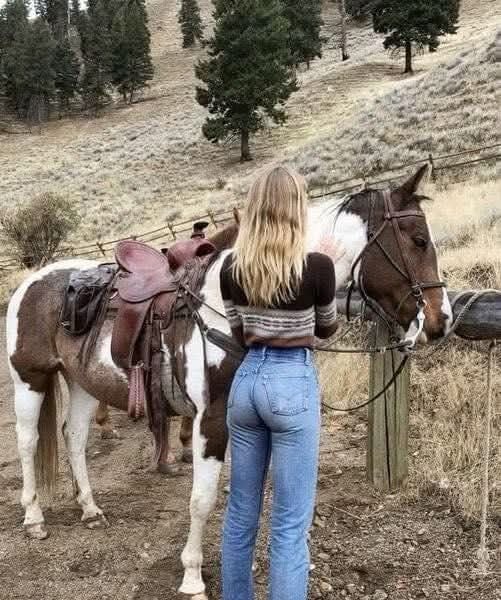
What began as a peaceful afternoon ride turned into an argument I never saw coming.
The day had been perfect. The trail wound through tall trees, sunlight filtered through the branches, and the steady rhythm of my horse made the worries of everyday life seem miles away. For a few hours, everything felt calm and uncomplicated. Wanting to share that moment with my husband, I pulled out my phone and snapped a quick picture. It wasn’t anything special—just a simple image of the trail ahead, with part of the saddle visible in the foreground.
I sent it without a second thought.
A few minutes later, my phone buzzed.
I expected a comment about the scenery or maybe a joke about me spending another afternoon with horses instead of relaxing at home.
Instead, his message contained a single question.
“What are the initials on the saddle?”
The sudden shift in tone immediately made my stomach tighten.
Confused, I opened the photo again and zoomed in. Near the front of the saddle, pressed into the worn leather, were two faded letters.
A.M.
They were small enough that I hadn’t even noticed them when I took the picture.
But once I saw them, I instantly recognized why they caught his attention.
Those initials belonged to someone from my distant past.
Someone I hadn’t spoken to in years.
Someone who no longer had any place in my life.
To me, it seemed like nothing more than an odd coincidence. Saddles, like most horse equipment, change owners constantly. They are bought, sold, traded, repaired, and passed from rider to rider for years. Old markings often remain long after their original owners have disappeared from the story.
In my mind, the explanation was simple.
The saddle was old.
The initials were old.
The connection ended there.
Unfortunately, my husband didn’t see it that way.
The moment those two letters entered the conversation, they stopped being random marks on leather.
They became questions.
Then suspicions.
Then something much larger.
I calmly explained where the saddle came from and why the initials meant nothing. I told him it was secondhand equipment and that countless riders had likely used it before me.
But instead of easing his concerns, my explanations seemed to have the opposite effect.
The more details I provided, the more convinced he became that there was something hidden beneath the surface.
Soon, we weren’t discussing a saddle anymore.
We weren’t talking about horses, trails, or photographs.
We were arguing about trust.
What frustrated me most was how quickly an innocent detail transformed into something entirely different. A peaceful afternoon suddenly became an investigation. A photograph intended to create connection somehow created distance instead.
As the conversation continued, I realized something important about suspicion.
Once doubt takes hold, it often stops searching for truth.
Instead, it begins collecting evidence for a story it has already decided to believe.
Every explanation becomes suspicious.
Every coincidence becomes meaningful.
Every detail becomes another piece of a puzzle that may not even exist.
The initials themselves never changed.
They remained exactly what they had always been—two faded letters stamped into old leather years ago.
What changed was the meaning attached to them.
In my husband’s mind, they became proof of something larger.
In mine, they remained nothing more than a forgotten mark left behind by time.
That experience forced me to think about how fragile trust can be.
Most relationships do not collapse because of major betrayals.
Often, the real danger comes from assumptions that slowly grow unchecked.
A small uncertainty becomes a question.
The question becomes a theory.
The theory becomes a story.
And eventually, the story feels more convincing than reality itself.
Looking back now, I realize the photograph never caused the conflict.
The saddle never caused the conflict.
Even the initials weren’t really the problem.
The problem was what happened after those initials were discovered.
It was the decision to view them through a lens of suspicion rather than trust.
That afternoon had begun with sunlight, fresh air, and the simple joy of sharing a beautiful moment with someone I loved.
Yet by evening, it had become a reminder of how easily perception can reshape reality.
Sometimes the most dangerous thing in a relationship isn’t a secret.
It’s the story people create when they believe there must be one.
And sometimes, all it takes to start that story is two faded letters on an old saddle.