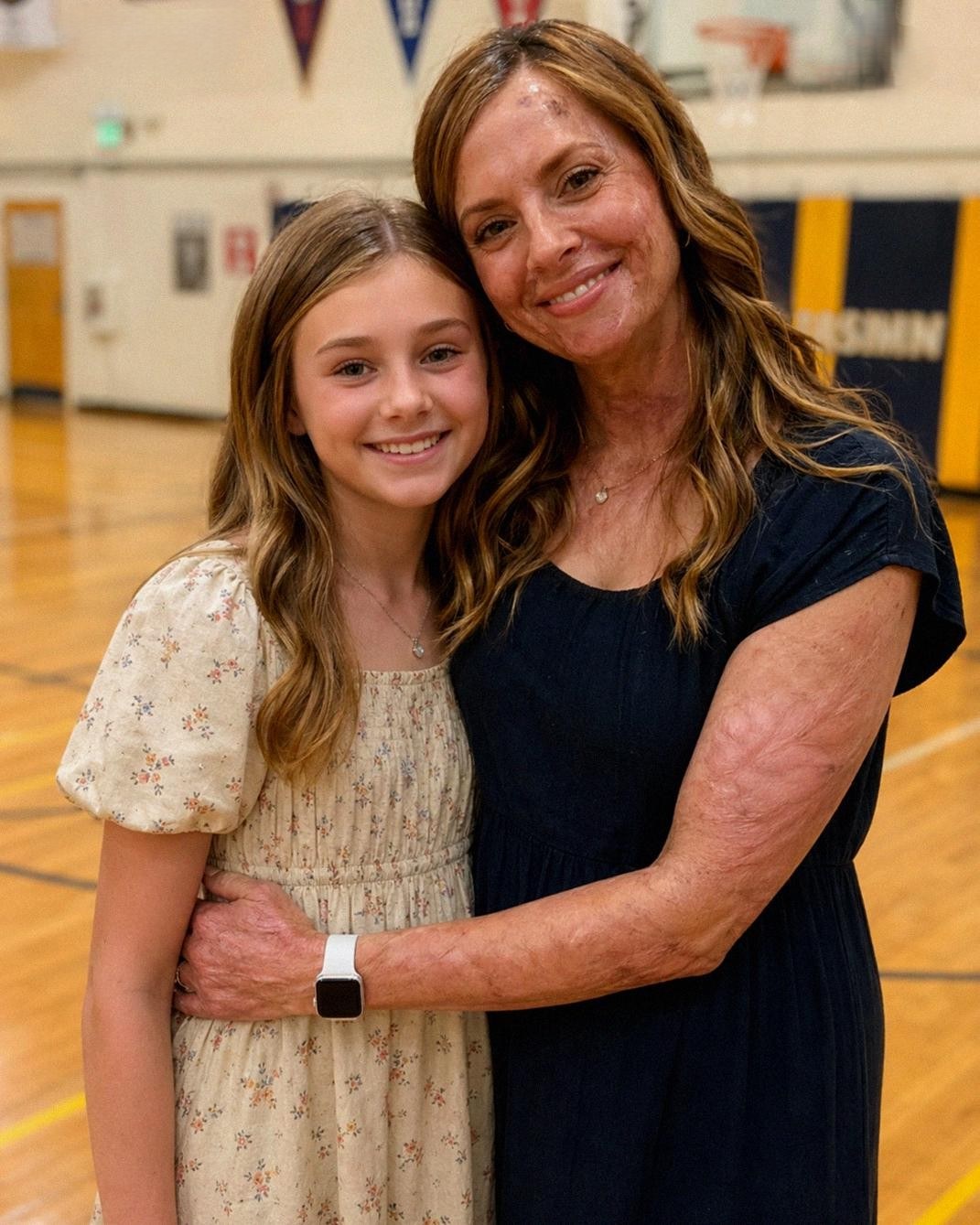
For twenty years, I learned how to live with people staring at my face.
The scars stretch from my temple down across my cheek and neck, thick and uneven like burn marks carved into my skin. Some people try not to look. Others stare openly. Children ask questions adults are too polite—or too uncomfortable—to say aloud. Over time, I became used to it. I stopped expecting the world to see past the damage.
What I never expected was watching my own daughter struggle because of it.
After my husband died, I raised Clara alone with help from my mother, Rose, who lived next door. Clara grew up knowing about my scars the same way children grow up knowing the sky is blue or rain is wet—they were simply part of me. When she was little, she would touch my face gently and ask if it hurt. I always smiled and told her no.
For years, that answer was enough.
But everything changed once she started fifth grade.
One afternoon, I arrived early to pick her up from school. As I waited outside, I saw Clara standing with a group of classmates. One boy pointed toward me and whispered something, and suddenly several children started laughing.
I watched Clara’s entire posture collapse.
She climbed into the car without speaking, staring down at her lap the whole drive home. Finally, through tears, she asked me something that hurt more than any scar ever had.
“Can Grandma come to school instead of you for Mother’s Day?”
My chest tightened instantly.
Clara explained that classmates had started calling me “the monster mom.” Some kids even teased her by calling her “monster’s daughter.” The upcoming Mother’s Day event at school terrified her because students would bring their mothers onstage for presentations.
She didn’t want everyone staring at me.
At first, I couldn’t even respond. I just sat there feeling the weight of those words settle deep inside me.
That night, after Clara went to bed, I sat alone in the kitchen tracing the rough lines along my face. Memories I spent years burying slowly resurfaced—the smoke, the heat, the screaming.
I had never told Clara the full truth about the fire.
I never wanted my entire identity to become “the woman with scars.” I didn’t want pity or admiration. I just wanted to be Mom.
But suddenly I realized something painful: by hiding the truth for so many years, I had allowed strangers to define my scars however they wanted.
The next morning, I decided things had to change.
I put on a navy dress, curled my hair instead of trying to hide behind it, and prepared myself like someone going into battle. Before leaving, my mother looked at me proudly and said something that stayed with me all day.
“Go make them uncomfortable.”
When Clara and I arrived at school, she looked terrified. She barely spoke as we entered the crowded auditorium filled with parents, teachers, and children.
Everywhere I looked, I felt eyes following me.
The presentations started one by one. Families walked onstage talking about traditions, favorite recipes, bedtime stories—all the ordinary beautiful things families share.
Then Clara’s name was called.
She froze.
I stood up anyway and gently held out my hand. Together we walked toward the stage.
Halfway there, something hit my shoulder.
A crumpled paper ball.
I opened it and found a cruel drawing of a scarred monster with exaggerated features. Then someone whispered loudly from the back:
“There’s the monster’s daughter.”
The room fell silent.
Not laughing silence.
Ashamed silence.
I stepped onto the stage and took the microphone. My hands trembled, but my voice stayed steady.
I told everyone that the hardest part of living with scars was not the staring or comments. The hardest part was watching my daughter feel ashamed because of them.
Then, for the first time publicly, I began explaining how I got burned.
Twenty years earlier, there had been a fire in an apartment building. I had run inside to rescue children trapped upstairs.
But before I could finish the story, the auditorium doors suddenly burst open.
A man rushed inside breathing heavily like he had been running.
It was Scott, the school’s music teacher.
Without hesitation, he walked straight to the stage and took the microphone from my hands.
Then he looked directly at the audience and said something none of them expected.
“She didn’t just save children from that fire,” he said emotionally. “She saved me.”
The room became completely still.
Scott explained that he had been ten years old during the fire. After Emily—me—rescued several children, she realized another child was still trapped inside the collapsing building.
Him.
Despite firefighters screaming for her not to go back, she ran into the flames again and carried him out herself.
“She lost her face saving my life,” Scott said quietly.
I could barely breathe listening to him.
He also revealed something I had never told anyone there: after the accident, I asked his family never to publicly share the story because I didn’t want him growing up feeling guilty for what happened to me.
Suddenly the entire atmosphere in the auditorium changed.
The same room that moments earlier felt filled with judgment now felt heavy with realization.
I looked toward the boy who threw the paper, and he couldn’t even lift his head anymore.
Then I turned toward Clara.
Tears streamed down her face as she stared at me differently than ever before—not as someone embarrassing, but as someone brave.
“I was ashamed,” she whispered. “And I let them laugh at you.”
I knelt down and hugged her tightly.
“You’re a child,” I told her softly. “There’s nothing to forgive.”
Then the applause started.
Not polite applause.
A real standing ovation that shook the room.
On the drive home afterward, everything felt different. Clara kept glancing at me with an expression I’ll never forget.
Finally she asked why I kept the story secret for so long.
And I answered honestly.
“Because I didn’t want the fire to become my whole identity.”
But somewhere between that stage and our front door, I realized something important.
The scars were never proof of ugliness or tragedy.
They were proof of love.
Proof that when someone else needed saving, I was willing to risk everything.
And for the first time in twenty years, when I looked into the mirror that night, I didn’t immediately look away.