At 3 a.m. on a quiet Sunday, the neon lights of the convenience store buzzed against the darkness outside. Those late-night hours usually belonged to exhausted travelers, lonely souls, and people carrying burdens too heavy to sleep through. I was busy stocking shelves, half-lost in the routine sound of cans sliding into place, when the deep rumble of a motorcycle rolled through the parking lot.
A biker stopped beside pump seven. Through the window, I noticed an older man climbing off the bike. He looked intimidating at first glance—broad shoulders, weathered face, a silver beard stretching down his chest, and a leather vest covered in faded patches from years on the road. But what truly caught my attention wasn’t the man himself. It was the baby carrier strapped awkwardly to the back of the motorcycle.
The infant inside was crying hysterically.
The man carefully unhooked the carrier with giant trembling hands, trying his best to rock the baby while pumping gas. Even from inside the store, I could see the exhaustion in his eyes. His face looked worn down by sleepless nights and something even heavier than fatigue.
A few minutes later, he entered the store carrying the screaming baby. In a rough, cracked voice, he asked where the restroom was. I pointed him toward the back hallway and returned to work, though something about him stayed in my mind.
Then I heard it.
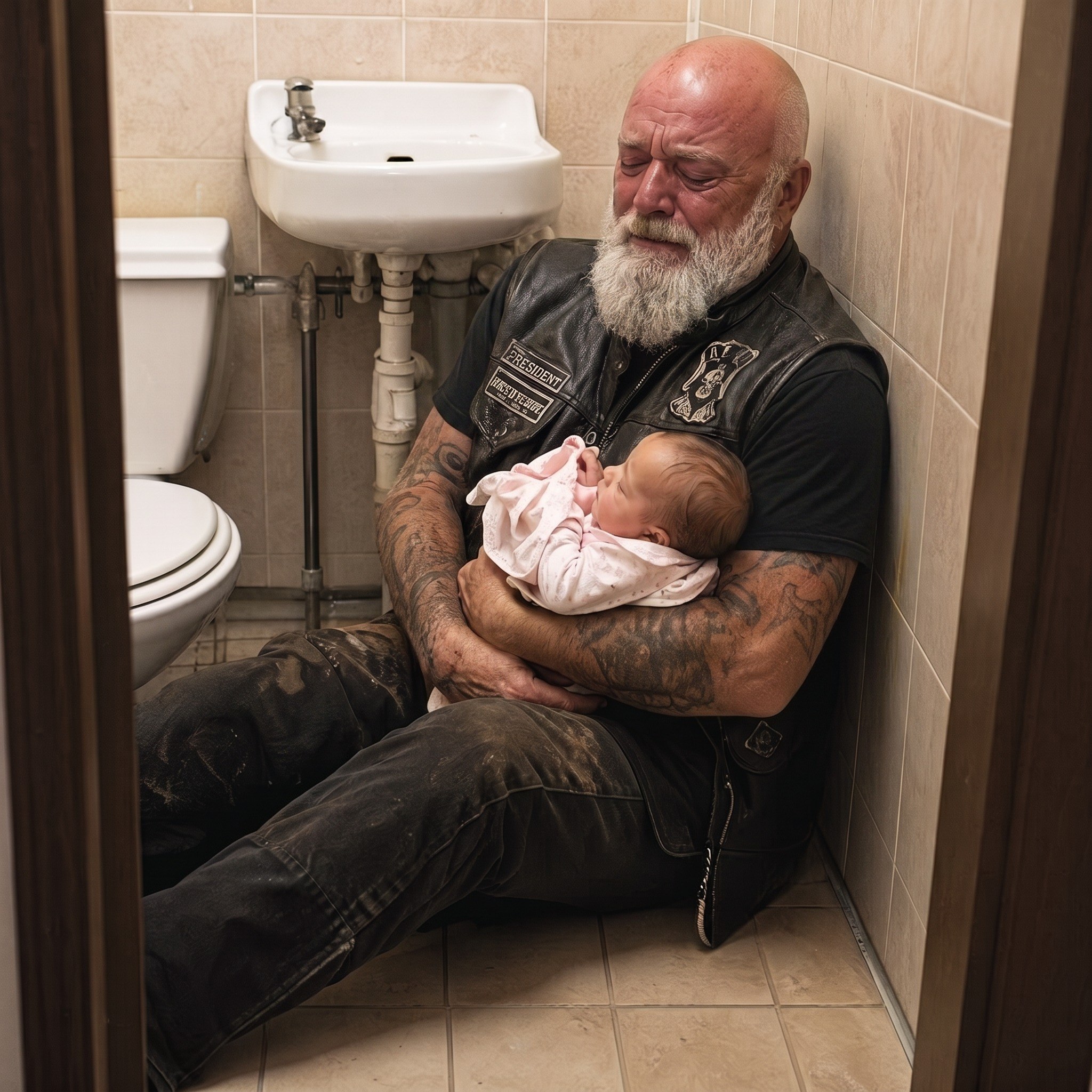
Beyond the baby’s cries came another sound—deep, painful sobbing from behind the bathroom door. It wasn’t ordinary frustration. It sounded like someone completely falling apart. I walked to the door and knocked gently, asking if everything was okay.
For a long moment there was silence.
Finally, a weak voice answered that he didn’t know what he was doing anymore.
I’ve raised three children myself, so I recognized that kind of desperation instantly. I told him I was coming in. Inside, the scene broke my heart. The huge biker was sitting on the floor with his face buried in his hands, while the baby lay beside him with a diaper fastened completely wrong. The poor little girl was soaked, uncomfortable, and exhausted from crying.
I knelt beside her and fixed the diaper properly. Once she was cleaned up and dry, the screaming slowly faded into soft little whimpers. She couldn’t have been older than three months, with dark hair sticking up in every direction. She immediately started searching for food, rooting against my hand.
When I asked when she had last eaten, the man looked completely lost. He guessed maybe five or six hours earlier. He admitted he had formula with him but had been too overwhelmed to stop and think clearly.
That’s when he finally introduced himself as David—and told me the truth.
His daughter, Jessica, had died from an overdose only two nights before. The baby, Emma, was all he had left of her.
As I made a bottle in the employee break room, David opened up completely. He explained that he’d spent most of his life working as a truck driver, always moving from one highway to another. After losing his wife years ago, he had raised Jessica alone, though he admitted he often failed to be present enough. Jessica had battled addiction for years, drifting between recovery and relapse. Recently, she had seemed determined to rebuild her life for Emma’s sake.
But then David found her unconscious in the bathroom.
After her death, Child Protective Services got involved. Because of his age and lack of parenting experience, they started discussing foster care. Terrified of losing his granddaughter to the system, David panicked. Instead of staying to fight, he packed up the motorcycle and rode away with Emma, hoping distance would somehow solve everything.
Looking at him trembling while feeding that tiny baby, I realized he didn’t need judgment. He needed help.
So I called my daughter, who happens to be a family lawyer, even though it was after three in the morning. She listened carefully to David’s story and immediately explained his legal options. She promised to help him for free and reassured him that running away would only hurt his chances. If he wanted to keep Emma, he needed to return and fight properly.
For the first time all night, I saw a small spark of hope appear in his face.
David stayed in the break room until my shift ended that morning. During those hours, I showed him simple things most new parents learn slowly over time—how to hold a baby securely, how to burp her after feeding, how to prepare formula correctly, and how to calm her when she fussed.
By sunrise, he no longer looked like a man escaping from his life. He looked like someone preparing to face it.
Three months later, he called me with good news. The court had granted him full custody of Emma. The judge saw his commitment, the parenting classes he had started attending, and the support system my daughter helped him build. David even sold the motorcycle and bought a safe family car with a proper car seat.
A few weeks after that, he visited my home with Emma. The difference in both of them was incredible. David seemed lighter, calmer, almost younger. Emma had grown into a healthy, smiling little baby who immediately reached out toward me the second she saw me.
That day, David told me he planned to make sure Emma always knew the full truth about her mother—not only her struggles, but also her love and her effort to become better before she died.
I still think about that night often. Most people would have looked at an old biker carrying a baby on a motorcycle at three in the morning and assumed the worst. Some might have called the police immediately without asking questions. But sometimes, what changes a person’s life isn’t punishment or suspicion. Sometimes it’s simply compassion from a stranger willing to stop and help.
David once joked that I had become Emma’s honorary grandmother. Honestly, I think he was right. And every time I hear the distant roar of a motorcycle now, I no longer picture danger. I picture a grieving grandfather trying desperately to save the last piece of his daughter that he had left.