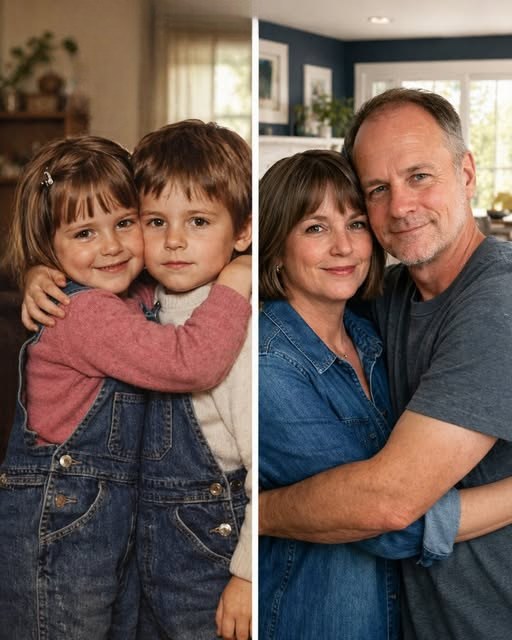
The smell of rain-soaked earth and stale whiskey clung to the cemetery air the day I lost Troy for the second time. Standing beside his open grave while quiet condolences drifted around me like distant noise, I felt detached from my own body, as though I were attending someone else’s funeral instead of burying the man I had loved for most of my life. We had spent thirty-six years together — not just as husband and wife, but as two people who had grown side by side since childhood. Our lives had been so deeply intertwined that for decades I believed there was nothing about him I didn’t understand. Then our marriage collapsed beneath secrets I thought pointed toward betrayal. By the time he died, I believed I knew exactly why our life together had ended. I was completely wrong.
Troy and I grew up in neighboring houses separated only by a thin wooden fence. Some of my earliest memories involved muddy shoes, scraped knees, and Troy appearing beside me before I even realized I needed him there. Ours was never the kind of dramatic romance people write novels about. It was steadier than that — quieter, deeper, built slowly through years of friendship, trust, and shared routines that eventually became the structure of our entire adult lives.
We married young, raised two children, and settled into a life that felt predictable in the safest possible way. We built routines around work schedules, family dinners, vacations, mortgage payments, and dreams about growing old together. I thought stability meant security. I thought knowing someone for forty years guaranteed honesty.
Then the money started disappearing.
At first it was small amounts missing from our joint account — a few hundred dollars here and there. I assumed it was accounting mistakes or forgotten expenses. But eventually the withdrawals became impossible to ignore. Thousands disappeared over the course of several months. Whenever I questioned Troy about it, he gave vague explanations about repairs, bills, or things he claimed he had already handled.
But something in him had changed.
Troy had always been easy to read. His face usually revealed every emotion before he even spoke. Suddenly, though, he became guarded in ways I had never experienced before. Conversations ended quickly. Eye contact disappeared. He carried exhaustion around him like a shadow he couldn’t escape.
The final crack came the afternoon I found the hotel receipts hidden inside his desk drawer.
Eleven separate stays at the same hotel in Massachusetts.
A place he had absolutely no reason to visit.
I remember staring at those receipts while my entire body went cold. My hands shook so badly I could barely hold the papers. Still, part of me desperately wanted an explanation that made sense. Something innocent. Something survivable.
Instead, when I called the hotel pretending to confirm a reservation, the concierge immediately recognized Troy’s name with the casual familiarity reserved for regular guests.
That was the moment my heart turned hard.
I confronted him that same night in our kitchen.
I placed the receipts directly in front of him and asked him one simple question:
“Who is she?”
He looked at the papers. Then at me.
And said nothing.
No denial.
No explanation.
No anger.
Just silence.
That silence destroyed us more completely than any confession could have.
I gave him every opportunity to tell me the truth. Every chance to save thirty-six years of marriage. But he stood there quietly while I unraveled in front of him, and eventually I stopped begging for answers entirely.
Two months later, we signed divorce papers.
I spent the next two years convincing myself I had survived betrayal.
I imagined another woman constantly. I searched for signs of her everywhere. I expected eventually some hidden relationship would surface publicly — a name, a photograph, some evidence proving I had been replaced. But nothing ever appeared. Troy lived alone after the divorce. He looked older every time I saw him. Tired. Hollow. But still he never explained himself.
Then came the phone call.
Sudden collapse.
Emergency room.
Gone before morning.
I attended his funeral feeling more confused than heartbroken because grief becomes complicated when anger survives beside it. People whispered sympathy while secretly watching me, the ex-wife standing awkwardly near the casket of the man who supposedly destroyed their marriage.
Then Troy’s father found me near the flowers.
Frank had never been an emotional man, but grief and alcohol loosened something dangerous inside him that day. His eyes were bloodshot, his voice unstable.
“You never knew what he sacrificed for you,” he muttered bitterly.
I stared at him in confusion.
“What are you talking about?”
Frank laughed harshly.
“Troy let you hate him because he thought it would hurt you less than watching him die.”
The world around me seemed to stop breathing.
“What?”
Frank shook his head slowly.
“He made the wrong choice,” he whispered. “But he thought he was protecting you.”
I barely remember the rest of the funeral after that.
Three days later, a courier delivered a sealed envelope to my house.
Inside was a letter written in Troy’s handwriting.
The moment I unfolded the paper, I felt him beside me again.
And then my entire understanding of the last two years shattered completely.
Troy had not been having an affair.
He had been dying.
The trips to Massachusetts were for specialized treatment at a medical facility treating a rare aggressive illness. The missing money from our accounts paid for procedures, hotel stays, and treatments he intentionally kept off our insurance records so I would never discover the diagnosis.
He had hidden everything deliberately.
According to the letter, he couldn’t bear the idea of our relationship transforming from marriage into caretaking. For nearly four decades, he had seen himself as my partner, provider, and protector. He believed if I knew the truth, the rest of our lives would become hospital rooms, medications, pity, and fear.
So instead, he chose silence.
He chose to let me believe he was unfaithful because he thought hatred would help me leave more easily than grief.
Reading those words nearly destroyed me.
The hotel rooms I imagined holding another woman had actually held my husband recovering alone after painful treatments. The money I believed he spent on betrayal had been spent trying desperately to stay alive a little longer.
And through all of it, he faced everything alone because he convinced himself protecting me mattered more than being honest with me.
His letter called it love.
But it also felt like abandonment.
He admitted he knew I would eventually leave him if I believed he had betrayed our marriage. He accepted the divorce because he thought losing him quickly would hurt less than watching him slowly disappear piece by piece.
What he never understood was that he stole something from us far more valuable than comfort.
He stole our final years together.
I sat alone in my kitchen rereading that letter until sunrise while every memory from the last two years rearranged itself painfully inside my mind. Suddenly, his exhaustion made sense. His silence made sense. The weight loss. The distance. The sadness in his eyes every time I walked away from him.
He had not been hiding another life.
He had been hiding the end of his own.
Now I live with a grief unlike anything I thought possible because I lost Troy twice.
First, I lost him to a lie I believed.
Then I lost him forever to the truth.
Sometimes I visit his grave and speak aloud to him because there are still too many things I never got the chance to say. I tell him I would have stayed. I tell him I would have sat beside every hospital bed, held his hand through every treatment, and loved him through every moment of weakness he feared showing me.
He thought illness would make him smaller in my eyes.
But loving someone means carrying them through the moments when they cannot carry themselves anymore.
The house is still painfully quiet now, but the silence feels different than it used to. The ghosts haunting these rooms are no longer imaginary women or betrayal. Instead, they are memories of a man who loved too fiercely and trusted too little in my ability to share his suffering.
I still have the letter.
And sometimes I think about how much pain could have been spared if he had simply told me the truth from the beginning.
Because in the end, I learned something heartbreaking about love.
Protecting someone from pain by hiding the truth often creates wounds far deeper than honesty ever could.
And if I could trade every missing dollar, every hotel receipt, every year of confusion and anger for just one final honest year beside him, I would do it without hesitation.