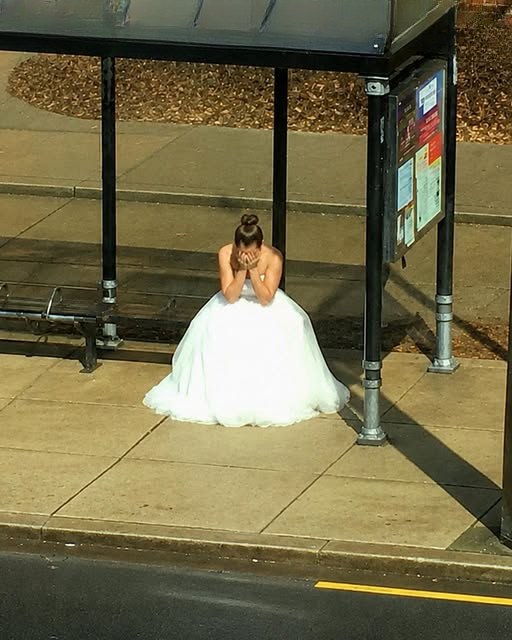
Every Friday evening, a woman wearing a wedding dress sat alone beneath the same flickering streetlight at the neighborhood bus stop while everyone around her pretended she didn’t exist. People whispered about her, laughed quietly, or crossed the street to avoid her entirely. Most assumed she was simply heartbroken or mentally unstable — another tragic figure people preferred not to understand too closely. But the night I finally gathered the courage to sit beside her, she whispered something that changed everything. In that moment, I realized she wasn’t waiting for lost love at all. She was terrified of someone watching her.
The evenings in my neighborhood always carried a strange heaviness, especially on Fridays when the sky turned deep orange and silence slowly settled over the streets. From the third-floor window of my apartment, I could clearly see the small bus stop across the road, illuminated by a weak streetlamp that flickered constantly like it was struggling to stay alive. As a graphic designer who often worked late into the night, I spent most evenings alone near that window with my laptop and coffee as my only company.
That was how I first noticed her.
For nearly a month, the same woman appeared every Friday just before sunset. She always wore a full white wedding gown, complete with a delicate veil trailing softly near the pavement. She would sit quietly on the bench with her hands folded tightly in her lap, staring toward the street with an expression so empty it felt painful to witness. Sometimes tears rolled silently down her face, but she never made a sound. Her grief looked too deep for crying itself.
Everyone in the neighborhood noticed her eventually.
One morning my upstairs neighbor Marcus stopped me in the hallway with an amused grin on his face.
“You saw the bride again last night?” he asked casually.
“The woman at the bus stop?” I replied. “Yeah.”
He laughed softly. “Crazy, isn’t she? Every Friday like clockwork. I tell people the same thing every time — just ignore her. She’s not your problem.”
I forced an awkward smile because it seemed easier than arguing.
“Probably got abandoned at the altar,” he added with a shrug. “Sad story, but you can’t save everybody.”
I nodded quietly, though something about the way he spoke unsettled me.
Back inside my apartment, I found myself staring out the window again. A teenage boy pointed at her and laughed while passing by. An older couple crossed to the opposite sidewalk just to avoid sitting near her. Nobody stopped. Nobody asked if she was okay.
And neither did I.
At first, I convinced myself I was respecting her privacy. I told myself she probably wanted to be left alone. But deep down, I knew the truth was uglier. I had recently gone through a painful breakup myself, and ever since then, loneliness in other people felt impossible to ignore. I recognized it immediately because I carried it too.
That Friday evening, she suddenly lifted her head and looked directly toward my building. For one brief second, I felt certain she could see me watching from the window. I stepped back instinctively, embarrassed by my own curiosity.
Long after she disappeared into the darkness, I remained staring at the empty bench beneath the streetlight.
Something about her sadness mirrored something broken inside me, and I hated myself for continuing to look away.
The following Friday, I finally decided I wouldn’t.
After finishing work late that evening, I walked across the street toward the bus stop with my jacket collar pulled tightly against the cold wind. She was already there exactly as always — same white dress, same delicate veil, same unsettling stillness.
I sat beside her carefully, pretending to check my phone while my heart pounded nervously.
Marcus’s voice echoed in my mind again: “Just ignore her.”
But now that I sat close enough to hear her breathing, ignoring her suddenly felt impossible.
I cleared my throat quietly.
“Hey,” I said softly. “Do you need help?”
At first she didn’t respond at all.
Then slowly she turned toward me, and the expression in her eyes hit me harder than anything I expected.
She wasn’t heartbroken.
She was frightened.
“You’re talking to me,” she whispered like she couldn’t believe it.
“Yeah,” I answered gently. “Is that okay?”
“Nobody talks to me.”
The sadness in those words stayed with me immediately.
Her fingers tightened against the fabric of her dress as she introduced herself as Elena. She explained she was waiting for her fiancé, who had promised to meet her at that exact bus stop on their wedding day.
“When was the wedding?” I asked carefully.
“Over a year ago,” she replied quietly.
Something about the way she said it felt rehearsed, almost like a line repeated too many times.
As we spoke, a black car rolled slowly past the corner nearby. Elena’s entire body suddenly tensed with fear. The car paused for a moment before driving away again into the darkness.
Only after it disappeared did she finally breathe normally again.
That was the moment I realized something much darker was happening.
When I offered to walk her home, she hesitated before agreeing. During the walk, she admitted she lived nearby with her brother, who “took care of everything.” The way she emphasized those words made me deeply uncomfortable.
Before we reached her house, she suddenly grabbed my wrist tightly.
“Please,” she whispered urgently. “Don’t tell anyone you talked to me.”
“Why?”
She glanced nervously toward the dark houses surrounding us.
“He’s watching.”
Then she disappeared into the shadows before I could ask anything else.
Over the following days, I couldn’t stop thinking about her. Eventually, after asking neighbors casual questions, I discovered something shocking.
Elena’s brother was Marcus.
The same Marcus who mocked her constantly.
The same Marcus who encouraged everyone to ignore her.
When I confronted him, his charming smile barely slipped before returning again.
“She’s fragile,” he explained calmly. “She imagines things. It’s best not to encourage her.”
Something inside me knew immediately he was lying.
A few days later, I found an envelope pushed beneath my apartment door. Inside was a handwritten letter from Elena.
As I read it, my blood ran cold.
Her fiancé had never died. Marcus had manipulated him into leaving her before the wedding. Worse still, Elena explained that their family inheritance could only legally transfer to her through marriage — or if she were declared mentally incompetent. Marcus had spent more than a year controlling her finances, medications, and movements while convincing the neighborhood she was delusional.
The wedding dress was not a symbol of insanity.
It was her final act of resistance.
She wore it every Friday because it was the one thing Marcus could not forcefully take from her without attracting attention.
The final lines of the letter nearly broke me.
“All I needed,” she wrote, “was for someone to ask if I was okay.”
That night changed everything.
With the help of a lawyer specializing in guardianship abuse, we pushed for an independent psychiatric evaluation. Weeks later, Elena was officially declared fully competent. Marcus lost control over her life and was later charged with financial exploitation.
Months afterward, on another quiet Friday evening, I sat once again at the bus stop beneath the flickering light. This time Elena approached wearing a simple blue dress instead of white.
She smiled softly and handed me a sketch she had drawn of the bus stop bench with two figures sitting side by side.
“For the man who finally looked at me,” she said gently.
As her bus disappeared down the street, I sat there holding the drawing and realizing something I would never forget again.
Sometimes changing someone’s life begins with nothing more complicated than asking a simple question — and genuinely waiting to hear the answer.