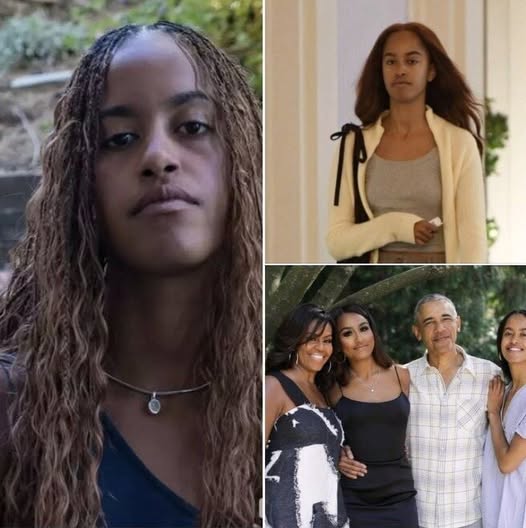
She made a choice most children born into political dynasties rarely dare to make.
Not a loud announcement.
Not a dramatic rejection.
Just a quiet shift in identity that says more than any speech ever could.
Malia Obama has stepped into Hollywood under a different professional name: Malia Ann.
And that small change carries enormous meaning.
For most of her life, the world has never allowed her to simply exist as herself. She grew up beneath cameras, headlines, security details, and the impossible weight attached to being the daughter of Barack Obama and Michelle Obama. Long before she ever had the chance to define herself, the world had already defined her.
People watched her childhood happen publicly.
Watched her walk across the White House lawn.
Watched her grow from a little girl into a young woman while projecting expectations onto her every step.
And that kind of visibility changes a person.
Because eventually, there comes a moment when someone raised inside history must decide whether they want to continue living as a symbol… or finally become an individual.
That is what the name “Malia Ann” quietly represents.
Not rebellion.
Authorship.
By choosing to professionally use her middle name instead of the Obama surname, she is not erasing where she came from. That legacy will follow her forever whether she embraces it publicly or not.
What she is doing instead is far more personal.
She is asking to be seen for her work before her bloodline.
For her ideas before her last name.
For her voice before her inheritance.
And in Hollywood, that matters.
Because fame inherited through family connections can open doors, but it can also imprison people inside assumptions they never chose for themselves. Every project becomes viewed through the lens of nepotism. Every success gets questioned. Every creative risk becomes overshadowed by the family attached to it.
Malia Ann appears deeply aware of that reality.
Rather than leaning harder into the power of the Obama name, she seems determined to build something quieter and more human — a creative identity that can stand on its own merit.
Her early career choices already reflect that instinct.
She worked in the writers’ room for Swarm alongside Donald Glover, a series deeply interested in obsession, identity, loneliness, and emotional instability beneath public image.
That alone says something about the kind of storytelling she gravitates toward.
Not glossy celebrity narratives.
Human complexity.
Her developing creative work reportedly explores themes surrounding identity, intimacy, self-discovery, and emotional isolation — subjects that feel almost impossible to separate from her own lived experience.
Because what does it mean to grow up globally recognized before you fully know who you are?
What does individuality even look like when the world keeps reducing you to your surname?
Those questions seem to quietly exist underneath her career choices.
And perhaps that is why “Malia Ann” feels so important.
It is not about running away from the Obama legacy.
It is about refusing to disappear underneath it.
There is something deeply understandable about that instinct. Children of famous families often spend their entire lives trapped between gratitude and suffocation. The opportunities are enormous, but so is the pressure. Every achievement becomes compared to the family legacy standing behind them.
Sometimes the only way to hear your own voice clearly is to slightly lower the volume of the name attached to you.
And there is courage in that.
Especially because the Obama name still carries enormous cultural weight globally. Walking away from the immediate power of that recognition — even partially — risks misunderstanding from every direction.
Some people will call it performative.
Others will insist she can never truly separate herself from privilege anyway.
And both things can coexist alongside another truth:
She is still trying to become her own person.
Like anyone else.
Just under infinitely brighter lights.
What makes her transition particularly compelling is how quietly she is handling it. There has been no grand declaration, no dramatic attempt to reject her family publicly, no manufactured reinvention designed for headlines.
Instead, the change feels subtle.
Deliberate.
Almost intimate.
A young woman carefully reclaiming authorship over her own identity one professional decision at a time.
And perhaps that is the real story here.
Not that she changed her name.
But that she is learning how to stand beside one of the most recognizable legacies in modern American history without allowing it to completely consume her own humanity.
The Obama legacy will always exist around her.
It always will.
But Malia Ann seems determined to walk beside that history rather than spend her entire life standing underneath it.
And maybe that is what growing up truly means for someone born inside a story the world already thought it understood.