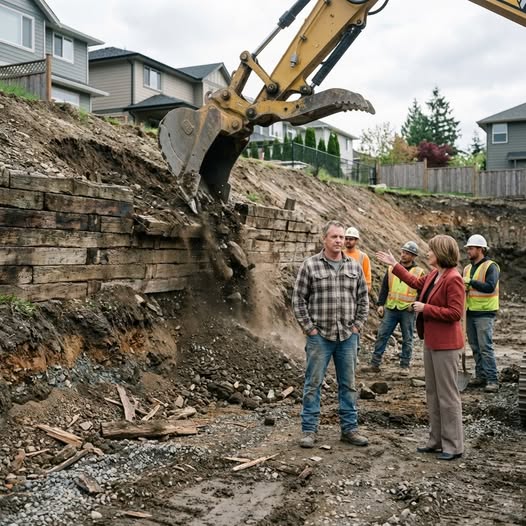
HOA ordered me to tear down my retaining wall. So I did.
The day my neighbor demanded I remove the retaining wall that had been holding an entire hillside together for more than twenty years, I remember standing in my driveway staring at the notice in my hand thinking, This is either going to become really funny or unbelievably expensive.
As it turned out, it became both.
Now, before this sounds like one of those exaggerated neighborhood wars people invent online, you should know I’m not someone who enjoys conflict. My name is Luke Harper. I’m forty-seven years old, and I’ve spent most of my adult life running a small landscaping business outside Eugene, Oregon. My world has always revolved around dirt, drainage, stone, grading, and fixing problems other people ignored too long.
It’s not glamorous work.
But if you spend thirty years working around hillsides and water runoff, you learn one important truth very quickly:
Gravity always wins.
And my property sits directly on a hillside.
Back in 2002, my wife and I bought the house because it was one of the few places we could actually afford with enough room for our kids and a workshop for my equipment. The house itself was nothing special — an aging cedar home from the late ’70s — but the lot had potential. The backyard sloped sharply downward about eight feet toward the three houses below us.
At first, the hill didn’t seem dangerous.
Then winter came.
During the first season of heavy Oregon rain, I noticed subtle warning signs immediately: cracks forming through the clay soil, fence posts slowly leaning downhill, sections of earth shifting after storms. To most homeowners, those changes might have looked harmless. To someone who works with land for a living, they looked like the beginning of a landslide.
So I built a retaining wall.
Not a beautiful one.
Not something you’d see in a luxury landscaping magazine.
I built it using thick old railroad ties salvaged from a yard outside town. Heavy timber soaked with creosote and age. The wall stretched roughly thirty-five feet across my backyard and stood around eight feet tall. Behind it sat nearly 180 cubic yards of compacted earth.
That wall wasn’t decorative.
It was structural.
It existed for one reason only: to stop the hillside from sliding into the three properties below mine.
And it worked perfectly.
The moment the wall went in, the slope stabilized. My backyard flattened out. The neighbors downhill stopped dealing with drainage problems. One neighbor, Carl Jensen, used to joke that my retaining wall was “the best insurance policy he never had to pay for.”
For nearly twenty years, nobody complained.
Then Carl moved away.
And Vanessa Caldwell arrived.
The first thing I noticed about Vanessa was that she looked like someone completely unfamiliar with dirt. Designer sunglasses. Perfect white sneakers untouched by mud. That polished confidence certain people carry when they assume every space they enter should immediately adapt to their preferences.
A few weeks later, I learned she had become president of our HOA.
Normally that wouldn’t matter much. Our neighborhood association mostly handled road maintenance and made sure nobody turned their property into a junkyard. Simple stuff.
But Vanessa clearly had bigger ambitions.
The first time she approached me, I was trimming shrubs near the fence line.
“Hi there,” she said brightly. “You must be Luke.”
I introduced myself and welcomed her to the neighborhood. Everything seemed friendly enough until her eyes settled on the retaining wall.
“That structure,” she said carefully. “Is it permanent?”
I laughed lightly.
“Yeah. It’s been there since 2003. Keeps the hillside from sliding into your backyard.”
She tilted her head.
“It’s quite… rustic.”
“Railroad ties,” I explained. “Solid. Functional.”
“But not very attractive.”
I shrugged.
“It’s a retaining wall. Not a garden feature.”
She stared at it another moment before smiling thinly.
“Well, we may need something more in line with the neighborhood aesthetic.”
That word immediately irritated me.
Aesthetic.
Because the wall wasn’t about appearance.
It was engineering.
Physics.
Safety.
Not decoration.
Two weeks later, I received an official HOA notice ordering me to remove the wall because it violated “current neighborhood aesthetic standards.” According to Vanessa, visible structures required architectural approval under updated HOA rules.
If I failed to comply within thirty days, they’d begin fining me $100 per day.
I honestly thought it had to be a joke.
So I called my wife first.
“Honey,” I said, “the HOA wants me to tear down the retaining wall.”
Pause.
“The wall keeping the hillside stable?”
“Yep.”
“What are you going to do?”
At first, I considered fighting it legally. My attorney Tom reviewed everything and confirmed the wall should probably qualify as grandfathered infrastructure because it existed long before the HOA created its architectural review process.
But lawsuits are expensive.
Engineers are expensive.
And honestly?
Vanessa’s confidence annoyed me enough that another idea slowly started forming in my head.
I attended an HOA meeting and explained exactly what the wall did.
I explained the volume of soil it retained.
I explained that replacing it properly with modern engineered materials could easily cost $40,000.
Vanessa listened politely before repeating the same phrase:
“We need something more attractive.”
That was when I realized something important.
She genuinely believed the wall existed for appearance.
She had absolutely no understanding of what it was actually doing.
So eventually, I decided to comply.
Exactly as instructed.
I sent the HOA a final written warning explaining that removing the retaining wall would likely result in soil movement and landslide activity affecting neighboring properties. I even included engineering concerns in writing.
No response.
So on May 15th, I started removing the wall.
Piece by piece.
Railroad tie by railroad tie.
Neighbors gathered to watch.
Vanessa stood in her backyard staring at me nervously.
“What are you doing?” she shouted finally.
“Complying with the HOA order,” I answered. “Removing the wall.”
“But what about the hill?”
“Good question.”
Two days later, the wall was gone entirely.
For the first time in twenty years, nothing stood between that hillside and gravity.
Then the rain arrived.
Not even a severe storm.
Just normal Oregon rain.
Around three in the morning, I heard the sound every landscaper recognizes immediately: saturated earth giving up. A low rolling rumble, like the ground itself slowly exhaling.
By sunrise, nearly forty cubic yards of mud and soil had slid directly into Vanessa’s backyard.
Her patio vanished beneath mud.
Garden boxes were crushed.
Soil pressed against her back door.
The neighboring properties downhill got hit too — buried window wells, destroyed landscaping, flooded yards.
At six in the morning, Vanessa called screaming.
“Your hillside destroyed my yard!”
I corrected her calmly.
“The hillside moved because there’s no retaining wall.”
“You knew this would happen!”
“Yes,” I answered. “That’s why I warned the HOA in writing.”
Then came the inevitable demand:
“Fix it.”
“I’d love to,” I said. “But I still need HOA approval for a replacement wall.”
By noon, an emergency HOA meeting was scheduled.
Vanessa looked completely different this time. Mud on her shoes. Hair disheveled. Confidence cracked wide open. The same woman who once criticized my wall for looking “rustic” now desperately begged me to rebuild it exactly the way it had been before.
I agreed.
Then I handed them the estimate.
Excavating the mud.
Recompacting the slope.
Rebuilding the wall.
Heavy equipment.
Labor.
About $15,000 total.
The room went silent.
One neighbor asked whether they could sue me.
Tom smiled before answering for me:
“Mr. Harper warned the HOA repeatedly and complied fully with their directive. The resulting damage occurred because the association ordered the removal.”
In other words:
They caused their own disaster.
Eventually the HOA paid.
I rebuilt the exact same wall using the exact same railroad ties.
Same appearance.
Same structure.
Same “rustic” aesthetic Vanessa hated so much.
Six months later, she sold her house and moved away.
Apparently to a flat condo development.
No hillsides.
No retaining walls.
No gravity problems.
The new neighbors are wonderful.
They actually thanked me for maintaining the wall because Carl had explained its importance before selling the property.
It’s been two years now.
The HOA quietly removed its aesthetic restrictions for structural infrastructure after the incident.
And every time heavy rain pounds against that hillside, I look at the wall and think about how quickly people dismiss things they don’t understand.
Vanessa saw an eyesore.
I saw engineering.
She saw ugly railroad ties.
I saw the only thing standing between three houses and a landslide.
That’s the problem with people who value appearances over function: they often don’t realize something is important until the moment it disappears.
The wall was never pretty.
It was necessary.
And in the end, gravity explained that lesson far better than I ever could.