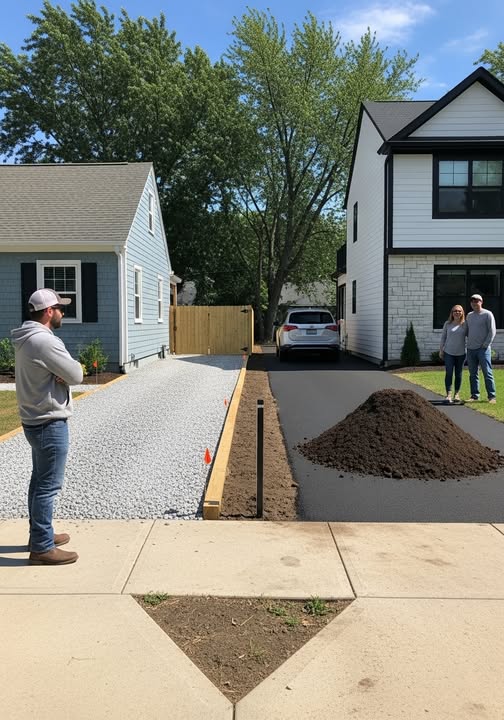
They stole my driveway — or at least they tried to.
At first, it sounded almost ridiculous. A few feet of gravel. A property line disagreement. The kind of suburban dispute people joke about over beers or complain about during cookouts. But anyone who has ever watched a neighbor slowly, confidently push into something you worked years to own understands the feeling immediately. It starts as disbelief before it becomes anger. Then eventually it settles into something deeper: insult. The quiet realization that someone standing a few feet away genuinely believes your rights matter less than their preferences.
I bought my house nine years ago, back when interest rates were still decent and the neighborhood felt simple and grounded. It was a modest corner-lot property in a blue-collar area outside a midwestern city. Nothing luxurious. Two bedrooms. One bathroom. Detached garage leaning slightly whenever the wind hit hard enough. But it had one thing I absolutely loved — a wide gravel driveway that wrapped around the sideyard and opened behind the fence.
That driveway wasn’t just convenient.
It was essential to my livelihood.
I run a small landscaping business. Nothing huge — just me and a couple guys during busy seasons. Trucks, trailers, mowers, mulch deliveries, pallets of stone. The wraparound drive allowed me to park everything neatly without clogging the street or irritating neighbors. I maintained it carefully for years. No junk piled outside. No leaking oil stains. No abandoned equipment. I took genuine pride in keeping the place clean and functional.
Nobody ever complained.
Then Brent and Elise Callaway moved in next door.
From the beginning, they looked like people who believed neighborhoods existed mainly to reflect status. Sharp clothes. Matching luxury SUVs. Contractors arriving constantly. Within weeks, the old house next door transformed into something out of a renovation show — white stone façade, black-trimmed windows, perfectly sculpted shrubs, spotless exterior lighting.
The first time Brent introduced himself, I should have recognized the warning immediately.
He walked over wearing loafers without socks and a crisp polo shirt, shaking my hand like we were closing a corporate merger.
“Hey there, neighbor,” he said smoothly. “We’re excited to elevate the feel of this street.”
Elevate.
That word stuck with me.
Not because it sounded friendly, but because it quietly implied something around him needed improving.
Specifically me.
He glanced toward my truck and trailer parked in the driveway.
“You run a business out of here?” he asked.
“Landscaping,” I answered. “Keeps me busy.”
He smiled politely, though his eyes stayed cold.
“Well, I’m sure we’ll all work together to keep things looking clean.”
At the time, I ignored it.
But over the following months, small comments started drifting over the fence regularly.
“That truck’s pretty big for a residential street.”
“Are you allowed to store equipment overnight?”
“I thought neighborhoods like this usually had regulations.”
They didn’t.
No HOA.
That freedom was one of the main reasons I bought there in the first place.
But Brent clearly missed living somewhere with stricter control.
The real conflict finally surfaced during one of their dinner parties. I returned home from work to find one of their guests’ BMWs blocking half my driveway entrance.
I knocked politely.
Elise answered holding a wine glass while Brent appeared behind her already irritated.
“It’s just for a few hours,” he said dismissively.
“You’ve got your driveway,” I replied. “This one’s mine.”
Then Brent tilted his head slightly and asked:
“Are you sure about that?”
That was the moment something changed.
Not anger yet.
Warning.
A week later, orange cones appeared sitting directly on my gravel near what Brent apparently believed was the property line. I calmly moved them onto his grass.
Ten minutes later, he knocked on my door.
“Nate, we need to talk about the property line,” he said calmly. Too calmly.
Then came the survey.
According to Brent, my driveway supposedly extended eight feet onto his property. He unfolded paperwork claiming a professional survey confirmed it.
The problem?
I already had my own survey from when I bought the house.
And it clearly showed the entire driveway belonged to me.
I hired my own surveyor immediately — a guy named Tom I trusted from previous commercial work. He spent hours checking markers, county records, deeds, and measurements.
When he finished, his conclusion was blunt:
“Your driveway is entirely on your property. Brent’s survey is wrong.”
Not slightly wrong.
Completely wrong.
Tom even suggested either incompetence or deliberate manipulation caused Brent’s measurements.
I thought that would end it.
It didn’t.
Two weeks later, I came home to find a chain-link fence cutting directly across my driveway.
Not along the property line.
Across the driveway itself.
Four feet high. Locked gate. Positioned exactly where Brent’s fake survey claimed the division existed.
I stood there staring at it in complete disbelief.
My own driveway.
Blocked.
Brent watched from his living room window smiling like he’d already won.
The police arrived after I called, but the officer explained what I already suspected: civil matter. I’d need to fight it legally.
So I called my lawyer.
Her name was Angela, and thankfully she specialized in property disputes. After reviewing everything — my deed, surveys, photos, county records — she said the situation was extremely clear.
“He’s trespassing,” she told me. “We’ll get an injunction.”
The problem was timing.
Court would take weeks.
And in the meantime, Brent’s fence remained standing across my driveway.
So I adapted.
If I couldn’t use the back half of my driveway, I’d maximize every inch still accessible.
I parked my landscaping truck right against the fence line.
Then my trailer.
Then backup equipment.
Everything legally parked entirely on my property — but positioned in a way Brent absolutely hated.
Suddenly his elegant renovated house overlooked commercial landscaping vehicles every single day.
His guests squeezed awkwardly around my equipment.
The pristine “elevated” neighborhood image he cared so much about became dominated by my business trucks.
He stormed over furious.
“You’re doing this on purpose.”
“Doing what?” I asked innocently.
“Parking like that.”
“I’m parking on my property,” I answered. “The part you didn’t steal.”
Then came court.
Angela presented everything: my original survey, updated verification, county records, photographs of the fence, deed history.
Brent’s lawyer tried arguing the property line remained disputed.
The judge was unimpressed almost immediately.
“Your survey contradicts every other document,” he told Brent directly. “On what evidence do you base this claim?”
Brent had no real answer.
The judge ruled completely in my favor.
Fence removal ordered within seven days.
Brent ignored the order.
So the sheriff’s department arrived days later with a removal crew. They dismantled the fence themselves and billed Brent for every dollar involved.
And somehow, even after losing, he still kept fighting.
Appeals.
County complaints.
Code enforcement reports.
Accusations about my landscaping business violating zoning laws.
Every single attempt failed because I had done everything properly from the beginning.
Licensed business.
Legal parking.
Correct surveys.
Documented ownership.
Eventually, Brent and Elise gave up entirely.
Six months later, they sold the house and moved into a gated HOA community — exactly the kind of place where nobody parks trucks, no gravel driveways exist, and every blade of grass looks identical.
The new neighbors who moved in afterward were normal people.
Friendly people.
The kind who borrow lawnmowers instead of hiring surveyors to steal land.
It’s been two years now.
I still park my trucks in that same wraparound gravel driveway every day. And every time I back my trailer into place, I think about what the whole fight really meant.
Because Brent never truly needed my driveway.
He simply disliked looking at it.
He saw something working-class, practical, and imperfect beside his carefully curated image of success — and decided his preferences mattered more than my rights.
So he tried to take it legally.
With fake paperwork.
Fences.
Pressure.
Harassment.
He assumed fighting back would become too exhausting or expensive for me to continue.
But some things are worth defending.
That driveway wasn’t just gravel.
It was my business.
My home.
My years of hard work.
My independence.
And when someone decides they can quietly erase something you earned simply because they dislike it, giving up stops being an option.
So I fought back the right way.
With evidence.
Lawyers.
Documentation.
And yes — a lot of very strategic parking.
Now the fence is gone permanently. The property line is crystal clear. And every inch of that driveway legally belongs exactly where it always did:
To me.