My name is Maya, and by twenty-six, I had already learned something painful about family: sometimes love becomes a ledger where one person gives endlessly while everyone else keeps taking. No matter how much I sacrificed, how many hours I worked, or how many times I rescued everyone around me, I somehow remained the one permanently “owing” more.
The night everything changed, I was folding my four-year-old son Liam’s tiny clothes in the fading evening light spilling across my bedroom floor. It was one of the few peaceful moments I got all week. Then my phone rang.
It was my older sister, Harper.
She didn’t bother with hello.
“You’re watching Mia tonight,” she said immediately, like she was assigning a task to an employee rather than speaking to family.
At that point in my life, exhaustion had become my permanent state. I worked full-time as a nurse while also picking up part-time diner shifts to survive financially. Liam and I lived in the small apartment above my parents’ garage — cramped, outdated, barely private — but technically “rent-free,” according to my family. In reality, I paid for it constantly through unpaid labor, babysitting, cleaning, and emotional obligation.
That night, I explained carefully that I couldn’t babysit because I had agreed to cover a night shift for a sick coworker.
Harper didn’t care.
“Wait until Dad hears about this,” she snapped before hanging up.
Those words followed me all the way to work like a storm cloud I couldn’t escape.
The diner that night blurred into endless noise — burnt coffee, flickering neon lights, impatient customers, and forced smiles. I moved automatically, refilling cups and carrying plates while my mind drifted somewhere else entirely. Sometimes during shifts like that, I thought about the life I once imagined for myself before survival took over everything. I had wanted to become a teacher once. I used to picture classrooms, books, stability, a future that felt hopeful instead of exhausting.
Instead, my life had become constant damage control.
When I finally pulled into my parents’ driveway after midnight, the light glowing from the living room window immediately felt wrong. Too bright. Too awake.
Not welcoming.
Waiting.
I walked inside expecting silence and instead found my father sitting rigidly in the living room like a judge preparing a sentence. My mother stood nearby in the shadows while Harper’s version of events had clearly already poisoned the room against me.
The argument escalated instantly.
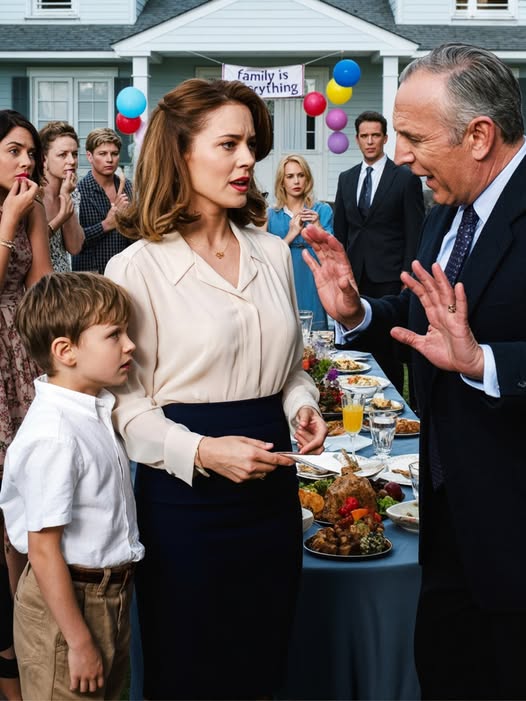
“You refused to help your sister?” my father demanded.
“I was working,” I answered carefully. “I’m supporting my son.”
“You’re always working,” he snapped. “You can never make time for family.”
I stared at him in disbelief.
Everything I did was for that family.
I babysat Harper’s daughter constantly. I cleaned the house every weekend. I gave them money I never got back. I worked two jobs while raising Liam alone. And somehow, I was still selfish in their eyes.
Then my father said the sentence I had heard in different forms my entire life:
“You’re nothing without this family.”
Something inside me cracked.
“I’m everything without this family,” I shot back before I could stop myself.
The room went silent.
Then he grabbed the chair.
At first I thought he was just angry enough to threaten me.
Then he swung it.
Pain exploded across my jaw as the chair struck me and sent me crashing sideways. My vision blurred instantly. I tasted blood. For a moment, the entire room tilted violently around me.
And my mother?
She didn’t rush to help me.
Didn’t scream.
Didn’t stop him.
She simply looked down at me and coldly said:
“You should have handled that better.”
That was the exact moment the final thread connecting me to them snapped completely.
Because suddenly I understood something devastating:
They did not see me as a daughter.
They saw me as a resource.
A servant.
A backup plan they could emotionally and physically destroy without consequences.
I carried Liam out to the car while he slept against my shoulder, completely unaware that our lives had just changed forever. I drove us to a motel and sat awake most of the night staring at the ceiling while my jaw throbbed in the darkness.
And then I remembered the deed.
Six years earlier, before my grandmother Rose died, she made a decision nobody else in the family knew about. She had grown terrified of my father’s gambling addiction and reckless financial behavior. Quietly, legally, she transferred ownership of the family house into my name to protect it from his debts.
“You’re the only one I trust,” she told me back then.
I kept the secret for years because I thought I was protecting everyone.
But lying awake in that motel room, bruised and bleeding after being attacked in a house I legally owned, I realized something:
I was protecting people who would never protect me.
The next morning, I called an attorney.
“I want to sell a property,” I said calmly.
Within days, Liam and I moved into a tiny one-bedroom apartment barely large enough for us to breathe comfortably. But it was ours. No screaming. No manipulation. No debt of emotional obligation hanging over every meal and conversation.
For six months, I stayed quiet.
I worked double shifts. Saved money. Built stability. Prepared paperwork carefully while my family continued living comfortably inside the house they still believed belonged to them. They assumed I would eventually crawl back emotionally like I always had before.
They were wrong.
When everything was ready, I signed the paperwork putting the house officially on the market.
Then I had legal notice delivered directly to their front door.
My mother called screaming.
“You can’t sell our house!”
“It’s not your house,” I answered quietly. “It’s mine.”
The silence afterward felt enormous.
I explained everything — the deed transfer, my grandmother’s decision, the years I kept protecting them while receiving nothing but exploitation in return.
Then I said the sentence that truly ended everything:
“You should have thought about this before you let him hit me.”
My father tried fighting legally. Harper accused me of destroying the family. Tyler stayed silent like always. None of it mattered because the law was clear.
The house belonged to me.
It sold three months later for $285,000. After paying remaining costs and mortgage balances, I walked away with enough money to finally change my life permanently.
I bought a small house for Liam and me.
Nothing luxurious.
Just safe.
Two bedrooms. A small yard. Peace.
For the first time in my life, I only worked one job instead of destroying myself across endless shifts trying to survive. Liam finally had stability. I finally had boundaries.
My family still occasionally tries contacting me.
Emails. Voicemails. Emotional manipulation disguised as reconciliation.
But every conversation eventually circles back to the same truth:
They only valued me when I was sacrificing myself for them.
People sometimes ask whether I regret selling the house and forcing my family out.
I don’t.
Because selling the house didn’t destroy our family.
The destruction happened years earlier — the moment they convinced themselves I existed solely to give while expecting nothing in return.
I spent most of my life trapped in emotional debt, always in the red no matter how much I sacrificed.
But not anymore.
My name is Maya.
I’m a nurse. A mother. A homeowner.
And for the first time in my entire life, the ledger finally feels balanced.