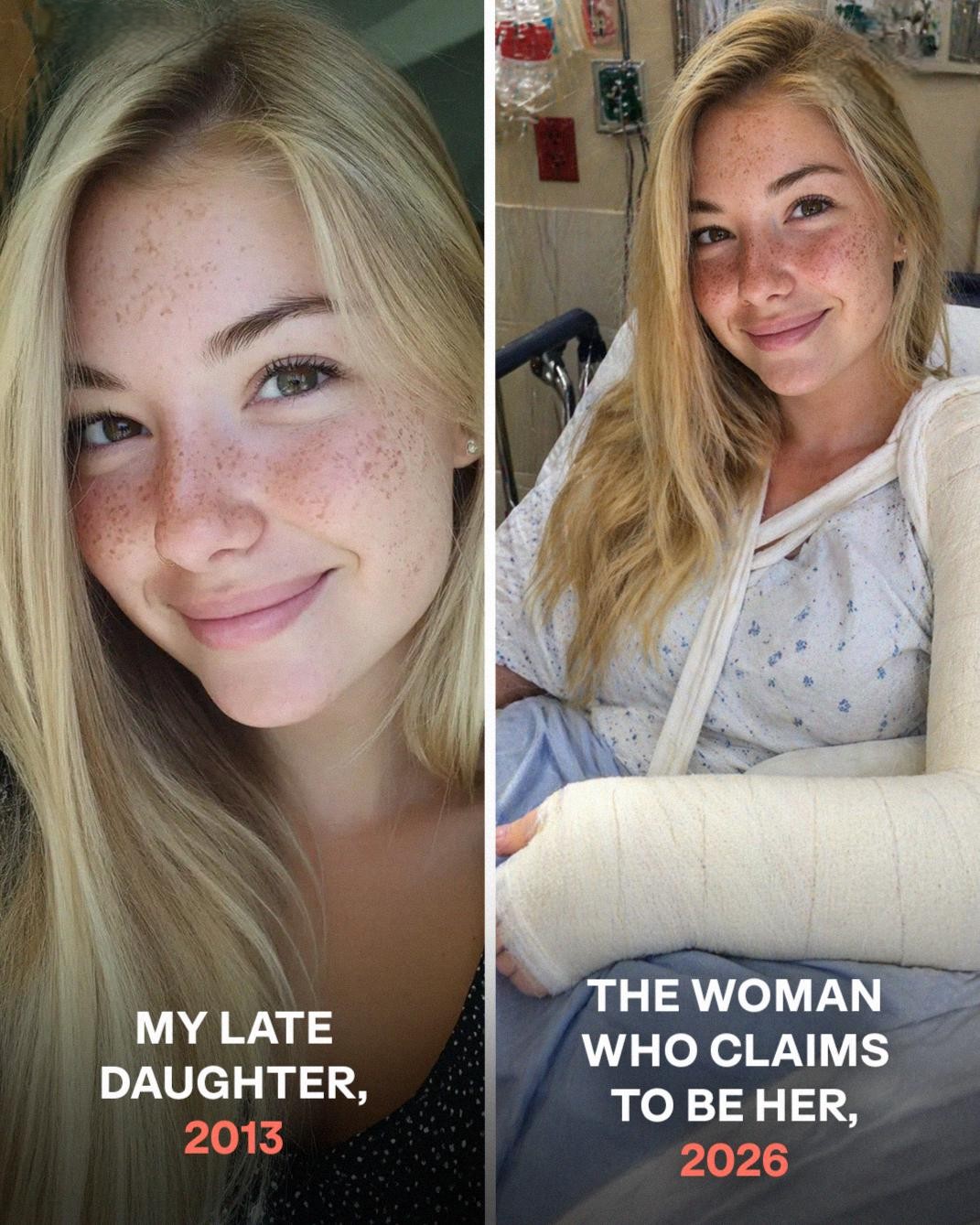
Usually, the quiet in my home was a haven created over thirteen years of grief. That quiet, however, broke into a thousand sharp fragments when the phone rang at 2:17 p.m. on a Tuesday. I was told by a clinical, detached woman that my daughter Lily had been brought to the hospital due to a fractured arm. I had a chilling rush of adrenaline, but it was a terrible perplexity rather than anxiety. The woman had the wrong individual, I informed her. I informed her that more than ten years ago, I had stood in the rain and witnessed the burial of my only kid in a coffin.
There was a long pause on the other end. The specifics followed. They had the birthdate in addition to the name. They were allergic to penicillin as children. The most eerie part was that they claimed the girl was awake and requesting her mother, Susan. My body was moving even if my mind was screaming that it was a joke, a horrible error in some computerized database. I was driving toward a ghost in my car, my hands shaking on the steering wheel.
The cops had contacted me in the middle of the night thirteen years ago. They described it as a highway accident. Low survivability, high speed. I recall the depressing finality of the paperwork and the scent of the hospital floor wax. Since then, I had led a half-life as a mother who had no one to care for. However, a small, illogical glimmer of hope—the type that drives you crazy—flickered in my chest as I pulled into the ER parking lot.
When I offered the name, the ER nurse didn’t hesitate. Her pitying glance made my skin crawl as she stared at me. I followed her to Room 4B. My footfall echoed like heartbeats as I moved along the antiseptic hallway. The door was open a little. I observed a young woman sitting on the side of a bed through the opening. Her right hand held a big manila folder to her chest as if it were a life preserver, and her left arm was covered in a splint.
I called her name in a whisper. The woman pivoted. The world stopped spinning for a heart-stopping moment. She was the one. The same soulful, dark eyes. The same subtle jaw curvature. She was an exact replica of the daughter I had lost, even down to the way she chewed her bottom lip in fear. I grabbed the doorframe to keep myself upright when my knees gave way. However, the illusion broke as she stepped into the light.
Just below her hairline was a little, black mole. There, Lily’s skin had been perfect. This woman was not my daughter, but she was a biological doppelgänger and a masterwork of coincidence.
Her voice was heavy with tears as she spoke. She referred to me as Mom. She informed me that for years, she had wanted to get in touch but had been too scared of her own mental uncertainty. A mixture of anguish and rage stopped me as I stood there. I accused her of playing a sick game and demanded to know who she was. She replied by opening the folder. Photocopies of my daughter’s life, including birth certificates, previous school records, and a hospital discharge summary dated the day Lily passed away, were found within.
I stayed put. I was unable to. I was stuck in that plastic medical chair for reasons that were beyond reason. After observing the girl drift off to sleep, I grabbed the folder. I started to realize how horrible the situation was as I turned the pages. It wasn’t limited to official records. Hundreds of handwritten notes in a variety of handwriting styles were present. They served as life’s instructions. On one page, it said: Lily is your name. Another person stated: Susan is your mother. If you are lost, give her a call. Another put it simply: You were involved in a vehicle collision. You tend to forget things. When you wake up, read this.
I was reading when the girl woke up. Her eyes were filled with deep panic. “I live in a world of sliding shadows,” she explained. On certain days, she was aware of who she was; on other days, the past was a blank slate that she had to use the folder to piece together. Since the doctors had given her the documents, she trusted them. Since Lily was the only identity the world had given her for thirteen years, she thought she was Lily.
Like a woman possessed, I went to the administrative offices. I requested a meeting rather than asking for one. I tossed the folder onto the table when a senior physician and the hospital’s records supervisor eventually took a seat across from me. With the accuracy of a prosecutor, I outlined the timeline. Two young women were taken in from the same highway pileup thirteen years ago. My daughter was one, and she passed away. The other was a girl who had a severe brain injury and no memory but managed to survive.
The room’s quiet was the result of a tremendous institutional failure. At last, the department head acknowledged that there had been a “breakdown in identification protocols,” using the most clinical terminology imaginable. They had switched the files amid the pandemonium of a mass casualty incident. They had sent the identification of a deceased girl home with a living girl who was unable to dispute it. This woman had been a ghost living in a dead girl’s body for more than ten years, and her real family, whomever they were, probably believed she was the deceased.
I returned to Room 4B. My sadness for the stranger on the bed was far worse than my fury towards the hospital. I had to be the one to shatter her world once more. She resisted my telling her that she wasn’t Lily. Screaming that the documents claimed she was mine, she clung to the folder. I had to gently explain that I would have been there for every birthday, every lonely night, and every hardship if I had been her mother. I informed her that the documents were fabrications resulting from a grave error.
She let forth a hollow, eerie cry. “If I’m not Lily, then who am I?” she posed, a question that will haunt me for the rest of my life.
I spent the entire night with her. I took her hand, the hand of a woman whose life had been taken from her due to a clerical error. At that moment, I understood that while my grief for Lily was over, this woman’s narrative was only getting started. She had been told she was someone else for thirteen years. She was a victim of a system that preferred giving names over looking for the truth.
The hospital eventually delivered the accurate records the following morning. With a new file and a deeply ashamed expression, the doctor came into the room. He turned to face the girl and said a name she hadn’t heard in more than ten years. “Natalie,” he said. “Natalie is your name.”
It was like witnessing someone breathe for the first time after being submerged when she repeated her own name. Finding her true family, regaining her past, and fighting the organization who erased her would be a difficult and drawn-out task. However, I knew I was staying put as I sat by her bed. I had been going to a headstone for thirteen years. I now had a living, breathing human being in need of a champion. I would not allow the world to lose Natalie again, even if I had already lost my daughter.