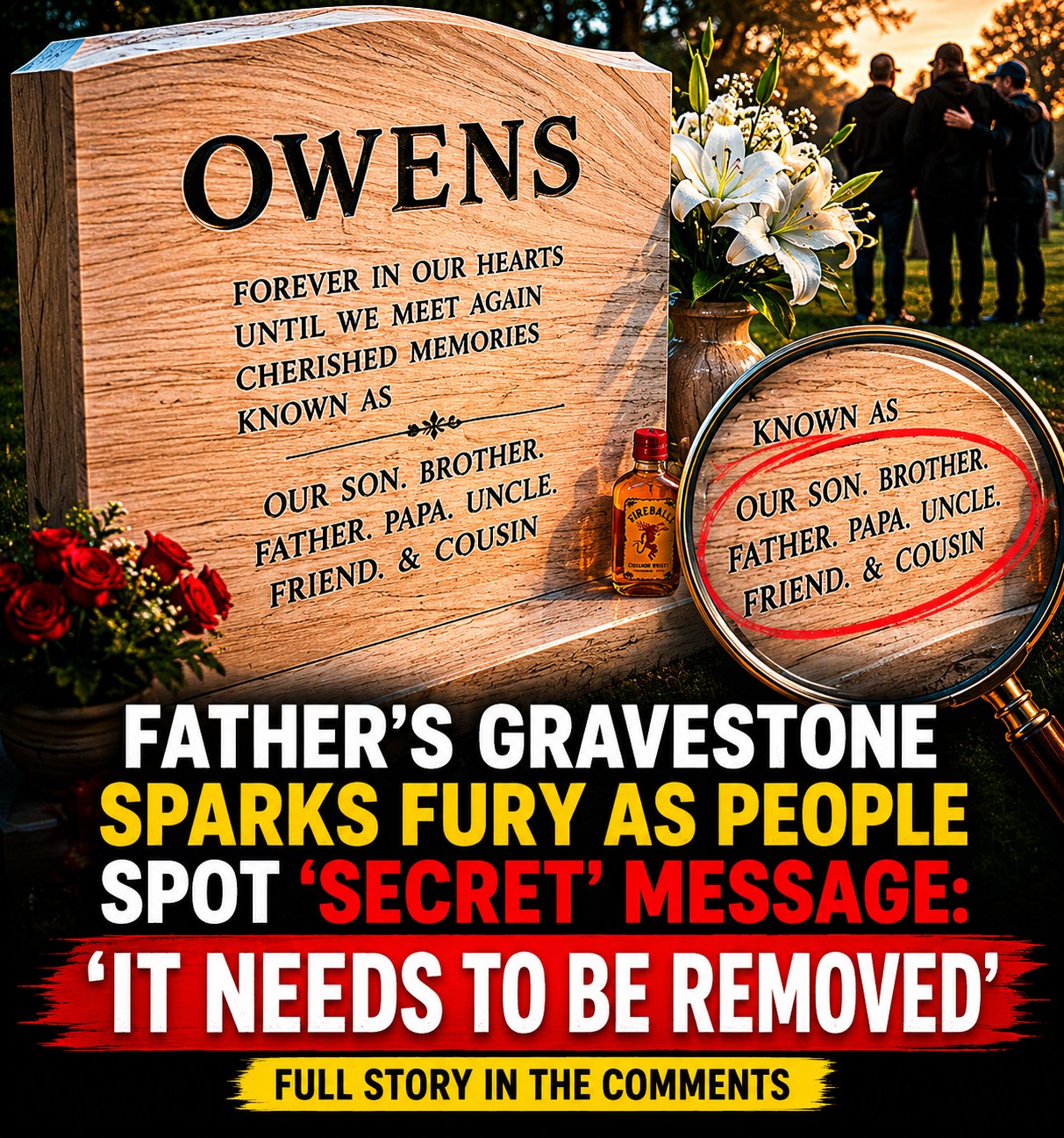
The outrage began quietly.
At first, only one visitor at Warren-Powers Cemetery noticed the unusual lettering on a gravestone. Then another person looked closer. Soon screenshots and photographs spread online, transforming a small Iowa cemetery into the center of a national argument about grief, profanity, and the limits of personal expression after death.
From a distance, the gravestone looked completely ordinary.
Gray stone. Traditional wording. A loving memorial like countless others standing among rows of graves and flowers. But people who carefully read the first letters of each line on the back discovered something hidden in plain sight: an acrostic message spelling out a profane phrase connected to the man buried there, Steven Owens.
For his family, the message was never meant as cruelty or rebellion.
According to relatives, the phrase was a private joke Steven used constantly with the people he loved most. To outsiders, the words looked offensive carved into cemetery stone. But to his children, the hidden message represented something entirely different — memories of their father laughing in the kitchen, teasing family members, pretending annoyance before breaking into a smile moments later.
That emotional context is what made the controversy so complicated.
To the Owens family, the gravestone captured Steven’s personality honestly. They believed memorials should reflect the real person being remembered, not an artificially polished version stripped of humor and individuality. The hidden acrostic, in their eyes, was not disrespectful. It was deeply personal affection translated into stone.
But cemeteries do not exist only for one family.
That reality quickly became the center of the backlash.
Officials connected to the cemetery and local township argued that grief unfolds in shared public space. Visitors arrive mourning parents, spouses, children, and siblings. They kneel beside graves carrying immense emotional weight already. Critics worried about the next grieving family who might unexpectedly notice the hidden profanity while placing flowers nearby and suddenly feel disturbed or offended in a place intended for peace and reflection.
That tension raised uncomfortable questions no simple rule easily resolves.
Where does personal mourning end and public responsibility begin?
Should families have complete freedom to memorialize loved ones however they choose? Or do cemeteries require shared standards because they function as communal spaces shaped by collective respect?
As the debate spread online, reactions divided sharply.
Some people defended the Owens family passionately, arguing that humor and personality do not disappear simply because someone dies. Many pointed out that grief is intensely personal and often expressed through inside jokes, strange rituals, or unconventional memorials outsiders may never fully understand. To supporters, the hidden message represented authenticity — proof that Steven was remembered not as a sanitized stranger, but as the flawed, funny human being his family actually loved.
Others felt very differently.
Critics argued that profanity, even hidden cleverly, simply does not belong in a cemetery. Some viewed the gravestone as immature or disrespectful to surrounding families grieving in the same space. Others worried that allowing one controversial message could open the door to increasingly offensive memorials in public burial grounds.
And perhaps most interestingly, many people found themselves emotionally conflicted.
They understood why the family cherished the joke while simultaneously understanding why strangers felt uncomfortable discovering it. The controversy lingered precisely because neither side fit neatly into villain or victim. Instead, it exposed how grief collides with public expectations in messy, deeply human ways.
Years later, the gravestone still stands in Warren-Powers Cemetery.
The acrostic remains hidden in plain sight, waiting for observant visitors to notice the letters lining up one by one. Some people still react with anger. Others laugh unexpectedly. Some simply stand there thinking longer than they expected to.
Because beneath the controversy lies something larger than profanity.
The stone forces people to confront what respect actually means after death. Whether honoring someone requires dignity and restraint, or whether true love sometimes includes preserving the parts of a person that were messy, irreverent, and impossible to make perfectly polite.
And maybe that is why the debate never fully disappeared.
The gravestone is not really about a hidden phrase.
It is about whether grief belongs entirely to the people closest to the dead — or whether once love is carved into public stone, it inevitably becomes something everyone feels entitled to judge.