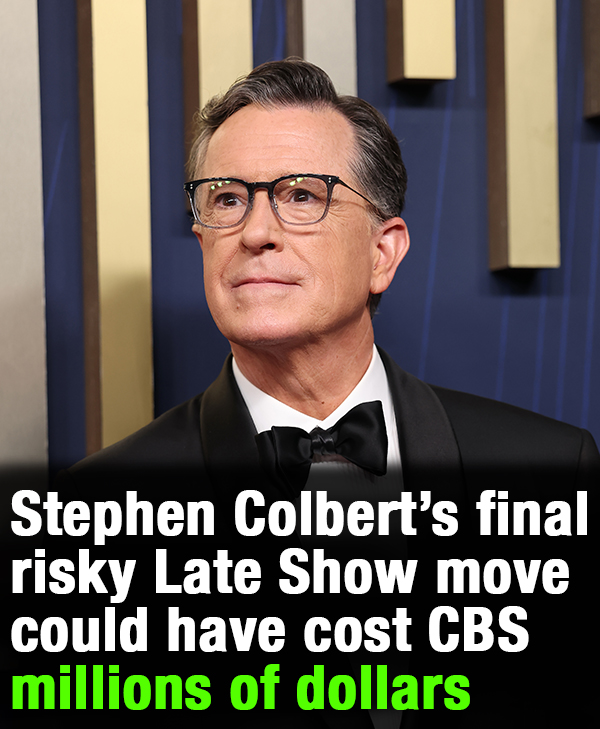
Stephen Colbert didn’t leave quietly. He left with a smile sharp enough to cut through months of corporate damage control.
During his final episode of The Late Show with Stephen Colbert, the studio was packed with celebrities, longtime friends, and late-night legends who understood they were witnessing more than the end of a television run. There was celebration in the room, but underneath it sat tension — the kind that builds when everyone knows a goodbye has become political long before anyone says it out loud.
Then came the moment people immediately replayed online.
For just a few seconds, the band slipped into the unmistakable “Peanuts” melody, playful and innocent on the surface. Colbert looked directly into the camera with perfect timing, paused long enough for the audience to sense something coming, and delivered the line that instantly exploded across social media:
“Oh no, I hope this doesn’t cost CBS any money.”
The crowd erupted.
But the joke landed because everyone understood it wasn’t really just a joke.
For months, CBS executives had insisted that tensions surrounding Colbert’s criticism, political commentary, and controversies connected to Donald Trump had “nothing to do with content.” Publicly, the network framed decisions around budgets, financial pressures, and shifting industry realities. Yet viewers increasingly suspected something deeper simmered beneath the official explanations.
Colbert’s final punchline sliced directly into that suspicion.
Many fans immediately interpreted it as a direct jab at corporate fear — especially after reports and speculation surrounding costly legal battles, settlements, and network anxiety connected to Trump-related controversy. When Colbert previously mocked certain corporate decisions as resembling a “big fat bribe,” supporters saw him positioning himself against the cautious, image-protective instincts of network executives.
So when he dropped that final line, it felt less like comedy and more like a carefully aimed closing argument.
That’s why the seven-second moment spread so quickly online.
On the surface, it was classic Colbert humor: dry, theatrical, deceptively casual. But underneath it sat frustration, defiance, and a refusal to leave silently packaged inside corporate language. His expression mattered almost as much as the words themselves. The audience laughed, but many viewers noticed the look behind the joke — amused, exhausted, and completely aware of the statement he was making.
In a single beat, he transformed a harmless musical cue into a public commentary on power, money, and censorship anxiety in modern media.
The symbolism became even bigger because of what Colbert represented to many viewers. Over the years, he evolved from satirical comedian into one of late-night television’s most recognizable political voices. Supporters admired him not just for jokes, but for the sense that he was willing to openly challenge powerful people and institutions without softening himself for comfort.
That reputation made his departure feel emotional for fans who believed late-night television was losing one of its last openly confrontational hosts.
And that final Peanuts riff became the perfect ending precisely because it was so brief.
No screaming monologue. No dramatic confrontation. Just seven seconds that said everything indirectly. In those few moments, Colbert honored the audience that understood the subtext, mocked the nervousness of corporate media culture, and reminded viewers that sometimes the sharpest criticism arrives disguised as humor.
CBS may have kept the studio, the logo, the broadcast slot, and the business machinery surrounding the show.
But many fans felt Stephen Colbert walked away with something more important: the final word.
And judging by the audience reaction, everyone in that room knew exactly whose side they were on.