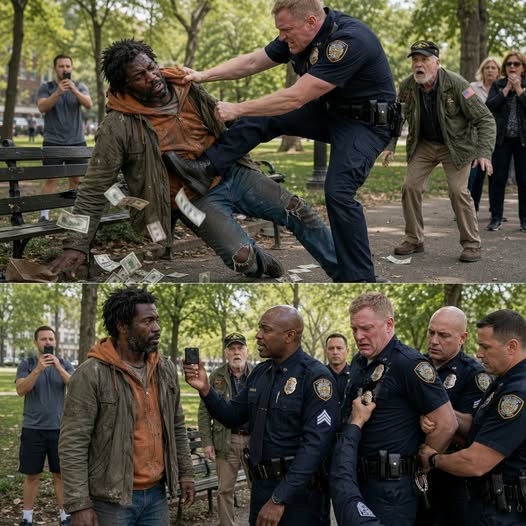
For six straight days, Morrison Park smelled like wet concrete, cigarette ash, diesel fumes, and human exhaustion. Wrapped in a torn gray blanket on a rusted park bench, I looked exactly like the dozens of forgotten men people passed every morning without a second glance. My beard had grown uneven. Dirt stained my hands and clothes. Most pedestrians avoided eye contact entirely, stepping around me as though poverty itself might be contagious. That invisibility was intentional. To everyone else, I was just another homeless man fading quietly into the background of the city. But to Officer Walsh, I was something even smaller.
A target.
Walsh had spent years patrolling Morrison Park with the confidence of a man who believed authority erased accountability. You could see it in the way he walked — shoulders loose, jaw clenched, eyes scanning people not for danger but for weakness. The badge on his chest wasn’t just part of the uniform anymore. It had become permission. Over the course of nearly a week, I watched him move through the homeless population like a predator testing how much cruelty the world would tolerate before anyone intervened.
Most people looked away.
That was part of the problem.
On Monday, I watched him threaten a homeless veteran with arrest simply because the man asked where he was supposed to sleep after being forced out of an alley. Walsh leaned close enough to spit while speaking, telling him people like him “disappeared every day” and nobody cared enough to ask questions. The man apologized repeatedly despite doing nothing wrong.
Tuesday was worse.
An older woman living out of two shopping carts had carefully folded blankets, canned food, and photographs stacked beside the bench where she slept. Walsh kicked one cart sideways into the mud because he said it “looked disgusting” near the jogging trail. I watched family photos scatter across puddles while she cried quietly and tried gathering them before the rain ruined them completely.
By Wednesday, the pattern was undeniable.
An elderly man muttering to himself near the public bathrooms moved too slowly when Walsh ordered him away. Walsh shoved him hard enough to send him collapsing face-first into the dirt while Officer Lopez stared silently at the ground pretending not to notice. No report. No accountability. Just another humiliation swallowed by the park itself.
And through all of it, I stayed invisible.
Because that was the assignment.
Buried beneath the coarse fabric of my filthy blanket sat pinhole cameras transmitting every interaction directly to Internal Affairs servers. Audio. Video. Timestamped evidence. Every insult, shove, threat, and abuse of power carefully documented while Walsh unknowingly performed for the very investigation designed to expose him.
By the sixth morning, the temperature had dropped sharply overnight. Frost clung to the benches while weak sunlight filtered through bare tree branches above the park. My ribs still ached from where Walsh kicked me earlier that morning after accusing me of “loitering” on public property. He laughed afterward, telling me to crawl somewhere else if I wanted sympathy.
Then I made the mistake he never expected.
I spoke calmly.
“Internal Affairs has been watching you.”
Walsh froze instantly.
Not fully at first. Just enough for uncertainty to flicker behind his eyes. His gloved hand tightened violently around the collar of my coat while he leaned close enough for me to smell stale coffee and nicotine on his breath.
“What did you say?” he asked quietly.
But it wasn’t confusion.
It was warning.
The kind predators give before violence.
I coughed deliberately, partly from the cold and partly to steady myself. Beneath the blanket, the cameras continued recording every twitch crossing his face. Slowly, carefully, I repeated the words.
“Internal Affairs has been watching you.”
Behind Walsh, Officer Carter finally lifted his head from the sidewalk. Lopez stopped moving entirely. The atmosphere shifted so suddenly it felt physical, like pressure dropping before a storm breaks open. For the first time all week, Walsh looked uncertain.
Then instinct took over.
He shoved me backward hard enough to slam my shoulder against the bench and immediately started shouting “resisting” at the top of his lungs — the reflexive language officers use to justify force before anyone asks questions later. His voice echoed through the park while a nearby jogger slowed nervously, phone halfway raised.
Walsh pointed aggressively toward the small crowd beginning to gather.
“Back up! Official police business!”
He was already rewriting reality in his head.
I stayed on the ground deliberately, continuing to play the exhausted homeless man he believed he controlled. Walsh reached for his handcuffs with jerky, panicked movements now, no longer confident but desperate.
“Hands behind your back!” he barked.
Instead, I reached slowly inside my coat.
Everything changed in that second.
Walsh’s hand snapped toward his holster instinctively. Carter took a step backward. Lopez looked genuinely terrified. But I moved with careful calmness, slowly pulling out the gold shield clipped inside my jacket.
Morning sunlight struck the badge sharply.
And the entire illusion collapsed.
“Captain Jonathan Rivers,” I said evenly. “Internal Affairs Division.”
Silence swallowed the park.
Not ordinary silence.
The kind that arrives when people suddenly realize the story unfolding around them is not what they believed it was.
Walsh stared at the badge like his brain physically refused to process what he was seeing. Then he looked at my face. Then back to the badge again.
“It’s a joke,” he muttered weakly.
I pointed calmly toward the seams of the blanket.
“Three hidden cameras,” I told him. “High-definition video. Direct feed to secure servers. Every interaction from the last six days already archived.”
Color drained from his face immediately.
One by one, I listed the incidents we documented.
Threatening homeless civilians.
Property destruction.
Physical assault.
Abuse of authority.
Targeting vulnerable people specifically because he believed nobody would defend them.
Walsh tried arguing at first. Claimed people on the streets lied constantly. Claimed officers needed to “handle situations differently” in dangerous environments.
I interrupted him with one sentence.
“They exist,” I said. “That alone is enough reason to treat them like human beings.”
For the first time since arriving in the park, Walsh had no response at all.
I pulled out my phone and requested immediate supervisory response units.
Sirens began faintly in the distance before growing louder with each passing second. As the sound filled the park, something unexpected happened: Officer Lopez stepped forward quietly beside Walsh holding handcuffs.
Not to help him.
To arrest him.
The click of the cuffs locking around Walsh’s wrists sounded almost surreal after six days of watching him terrorize people without consequence. He looked around wildly as if searching for someone to restore the version of reality where he still controlled the situation.
Nobody moved to help him.
Not Carter.
Not Lopez.
Not the bystanders filming now openly.
By the time supervisors arrived, the confrontation was already over. Walsh stood silently beside the patrol car in total disbelief while officers began securing evidence and taking statements. The jogger who stayed to record everything admitted quietly that he almost kept running when the shouting started.
I told him staying mattered more than he realized.
Because abuse survives longest in places where everyone convinces themselves someone else will intervene instead.
Later that evening, sitting alone inside the quiet Internal Affairs office, I replayed the footage repeatedly across multiple screens. Walsh kicking me in the ribs. Walsh screaming at terrified homeless civilians. Walsh laughing while people begged him to stop humiliating them publicly.
And the hardest realization wasn’t how cruel he had become.
It was how ordinary the system around him treated that cruelty.
Officer Carter and Lopez eventually gave full statements. Both admitted they stayed silent for years because challenging Walsh felt professionally dangerous. They weren’t innocent, and they knew it now. The cameras captured their silence too.
That mattered.
Because corruption rarely survives through one monster acting alone.
It survives through exhausted people convincing themselves silence is safer than courage.
As midnight approached, I watched one final clip from the hidden cameras.
Walsh standing over a man he believed was worthless.
Powerless.
Invisible.
And I realized something that stayed with me long after the investigation ended:
The badge itself never gave me the power to stop him.
The real power came from disappearing long enough to see how the world treats people it believes do not matter.
Walsh thought authority made him untouchable because he assumed nobody important was watching.
But the truth is far simpler and far more dangerous:
The way people treat the powerless reveals who they really are long before anyone else notices.