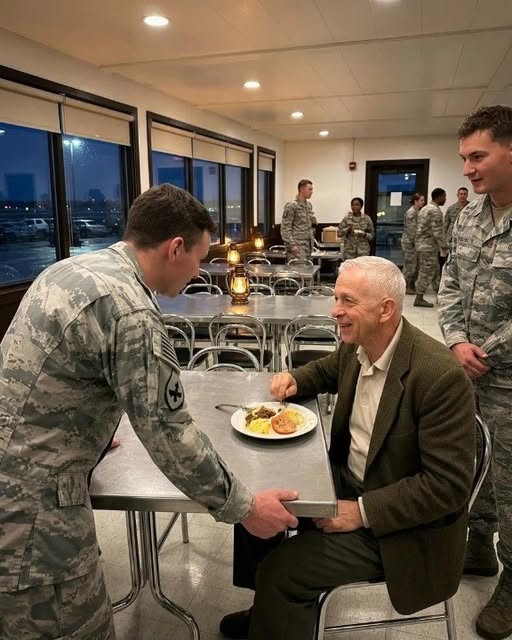
The military mess hall carried the familiar rhythm of controlled chaos that exists on nearly every base in the world. Metal trays slammed against tables, exhausted sailors traded loud jokes across crowded rows of seats, and the scent of burnt coffee mixed with hot food and floor polish beneath harsh fluorescent lights. It was one of the few places where rank briefly relaxed and service members could escape the relentless structure of military life long enough to eat, laugh, and complain together. Most mornings inside the hall blurred into routine noise and forgettable conversations. But on this particular day, a single careless question would transform the entire room into absolute silence — and leave behind a lesson nobody present would ever forget.
Near the far corner of the mess hall, separated slightly from the louder tables, sat an elderly man quietly eating a bowl of chili by himself.
At first glance, there was nothing remarkable about him.
His silver hair was neatly combed, his civilian clothes pressed carefully despite their age, and his posture carried the calm stillness of someone completely comfortable being unnoticed. He did not look like a decorated war hero or retired commander. In fact, he looked almost invisible among the younger military personnel rushing around the hall. Most people barely glanced at him before returning to their own conversations.
His name was George Stanton.
He was eighty-seven years old.
And almost nobody in the room had any idea who he truly was.
The trouble began with Petty Officer Miller.
Miller was young, athletic, loud, and painfully aware of all three qualities. Around the base, he carried himself with the swagger of someone who believed authority should always look intimidating. He enjoyed commanding attention, teasing quieter sailors, and turning ordinary interactions into performances for whoever happened to be watching. Confidence came naturally to him, but humility did not.
Spotting George alone in the corner seemed to trigger something inside him immediately.
Perhaps it was boredom.
Perhaps insecurity disguised as arrogance.
Or perhaps he simply assumed an old civilian sitting quietly among active personnel would make an easy target for amusement.
With several younger sailors already watching expectantly, Miller strutted toward George’s table carrying the grin of someone preparing to entertain an audience.
“Hey, old timer,” he called loudly enough for nearby tables to hear. “What’s your rank?”
The question itself wasn’t necessarily disrespectful.
The tone was.
George slowly looked up from his meal without irritation or fear. His expression remained calm, almost thoughtful, as though he had spent decades watching young men make the exact same mistake.
Then he answered quietly.
“Mess cook, third class.”
Laughter exploded almost instantly around the room.
Several sailors snorted into their drinks while others exchanged amused looks. Miller’s grin widened immediately because the answer confirmed exactly what he wanted to believe: the old man was insignificant. To him, “mess cook” sounded unimpressive, forgettable, weak.
Encouraged by the reaction around him, Miller leaned even further into the humiliation.
“So why exactly are you sitting in here?” he asked loudly. “This area’s usually for active personnel.”
George didn’t respond immediately.
Instead, he calmly lifted another spoonful of chili and continued eating.
That composure unsettled people more than anger would have.
He didn’t defend himself.
Didn’t brag.
Didn’t try proving anything.
He simply refused to shrink beneath the mockery.
The atmosphere slowly began changing.
Even some of the sailors who laughed moments earlier started sensing something uncomfortable beneath the interaction. There was a quiet weight surrounding George that didn’t match the harmless old-man image Miller kept trying to force onto him.
But Miller either ignored the shift or didn’t notice it at all.
Still feeding off the attention of the room, he demanded identification from George, turning casual teasing into a full public interrogation.
For the first time, George stopped eating entirely.
He placed the spoon carefully beside the bowl and reached slowly into the inner pocket of his jacket. His movements were steady, deliberate, almost ceremonial. But what struck several observers most was the sadness visible briefly in his eyes — not humiliation exactly, but disappointment. Like a man remembering too many moments where arrogance disguised itself as strength.
Before he could fully remove the identification card from his pocket, the doors at the front of the mess hall swung open.
Captain Allison Hale entered alongside Command Master Chief Sam Rourke.
Conversations continued for another few seconds until Rourke’s eyes landed directly on George.
Then everything changed instantly.
The hardened senior enlisted leader — a man feared and respected across the entire base — straightened immediately and marched across the mess hall with visible urgency. Without hesitation, Rourke snapped into one of the sharpest salutes anyone present had ever seen.
The room fell dead silent.
Every laugh disappeared.
Every tray stopped moving.
Miller’s confident expression evaporated completely.
“Sir,” Rourke said firmly, his voice carrying unmistakable respect. “It’s an honor to see you again.”
The sailors around the table looked stunned.
Nobody could reconcile the image in front of them — the quiet old civilian eating chili alone — with the reaction of one of the highest-ranking enlisted men on the base.
Then Rourke pointed toward a small faded insignia pinned discreetly near George’s jacket collar.
Most people in the room hadn’t even noticed it before.
But the moment they did, the atmosphere shifted completely from confusion into awe.
Slowly, the truth emerged.
George Stanton wasn’t simply an elderly veteran stopping by for breakfast.
Decades earlier, he had served in covert military operations so secretive that much of his work never appeared publicly in official histories. Long before elite units became cultural icons, George belonged to a generation of servicemen who operated entirely in silence — men sent into impossible situations without expectation of recognition, publicity, or even acknowledgment after returning home.
He had participated in dangerous conflicts where missions failed quietly, sacrifices remained classified, and survival itself often became the only reward. Many of the men he served beside never returned at all.
Yet what affected the room most wasn’t merely George’s military record.
It was the way he spoke about it.
Encouraged gently by Captain Hale and Master Chief Rourke, George finally shared fragments of his experiences. But unlike the exaggerated war stories many younger sailors expected, his voice remained calm, reflective, and deeply humble. He spoke not about glory, but responsibility. Not about heroism, but teamwork. He described losing friends whose names history would never remember and learning that leadership during wartime often meant carrying unbearable decisions silently for the rest of your life.
There was no ego in his words.
No performance.
No desire to impress anyone.
And somehow, that humility made his presence even more powerful.
Because everyone in the room suddenly realized the same thing:
The strongest man there had also been the quietest.
Eventually, George offered one final thought before returning calmly to his meal.
“Rank can demand obedience,” he said softly, “but only character earns respect.”
The sentence landed across the mess hall with almost physical force.
Especially for Miller.
The young sailor who entered the morning desperate to dominate attention now stood motionless beside the table looking completely transformed. The arrogance that fueled him earlier had vanished entirely. In its place sat genuine shame.
When he finally apologized, his voice sounded unrecognizable from the mocking tone he carried before.
George accepted the apology immediately without humiliation or bitterness.
That kindness somehow made the lesson even harder to forget.
Over the following weeks, sailors around the base noticed subtle but undeniable changes in Miller’s behavior. He stopped mocking quieter personnel. He listened more carefully during briefings. He became slower to judge people based on appearance or status. The transformation wasn’t dramatic or theatrical — just steady evidence that the encounter had genuinely reached him.
Then several weeks later, George quietly returned to the mess hall again.
This time, nobody laughed.
Nobody questioned his presence.
There were no speeches, no ceremonies, no dramatic recognition.
Just a shared table, warm food, and silent respect between generations of servicemen connected not by rank alone, but by understanding.
And long after George left that base for the final time, the lesson he carried into that crowded mess hall remained impossible for anyone there to ignore:
Real greatness rarely announces itself loudly.
The people who have sacrificed the most often feel the least need to prove anything at all.