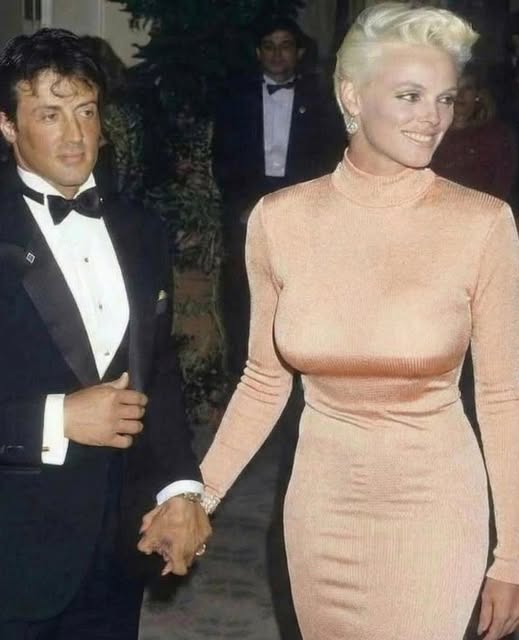
The dazzling illusion of Hollywood has always depended on a single fragile promise: youth lasts forever. Entire careers have been built around beauty, glamour, and the desperate attempt to outrun time itself. Yet every so often, a figure emerges who refuses to play by those rules — someone who doesn’t merely age in public, but completely redefines what aging is supposed to look like. Brigitte Nielsen has become one of those rare figures. Once known primarily as the towering blonde bombshell of the 1980s and the glamorous ex-wife of Sylvester Stallone, she has transformed into something far more powerful with time: a symbol of resilience, reinvention, and unapologetic authenticity. At sixty years old, she is no longer simply surviving the spotlight — she is redefining it entirely.
When Brigitte Nielsen first exploded onto the international stage, she looked unlike almost anyone Hollywood had seen before. Towering over six feet tall with platinum hair, sharp features, and an athletic presence that felt almost mythological, she shattered the image of the delicate, traditionally feminine movie star dominating the era. Her arrival in Red Sonja beside Arnold Schwarzenegger announced the emergence of a different kind of female action figure — one capable of commanding the screen with sheer physical intensity instead of relying solely on softness or vulnerability. Audiences weren’t just watching another actress; they were witnessing someone who seemed larger than life itself.
It wasn’t long before Hollywood became fascinated with her, and that fascination intensified dramatically once she crossed paths with Sylvester Stallone. Their relationship quickly transformed into one of the most talked-about celebrity romances of the decade. Together they embodied the excess and spectacle of 1980s fame — red carpets, paparazzi chaos, magazine covers, and endless public attention. When Nielsen appeared as Ludmilla Drago in Rocky IV, standing beside Stallone both on and off screen, the two became a symbol of Hollywood glamour at its loudest and most theatrical.
But like many relationships built under relentless public scrutiny, the marriage burned intensely and briefly. Their divorce after only two years placed Nielsen directly under the harsh glare of tabloid culture, an environment especially unforgiving toward women trying to rebuild themselves after highly publicized relationships with powerful men. During that era, celebrity culture often reduced women to supporting characters in famous men’s stories. Ex-wives became cautionary tales, relics of scandals, or symbols of failed glamour. Many people expected Brigitte Nielsen to quietly disappear into the background as another forgotten figure from a flashy decade.
Instead, she refused to vanish.
Rather than allowing herself to remain trapped inside the identity of “Stallone’s ex-wife,” Nielsen rebuilt herself repeatedly across different industries and countries. She moved fluidly between acting, modeling, music, and international television, especially across Europe where her charisma and blunt honesty earned her a devoted audience. What made her survival remarkable was not simply professional persistence, but adaptability. Hollywood often punishes women harshly for aging, reinvention, or refusing to disappear gracefully. Yet Nielsen navigated those pressures with a kind of defiant openness that made her impossible to fully dismiss.
One of the defining features of her later life has been her willingness to speak honestly about pain, insecurity, and personal mistakes in ways many celebrities avoid completely. In an entertainment industry built around carefully manufactured perfection, Brigitte Nielsen became surprisingly candid about her struggles with self-image, emotional hardship, and the pressure of constantly performing confidence in public. Her interviews, particularly a deeply emotional conversation with Oprah Winfrey in 2014, revealed someone far more vulnerable and reflective than the exaggerated media persona people once projected onto her.
Rather than hiding from past mistakes, she spoke openly about them. Instead of pretending her life had always been glamorous and controlled, she acknowledged the chaos, insecurity, and reinvention required to survive decades in the public eye. That honesty transformed her image completely. She stopped feeling like a distant celebrity from another era and began resonating with women who understood what it means to rebuild yourself repeatedly after heartbreak, aging, public criticism, and personal failure.
Perhaps the most controversial and inspiring chapter of her later life arrived when she became a mother again at fifty-four years old.
The announcement that Brigitte Nielsen had given birth to her fifth child, daughter Frida, ignited enormous debate around aging, motherhood, and women’s autonomy. Critics questioned her decision immediately, treating her pregnancy less like a personal milestone and more like a public controversy. But Nielsen responded with remarkable calmness and certainty. To her, Frida’s birth was not some reckless act of vanity or denial about aging. It was a deeply meaningful new beginning — one that brought profound happiness into her marriage with Mattia Dessì and challenged society’s rigid assumptions about when a woman’s life is “supposed” to stop evolving.
That decision changed how many people viewed her entirely.
Suddenly, she no longer represented merely nostalgia for the excesses of 1980s celebrity culture. She became a symbol of female autonomy in later life — someone refusing to let society dictate expiration dates for motherhood, beauty, ambition, or joy. While many public conversations around aging focus almost obsessively on decline, Brigitte Nielsen seemed determined to frame aging differently: not as disappearance, but as expansion.
Her physical transformation at sixty continues to attract attention, but what fascinates people most is not simply appearance. It is presence. Unlike many celebrities desperately chasing youth through endless cosmetic reinvention, Nielsen projects something calmer and more confident now. In recent photos and interviews, there is little evidence of panic about getting older. Instead, there is a visible comfort inside herself that many younger public figures still seem unable to achieve.
That confidence resonates strongly because it directly opposes the fear-driven messaging of much modern beauty culture. Society spends billions convincing women that aging is failure — something to conceal, erase, or apologize for constantly. Brigitte Nielsen increasingly represents the opposite philosophy entirely. She treats aging not as a loss of value, but as the accumulation of experience, resilience, and self-knowledge. Her elegance now comes less from physical perfection and more from emotional ease with who she has become.
Professionally, one of the most satisfying moments of her later career arrived when she returned to the role of Ludmilla Drago in Creed II. Walking back into the universe of the Rocky franchise decades after it first made her globally famous could have felt awkward or nostalgic in a sad way. Instead, her return felt triumphant. Sharing screen space connected once again to Sylvester Stallone demonstrated not only professionalism, but emotional maturity and confidence in her own legacy.
Importantly, the moment was never framed as a desperate attempt to reclaim lost glory. It was something far more graceful: an acknowledgment that her story still mattered. That her presence still carried power. That time had not erased her relevance — it had deepened it.
Today, Nielsen’s life looks radically different from the chaotic tabloid spectacle that once defined her image. She has built a quieter existence centered around family, motherhood, and personal well-being while still maintaining a vibrant connection to entertainment and public life. Her story now feels less like a cautionary tale about celebrity excess and more like a blueprint for reinvention.
What makes Brigitte Nielsen compelling at sixty is not merely that she “still looks good” or continues working. It is that she refuses to let society reduce her to any single era of her life. She survived fame, public scrutiny, divorce, reinvention, criticism, and the brutal expectations placed on women in Hollywood. And rather than shrinking under those pressures, she emerged more fully herself than ever before.
In the end, perhaps that is her real legacy.
Not simply beauty.
Not celebrity.
But the refusal to become smaller simply because time keeps moving forward.