My name is Sarah Torres. I’m twenty-eight years old, and the story I’m about to tell is the story of how I lost the people who gave me life at thirteen years old — and how I found my real family in the most unexpected place imaginable.
This is not a story about forgiveness or redemption. It’s about the true meaning of family. It’s about the difference between people who share your blood and people who choose you every single day even when it costs them everything. It’s about abandonment, survival, loyalty, and the kind of love that stays when things become ugly, expensive, exhausting, and terrifying. Before I tell you what happened in front of hundreds of people at my medical school graduation, I need to take you back to a hospital room on a Tuesday afternoon when I was thirteen years old and my entire world split apart in less than an hour.
I still remember the smell of St. Mary’s Hospital room 314 with horrifying clarity. Sharp antiseptic mixed with cheap floral air freshener trying unsuccessfully to disguise it. I sat on the examination table wearing one of those paper gowns that never fully close in the back while Dr. Patterson explained my diagnosis. Acute lymphoblastic leukemia. Childhood cancer. He spoke calmly about treatment plans, chemotherapy, survival rates, and how modern medicine gave me an eighty-five to ninety percent chance of recovery if treatment began immediately. He kept repeating the phrase “really good odds” as though statistics could soften the fear swallowing the room whole.
My mother Linda sat stiffly near the window staring blankly at the wall. My older sister Jessica scrolled through her phone without looking up. My father Robert stood with his arms crossed tightly across his chest, his face growing redder with every sentence the doctor spoke.
Then he asked the first question.
“How much?”
Not “Will she survive?” Not “What do we need to do?” Not “Is my daughter going to be okay?”
Just: “How much?”
Dr. Patterson carefully explained insurance coverage, payment plans, financial aid programs, and estimated costs that could potentially reach between sixty and one hundred thousand dollars over the course of treatment. My father laughed coldly when he heard the number. He spoke about Jessica’s college fund as though my existence itself had suddenly become an accounting problem. Yale. Princeton. Futures already planned and invested in.
Then came the sentence that changed my life forever.
“She’s thirteen,” my father said flatly. “She can be emancipated. Become a ward of the state. Then Medicaid covers everything and it doesn’t touch our finances.”
I remember waiting desperately for someone to stop him. I kept expecting my mother to tell him he was being cruel. I kept waiting for Jessica to finally look up from her phone. I kept hoping this was some horrible misunderstanding.
It wasn’t.
When I whispered that I was scared, my mother finally looked at me. But instead of comfort, she calmly explained that they couldn’t “sacrifice Jessica’s future” for me. My father looked directly into my face and called me average. Average grades. Average future. Not worth destroying a “promising” child’s opportunities to save.
Something inside me broke in that room.
Not because of the cancer.
Because I realized my parents had already decided my life was expendable.
Dr. Patterson eventually forced them to leave and threatened to involve social services immediately. The second the door closed behind them, I completely collapsed. I cried so hard I couldn’t breathe properly. Huge, violent sobs shook my body while the reality settled over me: I was thirteen years old, diagnosed with cancer, and utterly unwanted.
Dr. Patterson kept one promise that day. He told me I would not leave the hospital without people protecting me. Within hours, social workers were involved, emergency custody paperwork had been signed, and my parents surrendered responsibility for me almost immediately. They didn’t even say goodbye when they left the hospital.
That first night alone in pediatric oncology was the loneliest night of my entire life.
I lay in bed connected to IVs realizing I was no longer afraid of dying from cancer. I was afraid nobody cared whether I survived at all. Then sometime during the night shift, Rachel Torres walked into my room.
Rachel was thirty-four years old, a pediatric oncology nurse with tired eyes, dark curly hair, and the warmest smile I had ever seen. She introduced herself gently, pulled a chair beside my bed, and asked how I was feeling. When I answered honestly — “terrible” — she didn’t offer fake positivity or empty reassurance. She simply sat beside me and acknowledged that what my parents had done was deeply wrong.
That simple honesty mattered more than anything.
I started crying again, and instead of trying to stop me, Rachel stayed. She handed me tissues, listened patiently, and told me something I desperately needed to hear: that I was not alone anymore. She admitted the next few years would be brutal, but she promised she would be there through all of it. At thirteen years old, abandoned and terrified, that promise sounded almost impossible to believe.
But Rachel kept every word of it.
Over the next month, she became far more than my nurse. She became the steady presence holding my life together while everything else collapsed. She sat beside me when nausea made eating impossible. She distracted me with stories and card games during endless nights. When my hair started falling out, she made jokes about her own terrible hairstyles until I laughed again. When nightmares woke me in the middle of the night, she held my hand until I fell asleep.
Meanwhile, my biological family disappeared completely. My parents signed away their rights without hesitation. My sister focused on college applications. I no longer existed to them.
Except I wasn’t alone anymore.
Because Rachel stayed.
When my remission finally began and doctors prepared to discharge me into foster care, Rachel interrupted immediately. She announced that she wanted to take me home herself. She had already completed foster certification years earlier but had never accepted placement. Now she looked directly at me and asked one simple question:
“If Sarah wants to come home with me.”
I said yes before she even finished speaking.
A week later, Rachel drove me to her small house on Maple Street. Upstairs, she opened the door to a bedroom painted soft lavender — my favorite color, something I had casually mentioned only once. New books sat neatly on shelves. A framed picture of us together rested on the desk. Everything about the room said the same thing clearly:
You belong here.
I broke down crying instantly. Rachel held me quietly and whispered words I still carry inside me now:
“You’re safe. You’re home. And I’m not going anywhere.”
Chemotherapy was brutal. There is no poetic way to describe it. It was exhausting, humiliating, painful, and relentless. But Rachel somehow made survival feel possible. She drove me to every appointment, learned recipes gentle enough for my stomach, sat through homework sessions, and treated every difficult day like something we would survive together rather than something I faced alone.
Every single morning she greeted me with the same sentence:
“Good morning, beautiful girl. It’s a gift to see your face.”
Years later I learned she took out a second mortgage to help cover expenses insurance wouldn’t pay. She never once complained about money. Never once made me feel guilty for surviving.
Then one night, six months into treatment, she sat me down and asked if she could adopt me permanently.
Not foster.
Not temporary.
Her daughter forever.
I couldn’t even answer properly through the tears. I simply nodded while both of us cried at the kitchen table. Four months later, on my fourteenth birthday, I officially became Sarah Torres. Rachel gave me a necklace with our initials intertwined and softly said the words I had needed my entire life:
“You’re mine now. Forever.”
That love changed everything.
I beat cancer. Graduated with honors. Finished college early. Earned acceptance into Johns Hopkins medical school. Eventually I specialized in pediatric oncology because I wanted to become the doctor children like me deserved during the darkest moments of their lives.
Then came graduation.
I was selected valedictorian of my medical school class. Out of hundreds of students, I stood at the top academically and clinically. When I called Rachel to tell her, she screamed, cried, and laughed all at once. By then I had been calling her “Mom” for years because that was exactly who she was.
Two weeks before commencement, the university contacted me explaining that my biological parents had requested seats in my reserved section.
I sat silently for several minutes after reading the email.
Then I allowed it.
Not because I wanted reconciliation.
Because I wanted them to witness exactly what they abandoned.
The ceremony took place inside a massive arena packed with thousands of graduates and families. Rachel sat proudly in row three already crying before my name was even announced. Two seats away sat Linda and Robert Mitchell — older now, smaller somehow, scanning programs without realizing the honored graduate they were waiting for was me.
When the dean introduced “Dr. Sarah Torres” as valedictorian, Rachel leapt to her feet immediately.
My biological parents froze completely.
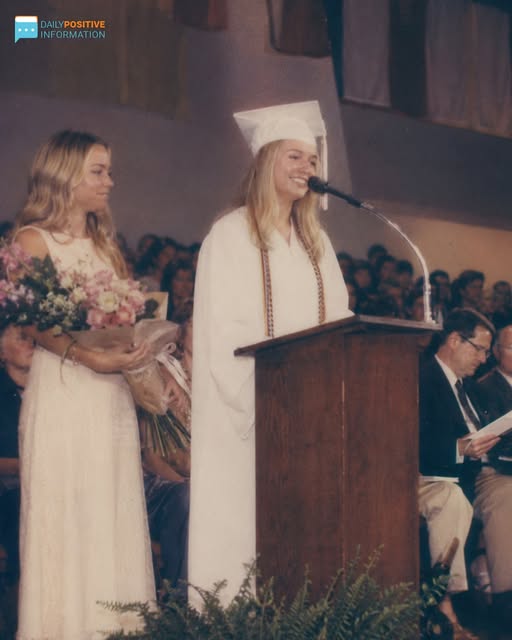
I stepped to the podium and told the truth.
I spoke about being thirteen years old, terrified, and abandoned in a hospital room because my life was considered too expensive. I explained how my biological parents chose protecting a college fund over protecting their daughter. I described the nurse who saw value in me when my own family refused to.
Then I spoke about Rachel.
About the woman who held my hand through chemotherapy, worked double shifts, believed in me when I couldn’t believe in myself, and taught me what real family actually means. Rachel cried openly in the audience while I explained that every achievement in my life belonged to her as much as to me.
Finally, I looked directly at my biological parents.
And I thanked them.
Not for loving me.
But for giving me up so I could find my real mother.
The arena exploded into applause.
Rachel stood there holding her hands over her heart mouthing the words “I love you” through tears while thousands of strangers rose to their feet around her.
My biological parents began calling that same night. Apologies mixed with excuses. Requests for forgiveness mixed with requests for financial help. They had financial problems now. Jessica no longer supported them. Suddenly the daughter they once abandoned had become successful enough to matter again.
I never answered.
After dozens of calls and emails, I finally sent one response explaining exactly what they had done to me and making one thing very clear:
I owed them nothing.
Today I’m thirty-one years old, completing my pediatric oncology fellowship and helping children facing the same disease that nearly destroyed my life. Rachel still calls me every single day. She remains my mother, my best friend, and the reason I survived long enough to become who I am.
People sometimes ask whether I regret the speech.
I don’t.
Because it was never about revenge.
It was about truth. About honoring the woman who chose me when choosing me was difficult, expensive, exhausting, and inconvenient. Rachel taught me that family is not biology. Family is the people who stay. The people who show up repeatedly even when nobody would blame them for walking away.
I’m Dr. Sarah Torres.
I survived cancer.
I became the doctor I once needed.
And I did it without the people who told me I wasn’t worth saving.
That isn’t revenge.
That’s justice.