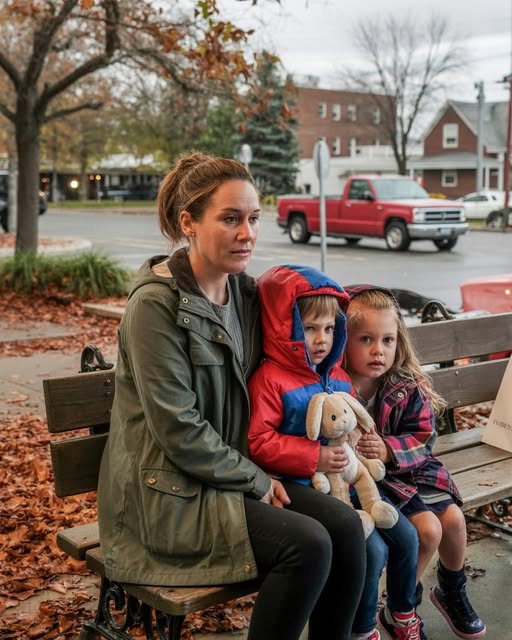
The last thing I expected to see was a worn-out stuffed rabbit’s ear pulsating with red light. My two girls and I had been living in a state of primordial fear for nine days, sleeping in the front seats of a small car, eating dollar store snacks in the dark, and listening to every passing motor with the jagged, urgent heartbeat of a hunted animal. Driven by a single, horrifying moment when my husband wrapped his hand on my wrist and told me I was not allowed to leave, I had departed my home under the pretense of a Tuesday morning. Fearful that he would discover us, I had only brought my kids and emergency cash, and for nine days I had persuaded myself that our only chance of survival was to become invisible. I thought we would ultimately disappear into the background of a world that didn’t care about us if I made myself tiny enough, didn’t ask for assistance, and kept quiet. I was mistaken.
My girls were curled up against me for warmth as we sat on a chilly park bench in November when Denise Harlan, a woman, took a seat at the far end. She was a calm, silver-haired woman with the steady stance of someone who had served as a refuge for people in need for decades. I was unaware at the time that she was an emergency department nurse and a former school counselor who dedicated her time to find ladies in similar circumstances to ours. All I knew was that there was a sense of calm, purpose, and extreme safety in the air surrounding her. Her serene, perceptive gaze was like a lifeline as she observed us. Despite the fact that my daughter’s shoe was double-knotted, she attempted to start a discussion by telling me it was untied. She was testing me, I realize now, to see if I was too shattered by dread to react. She offered us a heated bathroom in the local nature center when I didn’t lose it. My small daughter Ruthie held up her plush bunny and remarked, “Mommy, Bunny has a light,” just as I was about to decline, paralyzed by the fear that any interaction was dangerous.
My blood froze as I gazed down. A tiny, rhythmic pulse of red light was blinking from the rabbit’s longer ear. The red pickup truck I had been following in my peripheral vision for the previous ten minutes suddenly took on a menacing, inescapable appearance because it was a tracking tag. All along, the predator had been keeping an eye on us. Denise didn’t think twice. She didn’t try to explain away the light or question whether I was certain. With the seasoned precision of a lady who had performed this life-saving technique a thousand times, she took in the threat in a single breath, got to her feet, and motioned for us to follow. As we passed through a side door of the nature center, Denise talked on her phone, her voice a source of serenity amidst my crumbling reality. Not only was she assisting us, but she was also guiding us through the mist of my panic with the firm hand of someone who was well-versed in the landscape of domestic abuse.
Denise reminded my daughters that she wanted courageous hearts and quiet feet while locking the office door. She used a tiny pair of scissors from her keychain to cut open the rabbit’s ear seam, tipped the stuffing into her palm, and exposed the button-sized tracker while I stood dazed. Instead of throwing it in the garbage, she placed it in a lost-and-found bin and had it transferred to the opposite side of the building to divert our pursuer. At that moment, I realized that being seen by the proper person was more important for my existence than being invisible. Denise asked, “Do you want help, Shelby?” looking at me not as a problem to be solved but as a person with free will. I finally realized that hiding from danger and hiding from assistance are two very different things after that straightforward, present-tense question burst the dam of my inhibition.
We were brought to an ancient brick shelter on the west side of town that smelled like coffee and laundry soap. It was purposefully constructed from the remains of other people’s worst experiences. I spent hours writing down every detail of my life with Trent, the guy I married when I was twenty-four and grieving the death of my mother, while Denise sat with me. I described how he had entered the emptiness left by my mother, paying attention to me in a way that seemed familiar, only to gradually transform that concern into a cage. I wrote about the holes he smashed in the walls next to my head, the first time he shoved me, and the horrifying, conversational tone he used when he said, “Look what you make me do.” I wrote about the methodical destruction of my identity, including how he stole the bank accounts, controlled the phone plan, and forced me to stay at home until I had no money and no career. I wrote about the broken dishes, the apologies that seemed more like weather patterns than regret, and the perpetual, buzzing risk of a life structured around the expectation of his weather.
The ensuing legal proceedings were harsh, but I had a team for the first time. My chaotic memories were transformed into a coherent system of coercive control by Mireya Salas, a legal lawyer at the shelter. She helped me find the words for the subtle aggression that doesn’t leave marks but destroys a person from the inside out, and she recorded the texts in which Trent went from appealing to threatening. However, Hadley, my daughter, provided the last piece of proof we required to win our freedom. She had been using a broken school tablet to take pictures of clouds for months, and on the day I ran away, she was taking pictures when Trent started arguing. In a 43-second audio clip, he told me that our daughters should watch what happens when I don’t pay attention. His voice was calm and collected.
The key that opened the door to our future was that recording. It was more than simply a violent act; it was the terrifying, clear evidence of a man who thought he was beyond the law. As I stood in the courtroom and listened to the mounting evidence, I came to the realization that my years of silence had simply protected him. I had broken out from his shadow by speaking up, letting Denise see us, and having faith in the patterns Mireya had helped me create. We had no intention of returning. We weren’t going away. For the first time in my life, I realized that the truth was more powerful than any secret he could come up with while we were still alive. We were finally able to step into the light because my daughter had saved us with a picture of the sky.