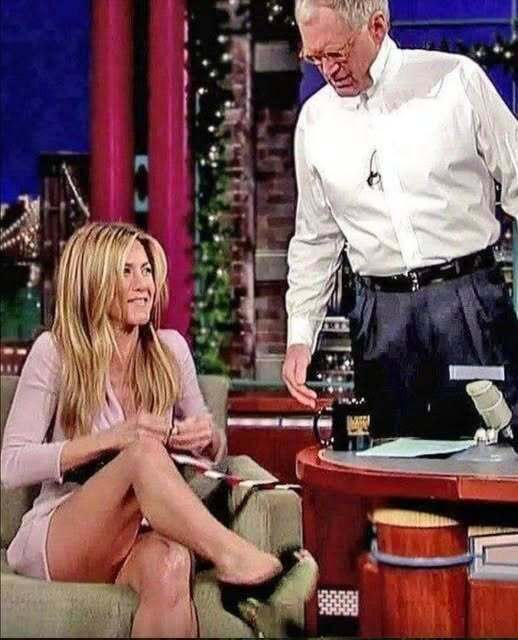
David Letterman was the unchallenged king of late-night television for many years. He defined an era of humor with his trademark dry delivery, gap-toothed grin, and quick wit. However, the legacy of his time at The Late Show has come under close examination as cultural norms have changed and the focus of contemporary social consciousness has switched to the past. Videos that were previously written off as harmless flirtation or edgy humor are now being reexamined, exposing a pattern of behavior with female visitors that many contemporary viewers find to be extremely intrusive, insulting, and unpleasant. Jennifer Aniston’s 2006 appearance on the show, which offers a startling glimpse into how women in Hollywood were compelled to negotiate the complexities of late-night television, is one of the more egregious examples that have resurfaced in the digital age.
Aniston appeared on the show to promote her romantic comedy, The Break-Up, during the height of her cinematic career. Wearing a fitted black top and shorts, she looked effortlessly stylish as she entered the stage. But the discussion quickly strayed from her career achievements and into objectification. Letterman became obsessed with her appearance rather than talking to her about the movie or her work. He complimented her attire at first, but he soon became fixated on her physique and said, “That is a tremendous outfit because you have tremendous legs.” Aniston gave a kind, strained laugh and attempted to return the conversation to the topic she was there to discuss, evidently caught off guard and trying to navigate the social contract of a professional visitor.
Her redirection, however, did not dissuade the host. He kept going back to his obsession, saying things like, “I can’t get over your legs,” and even making a joke about the camera crew making sure they got the best shot of her for the viewers. The studio became more tense as a result of these remarks being made repeatedly. Despite the presenter treating her more like an exhibit than a valued guest, Aniston sat on the couch, clearly attempting to preserve her professional poise and grace. An actress who had discovered early in her career that her value in the public eye was frequently determined by male consumption rather than professional competence gave a tutorial in resilience.
Letterman’s interrogation of Aniston about her personal life, particularly her alleged connection with co-star Vince Vaughn, was the most difficult part of the 2006 visit. He didn’t merely inquire about the relationship; even by the norms of tabloid-adjacent television, his level of intrusive detail was truly startling. In an attempt to antagonize and humiliate her, he even questioned whether Vaughn had wanted her to appear nude in the movie. Aniston hesitated for a time before skillfully sidestepping and told Letterman that he ought to have asked Vaughn that particular question directly, displaying the hardness that has characterized her decades-long career.
Surprisingly, Aniston has previously experienced the host’s intrusive actions. An even more boundary-crossing event is revealed in an unearthed clip from a 1998 interview, which has now gone viral for all the wrong reasons. Then Letterman reached over his desk, suddenly grabbed Aniston by the neck, and began sucking on a lock of her hair. Watching the video now is startling. In any professional situation, let alone one that is broadcast to millions of people, this blatant physical invasion would be unacceptable. The power disparity that compelled her to remain seated, keep a smile on her face, and carry on with the interview as if she hadn’t just been attacked by the host strikes you as you watch her flinch.
A major outcry on social media and in society at large has been triggered by the proliferation of these videos. It has sparked an important and awkward discussion about the historical treatment of women in the entertainment business and how frequently their discomfort was suppressed in the sake of comedy or entertainment. What was formerly dismissed as simply David Letterman being David Letterman is now widely acknowledged as a type of institutionalized disrespect that preyed on the notion that a guest’s main responsibility was to put up with the host’s ego.
Jennifer Aniston maintained the highest level of professionalism throughout these experiences. She never gave the presenter the joy of witnessing her crack, never lost her temper, and never stormed off the platform. She handled every circumstance with a stoic grace that, looking back, seems to have been a defensive necessity formed of a culture that lacked the vocabulary to hold such behavior accountable. She was caught between the necessity of promoting her job and the fact that she was being objectified, yet she handled it with a grace that contrasts sharply with the host’s actions.
These conversations are now essential and potent reminders of how quickly societal norms have changed. Once disregarded as edgy humor by network executives, producers, and viewers, the behavior is now appropriately recognized as improper, intrusive, and extremely rude. The fact that we no longer find it acceptable to witness a successful woman being reduced to the sum of her bodily parts or exposed to physical boundary-crossing on national television is evidence of the development of our social consciousness. These uncovered moments offer a crucial, sobering lesson about the significance of empathy, consent, and fundamental human respect in the workplace, even while David Letterman’s status as a pioneer of late-night television remains secure in terms of his impact on the format. They represent a moment in time that we have fortunately left behind.