Standing in the center of a barren industrial lot, the warehouse appeared to be a dilapidated hulk of rusted iron gates and peeling paint that even the neighborhood strays had abandoned. In a desperate attempt to find a single black automobile, a valet, or even a late guest in a suit, I killed the engine of my ancient Ford and peered through the rain-streaked windshield. But all that was heard was quiet. I double-checked the address Mark had gave me when I said I wanted to be at his wedding by checking the text message on my phone. It was the same place. Sitting in the rain for a long minute, it became clear to me that this had never been an error. To make sure I would miss the most important day of his life, my son purposefully sent me to this barren area of the city.
Mark had called three weeks prior to declare his engagement to Chloe, a tech billionaire’s daughter. I was so delighted to see him find a mate that I started crying happy tears. Then came the subtle, sharp undertones of “concern.” Mark continuously reminded me that I might not feel “comfortable” among the exclusive group he was now a part of, insisting that the event was extremely exclusive and highly formal. In essence, he was warning me that his future in-laws would find me to be too uncultured, too impoverished, and too much of a liability. After his father died, I worked as a grocery clerk during the day and a diner waitress at night, raising him on double shifts and clearance-rack casseroles. I had created his life out of scraps, only to see him develop into a man who was now incredibly ashamed of the hands that had given him his destiny.
I was adamant about being a mother in spite of his objections. For twelve dollars, I purchased a basic navy dress from a thrift store. To make it look acceptable, I hand-washed it in my kitchen sink and spent hours ironing it beneath a towel. I sobbed as I stood outside that dilapidated building, not only for the wedding I was missing but also for the son I had lost to his own conceit. When I was seven years old, I recalled him drawing a picture of a huge house with blue shutters and telling me that when he grew up, he would buy me a house so I would never have to work again. Now that he was older, the same child had come to believe that his mother was a liability to his social standing.
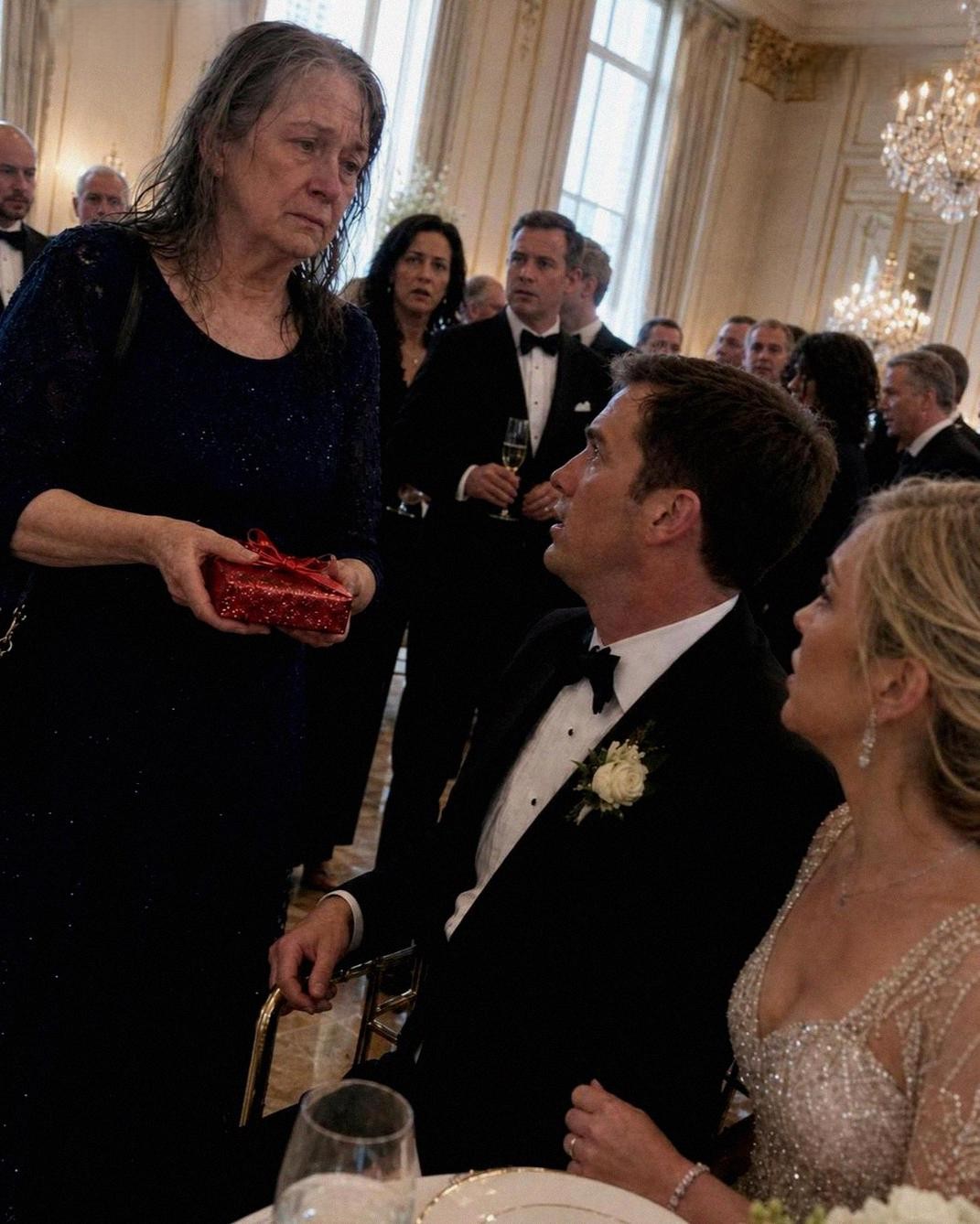
Driven by a sudden, acute clarity, I wiped my eyes. Chloe, who had nothing to conceal, had expressed their happiness on social media, whereas Mark had taken care not to post about the wedding. I quickly found the location—the Ritz downtown—after seeing her sophisticated, pale gold invitation image. Despite his brutality, I was desperate to see his marriage, so I turned the car around. In the midst of a heavy downpour, my car had a blown tire halfway there. I realized I couldn’t afford a tow as I stood in ankle-deep water, gazing at the destroyed rubber. I got out of the car, removed my jacket to keep the dress safe, and started to walk. One’s dignity gets taken away by traveling four blocks during a storm. My hair was a tangle of wet strands, my makeup was gone, and the rain had wrung out my thrift store dress by the time I got to the motel. He was correct—I didn’t belong in this world—and I felt the familiar pain of his judgment as I stopped at the glass doors and looked at my reflection. Nevertheless, I forced the doors open.
The ballroom was a sensory extravaganza of vanilla icing and white lilies. The music abruptly stopped as I walked in, and a stuffy quiet took its place. The soaked, disheveled woman standing in the entryway caught the attention of hundreds of guests dressed in luxury clothing. I heard someone say in a loud, disgusted whisper that I appeared to be homeless. Ignoring the insults, I made my way directly to the front table where Mark and his bride were seated. His chair shattered against the marble floor as he suddenly jumped up. I remained silent until I got to the table. I just took out a small velvet box from my purse that I had kept dry during the rain and placed it on his immaculate porcelain dish.
As he opened the box, the color left his face. He appeared to visibly shrink rather than merely go pale. There was a diamond ring inside, the same ring he had pointed to in a jewelry store display when he was seventeen and promised to get if he ever became wealthy enough to get married. For years, I had sneaked twenty-dollar dollars into an envelope and spent every spare dollar from every shift to get that ring. It was a promise I had made to the boy I used to know, the kid who believed he needed to become wealthy in order to be deserving of love, rather than a gift for his bride.
The room fell silent. As Mark raised the ring, his hands trembled furiously. Chloe, his bride, glanced between us and became shocked when she recognized the woman in the mud-stained outfit as the mother he had informed her was in the hospital and couldn’t make it. I took out the original store receipt, which was still transparent despite the water damage, and extended it. The entire amount was paid. The man seated next to Chloe, who was probably her father, scowled and inquired if I was an invader, but the room became silent when he saw the receipt, which was for more than $7,000.
Mark glanced at the ring and mumbled my name, tears welling up in his eyes. He was a son caught in the act of exposing his own soul, no longer the refined, aloof man he had been moments before. I told them I loved them, wished them a wonderful life, and turned to leave. I was chased out into the chilly night air by Mark. In order to bless the marriage, he pleaded with me to return inside and eat. I reminded him that my blessings had never been the issue—I had been blessing him every day, even when he was preoccupied with feeling embarrassed of me—as I gazed at him, my heart aching for the man he had grown into.
As her parents followed, having learned the truth, Chloe joined us, her bridal gown skimming the sidewalk, her countenance changing from bewilderment to icy reality. The façade was broken. Mark’s bride discovered that he had lied about his life, his past, and the health of his mother. I turned to face the ruins of his integrity as I got into a cab. I had come to show him that the only thing that had ever made him wealthy in the first place was the love he was fleeing, not to wreck his wedding. I sobbed in the back of the taxi, lamenting the son who had lost his identity, but when the hotel’s lights went out, I experienced an odd, subdued calm. I had arrived, fulfilled my commitment, and departed with my dignity intact. It is possible to forgive certain scars, but it doesn’t change the reality of what it cost to be forgotten.