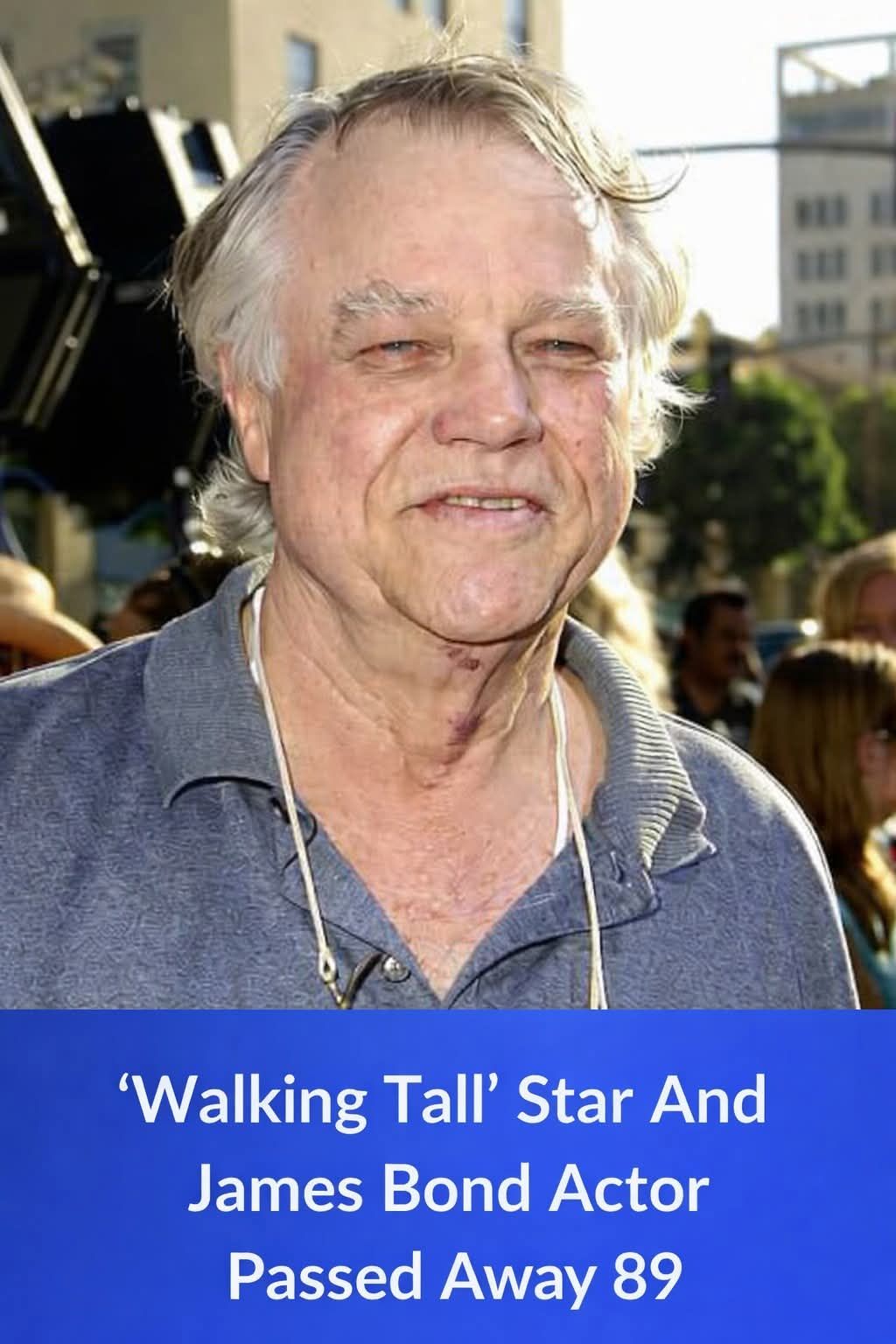
One of the most notable and consistently powerful figures in the film industry has departed. At the age of eighty-nine, Joe Don Baker, the tough, iconic American actor who built out a decades-long career by embodying roles defined by their grit, passion, and undeniable authenticity, passed away. His journey, which had taken him from the modest, dusty plains of Texas to the glittering, high-stakes arenas of Hollywood stardom, came to an end when his family confirmed the news of his passing. His death has sparked an outpouring of tributes from fans and colleagues who remember him not only for the parts he played but also for the unique, physical energy he brought to every frame of film he occupied, even though the specifics of his last moments are yet unknown.
Baker was born in the tiny Texas hamlet of Groesbeck in 1936, and his early years were characterized by both tragedy and resiliency. After losing his mother at the age of twelve, he had to grow up much more quickly than his friends and was finally reared by his aunt. The kind of harsh, grounded people he would later succeed at portraying may have been shaped by this early adversity. His work demonstrated that he was a man who recognized the impact of adversity. On a sports scholarship, he attended North Texas State College, where he graduated in 1958. He then spent two years in the US Army. His athletic background and this time of service gave him a physical confidence that made him ideal for the screen.
Baker aspired to hone his skills at the esteemed Actors Studio in New York City following his military service. As he started to negotiate the competitive world of theatrical acting and early television, the instruction he obtained there was vital. He earned his respect in the conventional manner by making appearances in classic shows that shaped the era, such Bonanza and Gunsmoke. He was able to hone his skills in portraying men of action and conviction by using these parts as a testing ground. His uncredited part in the iconic 1967 movie Cool Hand Luke marked his cinematic debut, placing him in the company of legends and hinting at the direction his career would soon take.
Although Baker’s roles in Westerns like Guns of the Magnificent Seven and Wild Rovers contributed to his rise to genuine fame, it was his portrayal of the renowned Sheriff Buford Pusser in the popular 1973 film Walking Tall that propelled him to the pinnacle of celebrity. Baker became a symbol of vigilante justice in that capacity. The image of the tall sheriff brandishing his trademark wooden club became ingrained in the minds of American moviegoers. Baker played the part with such passion that the movie became a huge box office success. The character required a precise blend of raw, physical intimidation and righteous indignation. He embraced the role rather than merely acting it, taking on the persona of a man on the verge of collapse and retaliating with whatever means at his disposal.
But Joe Don Baker’s extraordinary range was what really set him apart from many of his peers. Even while he was unquestionably skilled at it, he was never satisfied to stay stuck in the role of the “tough guy.” He demonstrated a versatility that enabled him to switch between genres and tones with ease throughout his career. In movies like the popular comedy Fletch, the baseball drama The Natural, the cult favorite Mitchell, and the criminal thriller Charley Varrick, he gave strong performances. Martin Scorsese’s 1991 remake of Cape Fear, where his presence contributed a dimension of menace and gravitas that was crucial to the film’s success, is arguably the clearest example of his ability to hold his own against industry heavyweights.
His unusual double-dipping in the James Bond series was arguably the most intriguing aspect of his career. Being remembered as both a dependable ally and a fearsome villain in one of the most legendary film series in history is a remarkable accomplishment for an actor. In 1987’s The Living Daylights, Baker played the brutal arms dealer Brad Whitaker. After that, he played CIA operative Jack Wade in GoldenEye and Tomorrow Next Dies, a role that gave Pierce Brosnan a much-needed dose of humor and grounded professionalism. His ability to play two very different parts in the same franchise demonstrated the breadth of his skill and his innate, captivating charm.
Baker’s impact was also seen in the television industry, where he kept taking on challenging, intricate parts. His work in the critically acclaimed Edge of Darkness and the biographical television film George Wallace gained him substantial praise and prestigious award nominations, demonstrating that his intensity translated as well to the small screen as it did to the big screen. He continued to work with a passion that belied his age in his latter years, contributing to a variety of films like the moody Mud, the fast-paced adaptation of The Dukes of Hazzard, and the amusing sci-fi comedy Mars Attacks!.
Joe Don Baker decided to leave the rigorous acting profession in 2012. His body of work is distinguished by its unwavering influence on popular culture, consistency, and tough integrity. He was a product of a particular, long-gone Hollywood period in which an actor’s physical presence, work ethic, and capacity to command the screen with little more than a piercing look were what identified them. He was one of the last of his kind, a true professional who brought an unwavering dedication to every character he played, whether he was working for the CIA in the midst of a global crisis or brandishing a club in the backwoods of Tennessee. This is evident when we reflect on his life and his contributions to film. Even though Joe Don Baker is no longer performing, his legacy is still deeply ingrained in American film history.