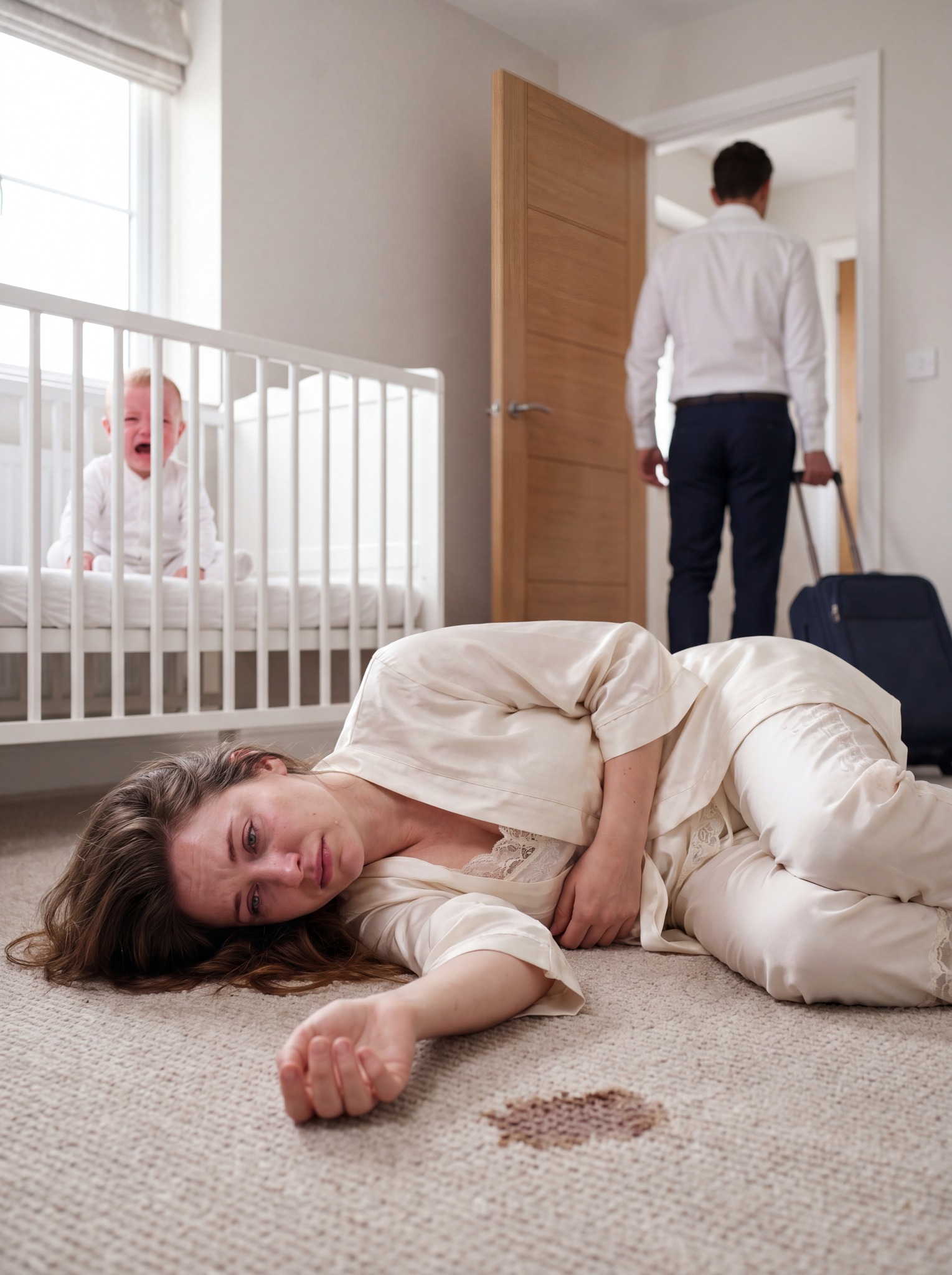
I remember staring at the nursery ceiling and thinking how strange it was that dying could happen in such an ordinary room.
The curtains were half open. Afternoon light spilled softly across the walls painted pale blue before my son was born. Tiny stuffed animals sat untouched on shelves beside neatly folded blankets. Everything looked gentle, peaceful, carefully prepared for a happy beginning. And yet beneath me, blood kept spreading across the rug in slow, unstoppable waves while my newborn son screamed so hard his tiny body shook.
Somewhere far away, my husband was eating steak and drinking whiskey in the mountains.
At first, I truly believed Tyler simply did not understand the seriousness of what was happening. That is the lie women often tell themselves when survival depends on hope. I kept calling him between contractions of pain, my fingers slippery against the phone while dizziness blurred the edges of the room. Each call went straight to voicemail. Then eventually, nothing. His phone had been switched to airplane mode.
Later, I would learn why.
He wanted “peace.”
He wanted “zero drama.”
He wanted a weekend away from responsibility after weeks of complaining online about how exhausted fatherhood already felt.
While I was bleeding onto the nursery floor, he was posting photographs of bourbon glasses beside mountain sunsets with captions about “disconnecting from negativity.” Friends commented how relaxed and happy he looked. Some joked that every dad deserved a break.
None of them knew his wife was trying not to die alone beside their screaming child.
The terrifying thing about severe blood loss is how quickly reality starts slipping sideways. At first there is panic. Then confusion. Then a frightening calmness begins creeping in as your body struggles to keep functioning. I remember pressing shaking hands against my stomach and realizing the warmth spreading beneath me was too much, too fast. I remember trying to crawl toward the crib because my son’s screams sounded desperate and terrified, even though he was only days old.
I could not make my body cooperate anymore.
The rug beneath me had been chosen by Tyler’s mother months earlier after she criticized nearly every decorating decision I made for the nursery. “A baby boy deserves something classic,” she had insisted while replacing the softer cream-colored rug I loved with a darker patterned one she considered more elegant.
I remember thinking stupidly, irrationally, that she would be furious when she saw the blood stains.
That is how trauma works sometimes. The brain clings to meaningless details because the larger reality feels too enormous to survive emotionally.
What saved me was my sister.
When she could not reach Tyler either, something in her instincts told her to come over immediately. She later told me she knew something was wrong the moment she opened the front door and heard the baby screaming nonstop upstairs. By the time she reached the nursery, I was barely conscious.
She called emergency services while pressing towels against my body with shaking hands slicked red. She kept talking to me constantly, refusing to let me disappear inward.
“Stay awake.”
“Look at me.”
“You are not leaving your son.”
“You hear me? Stay with me.”
Even now, years later, those words still echo inside me.
Doctors later explained that another hour alone might have killed me.
Tyler did not know any of this while it was happening.
He was busy constructing an entirely different reality online.
That was the part that broke something permanent inside me. Not only his absence, but the performance of innocence layered over it. While our son screamed himself hoarse in a blood-soaked nursery and surgeons fought to stabilize me, Tyler uploaded carefully filtered photographs portraying himself as a misunderstood husband escaping “stress.” People praised his self-care. They envied his peaceful weekend retreat.
Meanwhile, hospital staff were asking my sister whether they should prepare for the possibility that my child might lose his mother.
When Tyler finally walked back into the house hours later, he expected annoyance.
Maybe tears.
Maybe an argument.
What he found instead was silence so heavy it frightened him immediately.
There were still faint stains visible on the nursery floor where paramedics had worked frantically to stop the bleeding before transporting me. My son slept in a hospital bassinet nearby after doctors insisted he remain under observation too. My sister sat waiting at the kitchen table with an expression Tyler would later describe in court as “the first time I realized I might actually lose everything.”
Then she handed him the hospital paperwork.
Every timestamp.
Every missed call.
Every unanswered message.
Every hour his phone remained unreachable while his wife hemorrhaged alone caring for his newborn son.
Reality finally became unavoidable.
But the strange thing about betrayal that severe is this: grief eventually hardens into clarity.
In the weeks afterward, while my body slowly healed, something colder and steadier replaced the panic. Tyler still thought explanations could save him. He talked about stress, burnout, misunderstanding. He insisted he never imagined things were “that serious.” He cried publicly once people learned the truth, portraying himself as overwhelmed and imperfect rather than dangerously negligent.
What he failed to understand was that survival changes people permanently.
I stopped arguing emotionally.
I started documenting quietly.
Passwords changed first.
Then security footage was downloaded and backed up. Phone records were saved. His social media posts were archived before he could delete them. My sister helped me organize everything chronologically: the timestamps of his uploads, the unanswered calls from doctors, the hours he deliberately disconnected while his family remained in crisis.
The evidence formed a map of abandonment impossible to explain away.
Every arrogant caption became evidence.
Every ignored call became proof.
Every performative smile beside whiskey glasses turned into something uglier under legal scrutiny.
By the time court arrived, Tyler still believed charm might rescue him. Men like him often confuse performance with truth because performance has always worked before. He dressed carefully. Spoke softly. Called himself “human” and “flawed.” He talked about mental pressure and needing space.
Then the judge reviewed the timeline.
Something shifted visibly in the courtroom as the reality settled over everyone present. This was not simply a husband taking a poorly timed trip. This was a father who intentionally disconnected himself entirely while his medically vulnerable wife and newborn child remained alone. This was neglect so severe it nearly became fatal.
The judge did not soften her words.
She named what he had done.
And for the first time since the nursery floor, I felt something inside me finally release.
Not forgiveness.
Not peace exactly.
Freedom.
Because surviving that day forced me to understand something I should have learned years earlier: love cannot survive inside constant performance. Tyler loved being admired more than he loved being accountable. He loved appearing like a devoted husband far more than actually becoming one when it mattered most.
Now my son runs laughing through a different home entirely.
The silence here feels softer.
Safer.
There are no carefully staged online performances anymore. No walking on eggshells around a man addicted to appearances. Just ordinary life — bedtime stories, spilled cereal, small hands reaching for mine, laughter echoing through rooms once haunted by memory.
Sometimes I still think about the blood on that nursery floor.
Not with shame.
Not even with rage anymore.
But as the final thing I ever sacrificed for someone who confused attention with love and performance with responsibility.
I survived him.
And that survival became the beginning of everything better waiting afterward.