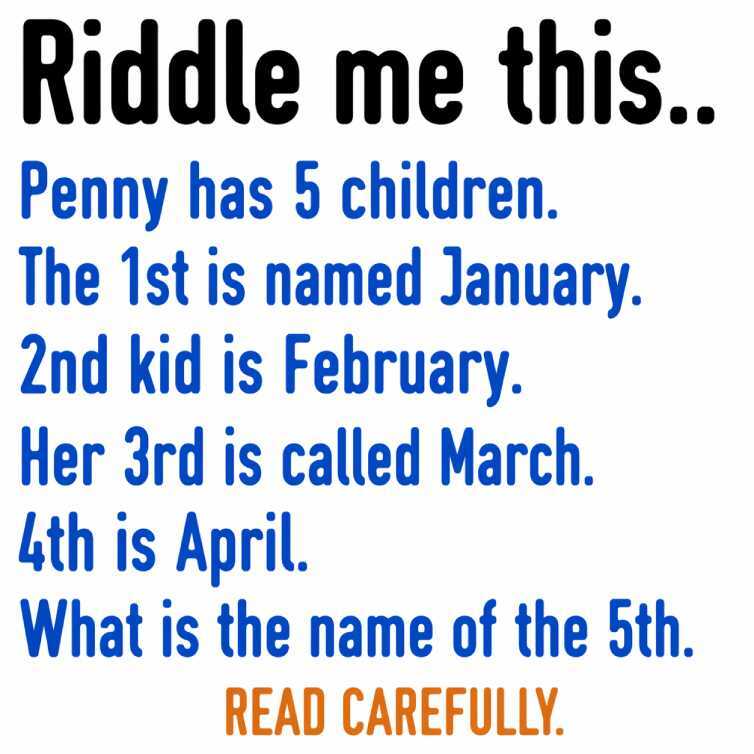
At first glance, the riddle feels almost too easy. Most people read it quickly, notice the pattern of month names, and immediately assume the fifth child must be named May. That’s exactly why so many people get it wrong. The trick is not about intelligence or math — it’s about slowing down long enough to notice what the sentence is actually saying instead of what your brain expects it to say.
The riddle goes like this:
“Penny has 5 children. The 1st kid is named January. 2nd kid is named February. Her 3rd is called March. 4th is April. What is the name of the 5th. Read carefully.”
The challenge became wildly popular online because it plays directly into how quickly people rely on patterns. Once readers see January, February, March, and April, their minds automatically continue the sequence toward May without stopping to question whether that’s really what the riddle is asking. It feels obvious — and that’s the trap.
The key lies in the wording and punctuation.
Many people overlook the final line because they assume it’s a question. But the riddle specifically warns readers to “Read carefully.” That warning matters more than it first appears. If you slow down and pay attention to the sentence structure, you realize something important: the phrase “What is the name of the 5th” can also be interpreted as a statement revealing the child’s name rather than asking for it.
In other words, the fifth child’s name is actually “What.”
That’s the hidden trick.
The riddle depends entirely on misdirection. Readers are encouraged to think about months of the year when the answer has nothing to do with months at all. The sequence of January through April exists only to distract your brain into overlooking the simplest interpretation hidden in plain sight.
That’s why these riddles spread so quickly online. They don’t test knowledge as much as they test attention. People often answer too quickly because the human brain loves recognizing patterns and jumping ahead. Once we believe we understand a pattern, we stop examining the details carefully. The riddle exploits that instinct perfectly.
Some people still argue the answer should be “May” because it fits the monthly sequence naturally. Others point out that the lack of a question mark changes the meaning entirely. That tiny punctuation detail is what makes the riddle clever. It transforms what appears to be a straightforward question into a statement containing the answer itself.
So the correct answer is:
“What.”
Did you catch it the first time, or did your brain automatically jump to May? That’s exactly what makes the riddle so satisfying — the answer feels obvious only after someone explains it.