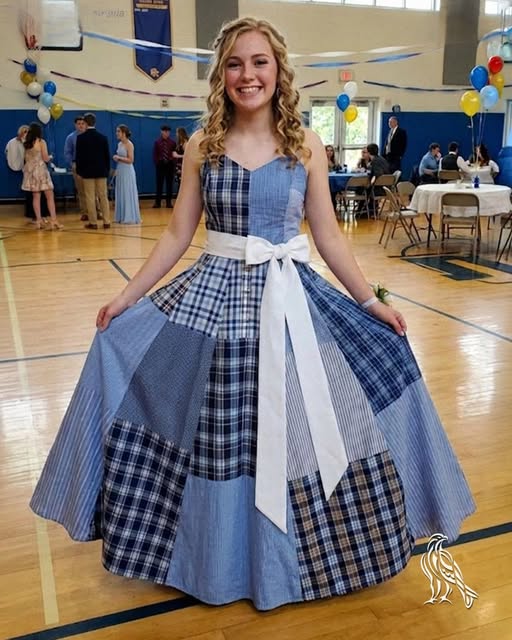
My mom died the day I came into the world, so Dad became everything all at once — my parent, protector, best friend, cook, and biggest supporter. He learned how to braid my hair by watching YouTube videos late at night when I was little. Every Sunday morning the house smelled like pancakes and coffee, and every school lunch he packed came with tiny folded notes tucked beside the napkin because he believed nobody should go through life without being reminded they mattered.
But my father was also the school janitor.
And to kids at school, that was apparently something worth mocking.
“Here comes the janitor’s daughter.”
“Your dad cleaned puke off the floor yesterday.”
“He spends his life scrubbing toilets.”
After a while, I mastered the art of pretending not to care. I kept my face emotionless in hallways and bathrooms, then cried alone once I got home. Somehow Dad always knew anyway. He would quietly place dinner in front of me and say, “You know what I think about people who hurt others just to feel important?”
“What?” I’d ask.
“Not much.”
And somehow, hearing that from him always made the world feel lighter again.
Dad believed dignity came from honesty, not status. He believed kindness mattered more than money or titles. He carried himself with a quiet pride that some people admired deeply while others completely overlooked. Watching him live that way made me promise myself something very young: one day, I would make him proud enough that none of the cruel things people said would matter anymore.
Then last year, everything changed.
Dad got cancer.
At first he acted like it was nothing serious. He still went to work every day, still joked with me at dinner, still smiled like everything was normal. But I noticed the small things. The way he leaned against counters when he thought no one was looking. The exhaustion in his eyes after work. The nights he sat silently at the kitchen table trying to catch his breath.
But no matter how bad things got, he kept repeating the same sentence.
“I just need to make it to your prom.”
I always laughed and told him he’d make it to my graduation too.
He’d smile softly and reply, “I just want to see you walk out that door all dressed up like you own the world.”
A few months before prom, he died.
I didn’t even make it to the hospital in time.
One moment I was standing in the school hallway with my backpack over my shoulder, and the next my Aunt Hilda was walking toward me with tears already falling down her face. After that, everything felt blurry. The funeral. The flowers. The casseroles from neighbors. The unbearable silence inside our house. Then moving into Aunt Hilda’s spare bedroom where nothing smelled like Dad anymore.
And somehow, life kept moving.
Prom season arrived.
Girls at school talked nonstop about expensive dresses, makeup appointments, and limousines while I felt completely disconnected from all of it. Prom had always been something Dad and I talked about together. He was supposed to take pictures at the front door. He was supposed to embarrass me by pretending not to cry.
Without him, the entire night felt empty before it even happened.
One evening, I opened the small box of belongings returned from the hospital. Inside were his wallet, his cracked watch, and beneath everything else, several neatly folded work shirts.
Blue.
Gray.
Green.
I held them in my lap for a long time.
And suddenly the idea came to me so clearly it almost felt like Dad himself had whispered it into my heart.
If he couldn’t come to prom with me… then I would bring part of him there another way.
“I don’t even know how to sew,” I told Aunt Hilda.
She smiled gently and answered, “Then we’ll learn together.”
For weeks, we stayed up late at the kitchen table cutting fabric, sewing crooked seams, and starting over whenever I made mistakes. Sometimes I cried quietly while holding certain shirts because every piece of fabric carried a memory.
The faded green shirt from the afternoon he taught me to ride my bike.
The blue shirt he wore on my first day of high school when he hugged me and told me I was stronger than I realized.
The gray shirt from the night he held me after the worst bullying incident of my life without forcing me to explain a single thing.
Slowly, the dress became more than just clothing.
It became memory stitched together with grief, love, and everything my father had ever been to me.
The night before prom, I finally finished it.
Standing in front of Aunt Hilda’s mirror, I stared at myself for a long time. It wasn’t glamorous. It wasn’t designer. But every part of it came from my father’s work shirts, sewn together with shaking hands and love.
For the first time since losing him, I didn’t feel completely alone anymore.
Aunt Hilda stood quietly in the doorway with tears in her eyes.
“Your dad would’ve been so proud of you,” she whispered.
Prom night arrived glowing with music, lights, and noise.
And the whispers started almost immediately.
At first they were quiet.
Then louder.
Then impossible to ignore.
“Is that made from janitor uniforms?”
“She seriously turned garbage into a dress.”
“Guess she couldn’t afford a real one.”
Laughter spread through the room like fire.
My face burned with humiliation.
One girl near the entrance smirked and said loudly, “Did you actually make your dress out of the janitor’s old rags?”
Something inside me finally broke.
“My dad died,” I said, my voice trembling. “I made this dress from his shirts because I wanted him with me tonight.”
For one brief second, the entire ballroom went silent.
Then another girl rolled her eyes.
“Okay, nobody asked for the sad speech.”
The laughter returned instantly.
And suddenly I wasn’t eighteen anymore. I was eleven again, standing in a hallway pretending cruel words didn’t hurt while people mocked the man I loved most in the world.
I sat near the edge of the room fighting tears as someone behind me muttered that the dress looked “disgusting.”
I was seconds away from leaving when suddenly the music stopped.
The DJ looked confused.
Then Principal Bradley walked slowly onto the dance floor holding a microphone.
The room quieted immediately.
He looked directly at me before speaking.
“For eleven years,” he began carefully, “Johnny worked in this school building. Most people knew him simply as the janitor.”
The room stayed silent.
“But what many of you never noticed,” he continued, “is that Johnny stayed late repairing broken lockers so students wouldn’t lose their belongings. He quietly fixed backpacks for kids who couldn’t afford new ones. He washed sports uniforms for families struggling financially. He came in before storms to make sure classrooms wouldn’t flood overnight.”
People shifted uncomfortably in their seats.
Then Mr. Bradley said something that changed everything.
“That dress is not made from rags. It is made from the clothing of a man who spent years quietly taking care of everyone in this building without ever asking for recognition.”
You could feel the entire atmosphere changing.
Then he looked around the ballroom and said, “If Johnny ever helped you in any way — repaired something, listened to you, stayed late for you, carried something for you, or simply made your day easier — please stand.”
At first only one teacher stood.
Then a football player.
Then another teacher.
Then more students.
More parents.
More coaches.
More people.
Until over half the room was standing for my father.
Some of the same people who laughed earlier now looked ashamed as they slowly rose to their feet.
I couldn’t stop crying.
But this time, I didn’t feel small.
Someone began clapping softly.
Then everyone joined in.
The same room that mocked my father’s shirts moments before was now standing to honor the man who wore them every day with dignity.
The girl who called them “rags” stared silently at the floor.
Principal Bradley walked over and gently handed me the microphone.
My hands shook as I held it.
“I made a promise to myself a long time ago,” I whispered through tears. “I promised I would make my dad proud someday.”
I looked around the room filled with people standing for him.
“I hope I finally did.”
My voice cracked completely after that, but I didn’t need to say anything else.
Later that night, Aunt Hilda drove me to the cemetery.
The ground was still damp from the rain, and the evening sky glowed gold above the trees. I knelt beside Dad’s headstone, smoothing my hands over the fabric of the dress one last time.
“I did it, Dad,” I whispered softly. “You were there with me after all.”
The air around me stayed perfectly still.
But for the first time since losing him, the silence no longer felt empty.