The first insult came before the plane even reached cruising altitude.
Not loud enough to trigger confrontation. Just quiet enough to invite laughter.
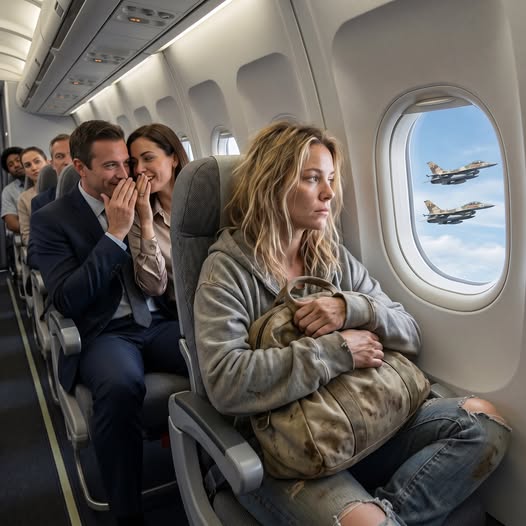
A man across the aisle glanced at the woman in seat 22C and smirked at his coworker. “Rough night?” he whispered, nodding toward her oversized gray hoodie and worn canvas tote bag resting beneath her knees. The coworker laughed immediately. Someone behind them joined in. Within minutes, the woman had become the morning’s unspoken entertainment for half the cabin.
She looked exhausted.
That was the easiest thing to notice about her.
Not dramatic exhaustion. Not the glamorous kind celebrities wear in airport photographs while still somehow looking perfect. Real exhaustion. The kind that settles into a person’s posture after too many sleepless nights and too many years spent carrying invisible weight. Her sneakers were scuffed. Her hair was pulled back carelessly beneath a faded baseball cap. She stared mostly out the window, hands folded calmly in her lap, saying almost nothing.
And for some reason, that silence encouraged people.
A young influencer seated nearby discreetly angled her phone camera toward 22C while pretending to record herself. Two consultants in pressed suits made jokes about “economy class special forces.” Another passenger muttered something about airlines “letting anyone fly these days.”
Each comment fed the next.
That is how public humiliation often works—not through one act of cruelty, but through permission. Someone mocks first. Others join because group laughter feels safer than individual conscience. Soon a stranger stops being human and becomes material. A temporary character created for collective amusement.
Seat 22C endured all of it quietly.
A flight attendant eventually approached her with the forced politeness reserved for passengers crew members suspect may become problems later. But the woman only thanked her softly for the coffee refill and returned to staring out the window.
The influencer posted a short clip before the plane even crossed state lines.
“POV: your flight has a homeless Jason Bourne onboard.”
Within an hour the video gathered thousands of views.
People online dissected her appearance instantly.
Speculating.
Mocking.
Inventing entire lives from a hoodie and tired eyes.
Nobody asked her name.
At 34,000 feet, the aircraft suddenly jolted hard enough to silence the cabin.
A violent shudder rippled through the frame, sending drinks sloshing onto tray tables. Nervous laughter broke out at first, followed by uneasy glances as the plane tilted unexpectedly. Then came another vibration—stronger this time, deep enough to feel through the floor beneath their feet.
The captain’s voice arrived strained over the speakers.
“Ladies and gentlemen, please remain seated while we navigate a temporary airspace situation.”
People looked around immediately.
Phones lowered.
Conversations stopped.
Then someone near the windows gasped.
Two gray fighter jets had appeared beside the aircraft.
They moved with terrifying precision, impossibly close against the morning sky. One positioned itself near the left wing while the other held slightly ahead on the right. The entire cabin shifted instantly from irritation to fear.
Passengers began filming again, but now with trembling hands.
Questions spread rapidly.
Was there a threat onboard?
A hijacking?
A military emergency?
The flight attendants looked pale.
One hurried toward the cockpit while another attempted calming explanations she clearly did not fully believe herself.
Through it all, the woman in seat 22C remained strangely calm.
Not unconcerned.
Familiar.
That was the unsettling part.
While everyone else pressed toward windows or whispered anxiously into phones, she simply unclipped her seatbelt and stood. Several passengers stared immediately, offended by the apparent audacity.
“Ma’am, you need to sit down,” a flight attendant snapped.
The woman nodded politely.
Then she walked directly toward the galley phone.
There was something about the way she moved that changed the atmosphere before anyone even understood why. Not arrogance. Not panic. Habit. Precision. Like someone stepping automatically into a role their body remembered long before their mind caught up.
The nearest attendant tried to stop her again.
But then the woman calmly reached for the receiver and spoke a sentence that seemed to split reality in half.
“This is Night Viper Two-Two requesting confirmation.”
The response crackled instantly through the partially open channel.
“Night Viper Two-Two, this is Falcon Escort Lead. Welcome home, ma’am.”
Silence swallowed the cabin.
Absolute silence.
Then one of the fighter jets outside dipped its wing in a formal salute.
A second later, another voice entered the transmission—older, emotional, unmistakably military.
“Captain Mercer, the president asked us to make sure you made it safely.”
Every person near the galley stared at her like the floor had disappeared beneath them.
The woman they had mocked for two hours slowly lowered the receiver.
And suddenly the internet clip, the whispers, the laughter, the smirks—all of it became unbearable to witness in retrospect.
Because seat 22C was not occupied by some unstable drifter or socially invisible nobody.
It was occupied by Captain Olivia Mercer.
The pilot officially presumed dead five years earlier after the catastrophic failure aboard a presidential support aircraft over the Atlantic. The woman whose emergency maneuvering reportedly saved dozens of lives—including senior government officials—before her aircraft vanished during the storm. The woman whose body was never recovered. The woman quietly rescued after days at sea and subsequently buried beneath layers of classified military silence during recovery operations and national security investigations.
Most Americans knew the story.
Almost nobody recognized her face.
Especially not dressed in an old hoodie, traveling alone on a commercial flight like someone trying desperately not to be noticed.
The fighter escort, it turned out, had been arranged privately after intelligence systems flagged her route home following the formal closure of her final debriefing. A symbolic gesture from people who considered her a national hero.
But none of that hit the passengers as hard as what came next.
Because Captain Mercer did not yell.
Did not humiliate anyone publicly.
Did not demand apologies.
She simply returned quietly to seat 22C while the cabin watched in stunned shame. The same people who mocked her now avoided eye contact entirely. The influencer deleted her video before landing. One businessman attempted an awkward apology midway through the flight but lost confidence halfway through the sentence.
Olivia listened politely.
Then answered with words that would later circle the entire country after another passenger repeated them online.
“I don’t owe strangers a résumé before they decide to behave.”
No anger.
No speech.
Just truth delivered calmly enough to hurt.
By the time the plane landed, news organizations were already piecing together the story. Airport footage spread online within hours. Analysts replayed the fighter escort. Veterans identified the call sign immediately. The internet transformed overnight from ridicule into admiration so intense it bordered on guilt.
But the most powerful part of the story was not the military escort.
Not the classified history.
Not even the revelation itself.
It was the uncomfortable recognition underneath all of it.
People had not been cruel because they knew who Olivia Mercer was.
They had been cruel because they believed she was nobody important.
And that realization lingered.
Because suddenly the story became larger than one woman on one flight. It exposed how quickly ordinary people reduce strangers into assumptions based on appearance, exhaustion, clothing, age, silence, or perceived status. How eagerly groups turn vulnerability into entertainment once they decide someone lacks the power to defend themselves.
Captain Mercer eventually released a short statement asking for privacy.
No interviews.
No book deals.
No television appearances.
She returned quietly to her small hometown, her porch overlooking a lake, her diner coffee served every morning by people who already knew her long before the internet rediscovered her.
Meanwhile the passengers from Flight 728 returned to their own lives carrying something less visible.
Embarrassment.
Not the shallow embarrassment of being publicly wrong, but the deeper kind—the kind that forces people to reexamine the reflexes they once considered harmless.
And in small ways, something shifted afterward.
On flights, in grocery lines, in waiting rooms, people hesitated a little longer before mocking strangers. Some offered help faster. Some spoke softer. Some remembered the woman in seat 22C before turning another tired person into a joke.
Not because every quiet stranger is secretly a decorated hero.
But because basic decency should never depend on finding out they are.