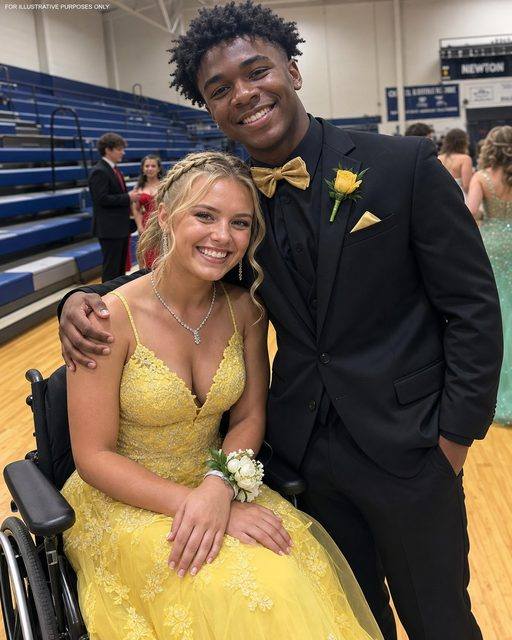
The knock on our front door the morning after prom sounded ordinary at first. Just three sharp raps against wood before sunrise, the kind that usually means a package delivery or a neighbor needing help. But something about it pulled me awake instantly. Maybe it was the hour. Maybe it was the strange heaviness already sitting in my chest before I even opened my eyes. By the time my grandmother shuffled toward the hallway, wrapping her robe tighter around herself, I was already sitting upright in bed with the uneasy feeling that life was about to divide itself into before and after once again.
I had no idea how right that feeling was.
Just twelve hours earlier, I had been standing beneath strings of cheap lights in a school gymnasium pretending, for the first time in years, that I was still a normal teenager. Prom had felt impossible to me for a long time. Not because of the dress or the crowds or the music, but because grief changes the shape of ordinary things. It turns milestones into reminders. Every celebration quietly asks who is missing.
My parents had been gone for years by then, killed in the car accident everyone in town still spoke about in lowered voices. I survived. They didn’t. That single fact became the center of my entire identity before I was old enough to understand what survivor’s guilt even meant.
People treated me carefully afterward.
Teachers softened their voices around me.
Friends hesitated before mentioning family vacations or birthdays.
Adults looked at me with that expression I came to hate most—the mixture of pity and relief people wear when tragedy happens to someone else instead of them.
Over time, I learned how to function again. At least publicly. I smiled when expected. Went to school. Answered questions. Learned how to carry grief in ways that made other people comfortable. But inside, part of me still felt frozen on that highway beside twisted metal and smoke, trapped in a moment I couldn’t even fully remember.
So when I almost skipped prom, nobody would have blamed me.
But my grandmother insisted gently.
“You deserve one normal night,” she said while helping pin my hair back.
I didn’t believe her then.
Yet somehow, against all expectation, that night became exactly that.
And the reason was a boy named Daniel.
He wasn’t the loud type. Not the center-of-attention kind of guy movies usually turn into romantic heroes. He was quiet, calm, almost awkward in a way that made him feel safe immediately. We had spoken before in passing at school, but never much more than that. Still, when he walked over to me near the refreshment table and asked me to dance, there was something steady in his expression that made it impossible to say no.
At first I worried everyone was staring.
The wheelchair always made me hyperaware of space, of movement, of inconvenience. Even years after the accident, I still sometimes felt like I entered rooms as a disruption rather than a person. But Daniel never treated me that way. He didn’t pity me. Didn’t overcompensate. Didn’t act inspirationally kind in the performative way some people do when they want credit for basic decency.
He simply saw me.
That was what made it unforgettable.
On the dance floor, under dim lights and terrible pop music, he laughed easily and talked to me like I was ordinary. Not broken. Not tragic. Just a girl at prom trying to enjoy herself. And somewhere during those songs, something inside me loosened for the first time in years. I realized how exhausted I was from carrying the invisible weight of everyone’s expectations about who I had become after the accident.
Daniel gave me a few hours where none of that existed.
For the first time since losing my parents, I felt light.
Alive.
Wanted.
When he rolled me beneath the spinning lights, smiling like neither of us needed to be afraid of anything for one night, I almost forgot grief entirely. Not erased—just quieter. Manageable. Like maybe my life could eventually become bigger than the worst thing that had ever happened to me.
That feeling followed me home.
I fell asleep replaying little moments from the evening: his terrible dancing, the way he pretended not to notice when I got nervous, the warmth in his voice when he called me beautiful so casually it sounded like a fact instead of reassurance.
Then came the knock at the door.
Two police officers stood outside beneath the gray morning sky.
My stomach dropped instantly.
For one horrifying second, I thought something had happened to my grandmother. But then one of the officers asked a different question.
“Do you know a boy named Daniel Mercer?”
Everything after that felt unreal.
The officers explained that Daniel had been connected to the crash that killed my parents years earlier. Not as a suspect. Not as someone responsible. But as a witness. A survivor. Someone who had never spoken publicly about what happened that night.
I remember gripping the doorframe so hard my hands hurt.
They told me Daniel had been there before emergency responders arrived. His family had been driving behind us when the accident happened. Flames spread quickly after the collision. Adults panicked. People screamed. Nobody knew whether the car would explode.
Except Daniel moved.
At fourteen years old, while grown adults hesitated, he crawled toward the wreckage.
Toward fire.
Toward shattered glass.
Toward death.
And somehow, impossibly, he found me unconscious in the back seat.
The officers said witnesses still talked about it years later. How he ignored people shouting at him to stop. How he burned his hands trying to free my seatbelt. How he dragged me across the pavement seconds before flames swallowed the inside of the car completely.
Then came the part that shattered me most:
He never told me.
Not once.
Not during our conversations at school.
Not at prom.
Not while holding my hand on the dance floor.
He carried that secret quietly for years.
I couldn’t breathe properly after the officers left.
My grandmother cried openly in the kitchen while I sat frozen, trying to force my mind around a reality that suddenly looked completely different. My parents’ deaths had always felt like a closed story in my head: tragedy, loss, survival, aftermath. But now another truth existed beneath it. Someone had stepped into hell for me. Someone had chosen my life over his own safety long before I ever knew his name.
And somehow that someone had become the boy who made me laugh at prom.
Later that afternoon, I found Daniel waiting near the edge of town beside the old road where the accident happened. The same road I had spent years avoiding. He looked terrified when he saw me, like he expected anger instead of understanding.
“I didn’t want you to know me because of that,” he admitted quietly.
The wind moved through the trees while cars hissed past in the distance. For a long moment neither of us spoke.
Then he finally told me everything.
How he had nightmares afterward.
How he kept checking newspapers hoping I survived.
How seeing me at school years later felt unreal.
How he almost introduced himself a hundred different times but never knew whether reopening the past would hurt me more than help me.
And suddenly I understood why he looked at me the way he did on the dance floor.
It wasn’t pity.
It wasn’t guilt.
It was relief.
Relief that I was alive.
Standing there beside the road where my entire life changed, I realized something else too: the story I told myself for years had been incomplete. I thought my life was defined by fire, by loss, by the brutal randomness of survival. But survival is never entirely random. Sometimes it is built from invisible acts of courage people carry silently long after everyone stops noticing.
Daniel had stepped into flames for me once.
Then years later, without even realizing it, he stepped into them again—pulling me slowly out of grief, isolation, and the belief that I would forever be defined only by tragedy.
And for the first time since the accident, I understood something my younger self never could:
My story did not end in that burning car.
It continued in every person who refused to let me disappear afterward.