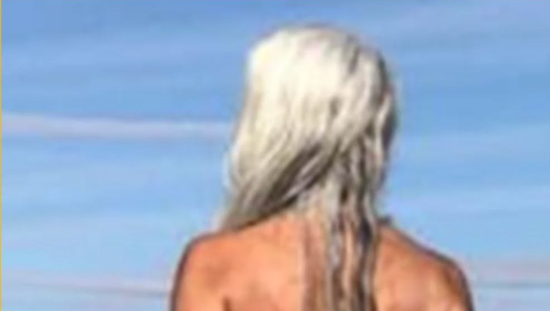
Yazemeenah Rossi was never supposed to fit the fashion industry’s idea of beauty.
According to the rules that dominated modeling for decades, she arrived too late, aged too visibly, and refused too completely to hide the passage of time. By the standards many women are taught to fear, she should have disappeared quietly from visibility long ago.
Instead, at 70, she continues turning heads across the world.
Not by pretending to be younger.
Not by erasing every wrinkle.
Not by apologizing for silver hair or aging skin.
But by standing fully inside herself without asking permission.
That is what makes her presence feel so striking.
Her story began far from glamour. As a newborn, she reportedly entered the world so fragile she had to survive inside an oxygen tent, a sick child many doubted would live at all. Those earliest years unfolded in a life rooted much closer to nature than modern luxury—without electricity, without running water, washing in rivers and learning early how to exist with simplicity rather than excess.
At the time, none of it looked like preparation for fashion.
Yet in hindsight, those experiences shaped almost everything that later made her different.
Because while the beauty industry became increasingly obsessed with surface perfection, youth preservation, and artificial transformation, Yazemeenah Rossi built her identity around something deeper and harder to manufacture:
connection to nature,
independence,
physical vitality,
and refusal to separate beauty from real living.
When she entered modeling at 28, she already violated nearly every expectation the industry held. Most models begin as teenagers. She arrived as an adult woman, already a mother of two, already carrying visible strands of gray hair. Agencies and advertisers often treated aging as something women needed to conceal immediately, especially in visual industries built around fantasy.
But she refused to disappear.
And somehow, decade after decade, she kept working.
That persistence matters because aging women are often taught visibility itself is conditional. Remain youthful enough, smooth enough, desirable enough—and society may continue rewarding your presence. But once visible aging appears, many women feel pressured to either fight it aggressively or retreat quietly from public attention altogether.
Yazemeenah Rossi chose neither.
She allowed herself to age openly.
Not passively, not carelessly, but honestly.
While many public figures became trapped inside endless cycles of cosmetic reinvention trying to outrun time itself, she embraced routines grounded in care rather than erasure. Oils instead of extreme procedures. Simple foods instead of obsessive restriction. Yoga, movement, desert hikes, sunlight, and physical connection to the natural world rather than punishing attempts to freeze herself artificially in one permanent decade.
That distinction is important.
Her appearance is not built around pretending age does not exist.
It is built around living inside age fully without shame.
And that mindset quietly disrupts an industry—and culture—that profits enormously from convincing women their value decreases the more visibly human they become over time.
Now living in the high desert of California, a grandmother of two, she speaks about aging with a perspective that feels almost radical in modern beauty culture. She does not describe growing older as tragic decline. Instead, she often frames it as expansion: more freedom, more clarity, more intensity, more comfort inside herself.
That emotional confidence may be what people respond to most strongly.
Because true self-acceptance carries a kind of presence cosmetic perfection alone cannot replicate. There is something magnetic about someone no longer negotiating constantly with their own reflection.
Especially in a world obsessed with correction.
Yazemeenah Rossi’s appeal ultimately goes far beyond appearance itself. She represents something many people quietly hunger for:
proof that aging does not have to mean emotional disappearance.
That a woman can still be sensual, creative, visible, powerful, and alive long after society expects her to shrink quietly into the background.
And perhaps most importantly, she refuses to frame herself as “beautiful despite aging.”
That language matters.
Because it suggests age itself is the flaw needing forgiveness.
Instead, she embodies another possibility entirely:
that aging can deepen beauty rather than erase it.
Not because wrinkles are magically glamorous or because growing older is painless. Aging carries loss too—physical changes, grief, time moving faster than expected. But there is also another side rarely celebrated loudly enough:
wisdom without apology,
freedom from performance,
comfort inside authenticity,
and the fierce calm that comes from surviving long enough to stop seeking permission to exist fully.
That is the real secret people keep trying to locate in her face.
Not one product.
Not one treatment.
Not one impossible anti-aging trick.
But a life lived in alignment with herself strongly enough that time became something she carries visibly rather than something she spends her existence trying to hide.
And perhaps that is why she continues captivating people decades after the industry insisted she should have disappeared.
Because while fashion spent years worshipping youth, Yazemeenah Rossi quietly proved something much more powerful:
There is nothing more striking than a woman fully unafraid of becoming herself at every age.