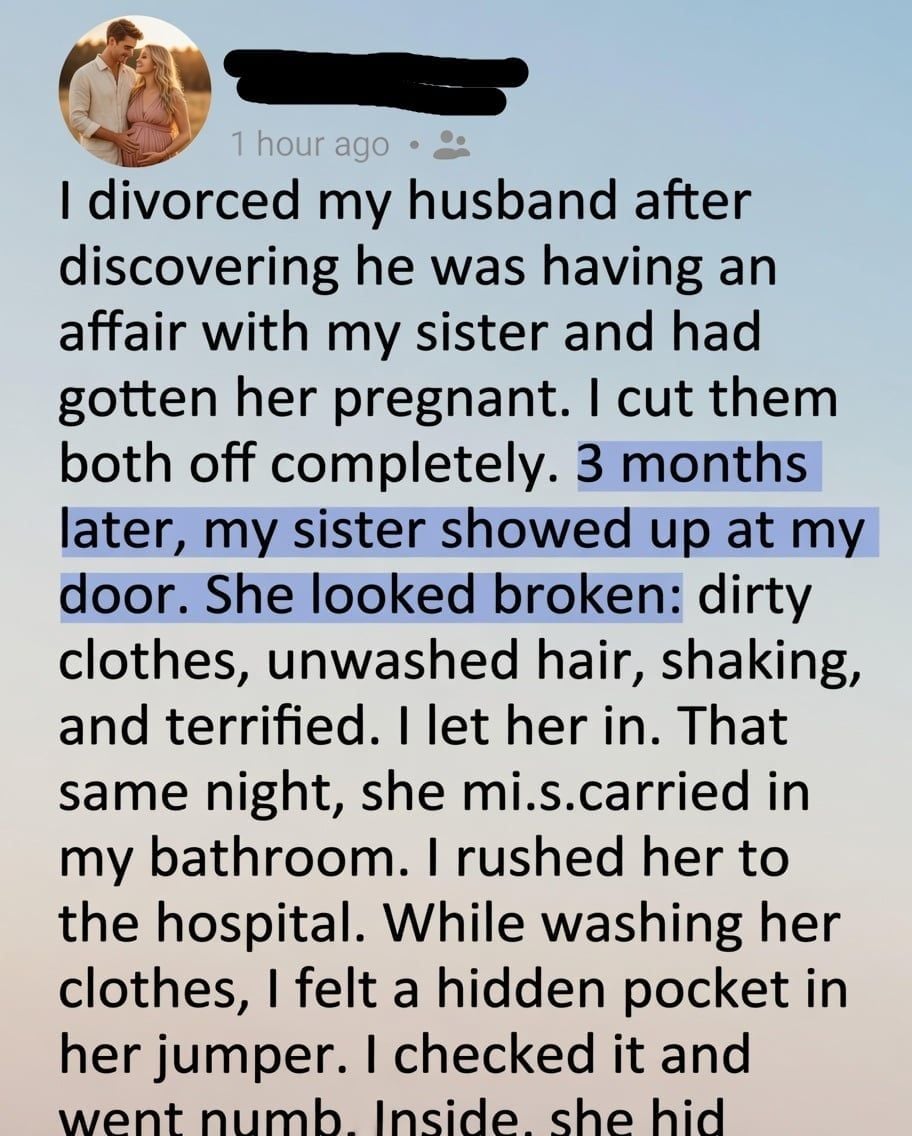
The night I opened the door and saw my sister standing there, I wanted to hate her.
For months, maybe years, I had rehearsed that moment in my mind. I imagined myself cold, untouchable, finally strong enough to slam the door in her face the way she had once shattered my trust without hesitation. In every version of the story I told myself, I was the wounded one and she was the villain. Clear. Simple. Final.
Then I saw her.
She wasn’t standing proudly or defensively. She collapsed the moment I reached the doorway, shaking so hard she could barely breathe. Blood stained her sleeve. Her voice broke apart trying to say my name. Whatever anger I had prepared dissolved instantly beneath something much more frightening:
She looked destroyed.
Not guilty.
Not manipulative.
Broken.
I remember kneeling beside her while my mind desperately tried to hold onto the version of reality I had survived with for so long. Because hatred can become strangely comforting after betrayal. It simplifies pain. It gives grief a target. As long as I could make her entirely responsible for what happened between us, I never had to examine the deeper wreckage left behind by him.
At the hospital, everything changed.
The bracelet lay loosely around her wrist while she slept beneath harsh fluorescent light. I only noticed it because her hand shifted against the blanket.
My name.
Then the baby’s name underneath it.
For a second, I genuinely could not breathe.
Every certainty I had built my survival around split open in that instant. All the stories I had repeated to myself—about betrayal, loyalty, innocence, blame—suddenly became far more complicated than rage had ever allowed me to admit.
Because how do you keep condemning someone once you realize they are shattered by the same person who shattered you?
How do you continue protecting anger when the only other person who fully understands your pain is the one you spent years trying to erase from your life?
That realization felt unbearable.
I once believed survival meant cutting her out completely. Pretending she existed only as the sister who betrayed me, never again as the girl who grew up beside me, shared secrets with me, protected me when we were children, laughed with me before life became so complicated and cruel.
But grief strips people down eventually.
It removes performance.
It removes certainty.
It leaves behind only what remains true when everything comfortable has collapsed.
And standing beside her hospital bed, watching her sleep with swollen eyes and empty arms, I finally understood something I had avoided for far too long:
He had not only cheated.
He had divided us.
He turned us into enemies while keeping himself untouched at the center of the destruction. As long as my sister and I focused our pain on each other, neither of us fully confronted how thoroughly he manipulated, isolated, and abandoned us both.
That understanding did not magically erase what happened.
Pain doesn’t disappear just because context becomes clearer. Betrayal still existed. Trust still lay in ruins between us. There were still memories sharp enough to reopen wounds instantly. Some nights I still replay old moments wondering how either of us became strangers capable of hurting each other that deeply.
But hatred no longer fit cleanly anymore.
And strangely, losing hatred felt almost as frightening as losing love once had.
Because anger gives structure to grief. Without it, you are left standing inside something much messier: compassion mixed with hurt, loyalty tangled with resentment, love surviving where you wished only indifference remained.
Taking her home afterward was not forgiveness wrapped neatly in understanding.
It was simply choosing complexity over emotional simplicity.
Some days remain difficult even now. The silence between us can still feel fragile, crowded with things too painful to fully say aloud. There are conversations we start and cannot finish. Memories that still make one of us leave the room suddenly. Healing is not linear when betrayal once lived inside the same house as love.
But healing has started appearing quietly anyway.
In small rituals.
Morning coffee shared without forcing conversation.
Her steadying my hand when memories hit unexpectedly.
Laughter returning suddenly in brief moments that surprise us both because we forgot we were still capable of it together.
Those tiny moments matter more than dramatic apologies ever could.
Because rebuilding trust after devastation is not accomplished through one emotional breakthrough. It happens through repetition. Through showing up gently enough times that fear slowly loosens its grip.
What I understand now is something grief forced me to learn painfully:
People are rarely only the worst thing they have done to us.
My sister hurt me deeply. That truth remains real. But she was also hurt, manipulated, abandoned, and left carrying unbearable grief of her own. Holding both truths at once feels emotionally exhausting sometimes.
Yet it also feels honest.
And honesty, I’ve learned, heals more slowly than hatred—but far more completely.
We are not the sisters we once were before everything broke apart.
That version of us is gone.
But in its place, we are building something new from the ruins:
imperfect,
scarred,
fragile sometimes,
yet finally real enough to survive without pretending anymore.