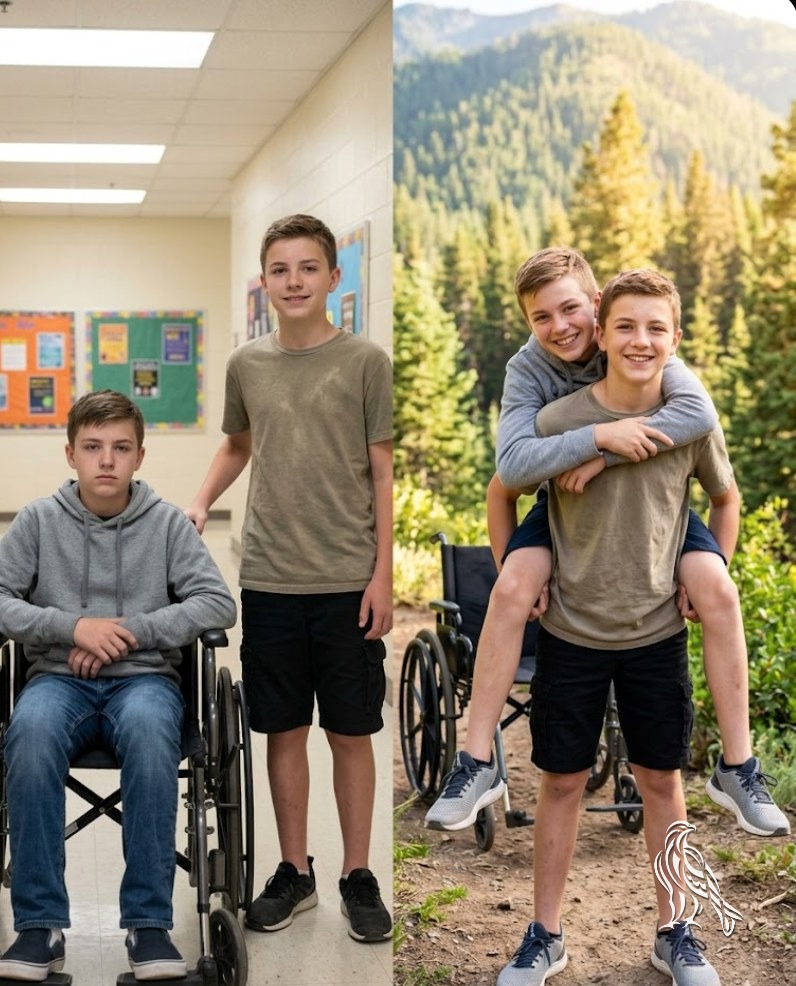
My son stumbled through the front door covered in mud, his shoulders trembling so hard it looked painful to stand upright.
For one terrifying second, I thought he had been hurt.
Then I saw his face.
Not defiant.
Not angry.
Destroyed.
His eyes looked hollow with exhaustion, the kind that comes from carrying something emotionally far too heavy for a child. Dirt streaked across his clothes and arms, and his breathing still came unevenly, like he had spent hours pushing himself past the point of collapse.
I asked him what happened.
He wouldn’t answer.
That silence frightened me more than anything he could have confessed.
All night my mind spiraled through possibilities. Fights. Police. Drugs. Theft. Some irreversible mistake that would follow him forever. Grief had already been eating pieces of my son away ever since his best friend Sam lost his father, Mark, the previous year. Leo had changed after that funeral. Quieter. Older somehow. As though childhood itself no longer fit him properly.
So when the school called the next morning demanding I come immediately because military officers were present, panic settled deep into my chest.
By the time I reached the office, I was prepared for disaster.
I expected suspension papers, angry lectures about reckless behavior, maybe even police involvement. I walked into that building ready to defend my son before I even knew what he’d done.
Instead, I walked into silence.
The room was crowded with uniformed soldiers standing stiffly near the walls. Leo sat in a chair near the principal’s desk, his head lowered, fingers gripping the edge of the seat so tightly his knuckles had gone pale. He looked terrified.
Still convinced he was in trouble.
The moment I entered, several of the soldiers turned toward him—not with anger, but with something far heavier.
Respect.
One by one, those men stood at attention for my son.
The room suddenly felt impossibly small, crowded with uniforms, grief, memory, and the invisible weight of everything Leo had apparently carried alone the day before. He looked confused, almost panicked, as though he couldn’t understand why hardened military men were saluting him.
Then one of them spoke.
The officer explained that Sam had confessed everything after finally breaking down that morning. The boys had hiked deep into the mountains carrying something hidden carefully inside Leo’s backpack: Mark’s ashes.
Sam had been falling apart privately for months. Since his father’s death, he’d become consumed by one thought he could not let go of—that Mark never got the farewell he deserved. Before deployment years earlier, Mark had apparently promised his son that one day they would hike together to a mountain overlook he loved most.
They never got the chance.
So Leo decided they would finish it for him.
The boys hiked for hours through mud, rain, and steep terrain carrying the ashes themselves because Sam wanted his father to rest where he always dreamed of taking him. Somewhere above the trees. Somewhere beautiful.
When weather turned dangerous and darkness started closing in, Leo physically carried Sam part of the way back after exhaustion and grief overwhelmed him. By the time they reached town again, Leo could barely stand.
And somehow, he still thought he deserved punishment.
The officer placed something carefully into Leo’s trembling hands.
A military patch that had belonged to Mark.
Then another soldier spoke quietly about duty, loyalty, and sacrifice—not in war this time, but in friendship. He explained that courage is not always loud or grown-up. Sometimes courage looks like a grieving boy refusing to let another grieving boy carry unbearable pain alone.
Leo immediately shook his head through tears.
“I’m not heroic,” he whispered. “I just did what any real friend would do.”
That sentence broke something open in the room.
Because children often understand love more honestly than adults do. They haven’t fully learned yet how to calculate compassion, how to protect themselves emotionally by stepping back from another person’s suffering.
Leo simply saw his friend drowning in grief and decided to climb into the storm beside him.
Then Sam spoke.
For the first time since entering the office, his face brightened slightly as he described the summit—the mountain air, the endless view stretching beyond the trees, the moment they scattered Mark’s ashes into the wind. He talked about how it finally felt like his father had made it home.
And while he spoke, I watched my son carefully.
Something inside him was changing.
Not because of the soldiers.
Not because of the scholarship they later announced in Mark’s honor.
Not because of the patch or the salute or the praise filling that room.
Those things mattered, but they were symbols.
What truly transformed Leo was the realization that his love had carried another human being through unimaginable pain successfully. That loyalty was not small. That compassion could become strong enough to physically move people through grief when they no longer had the strength to walk alone.
Children are rarely told that kind of truth directly.
But sitting there surrounded by soldiers honoring him not for strength or achievement, but for kindness, my son finally understood something many adults spend lifetimes missing:
Love is not weakness.
Sometimes it is the strongest force a human being can carry.
That night, after everything settled quiet again, I passed Leo’s room and saw the military patch resting carefully beside his bed. He sat staring at it silently, still trying to process what had happened.
And for the first time in months, he didn’t look hollow anymore.
He looked tired.
Still grieving.
Still young.
But no longer lost.
Because somewhere on that mountain, carrying his friend through mud and heartbreak beneath the weight of another man’s ashes, my son had unknowingly carried himself back toward something too:
The understanding that even a child’s love can be powerful enough to help another soul reach the summit.