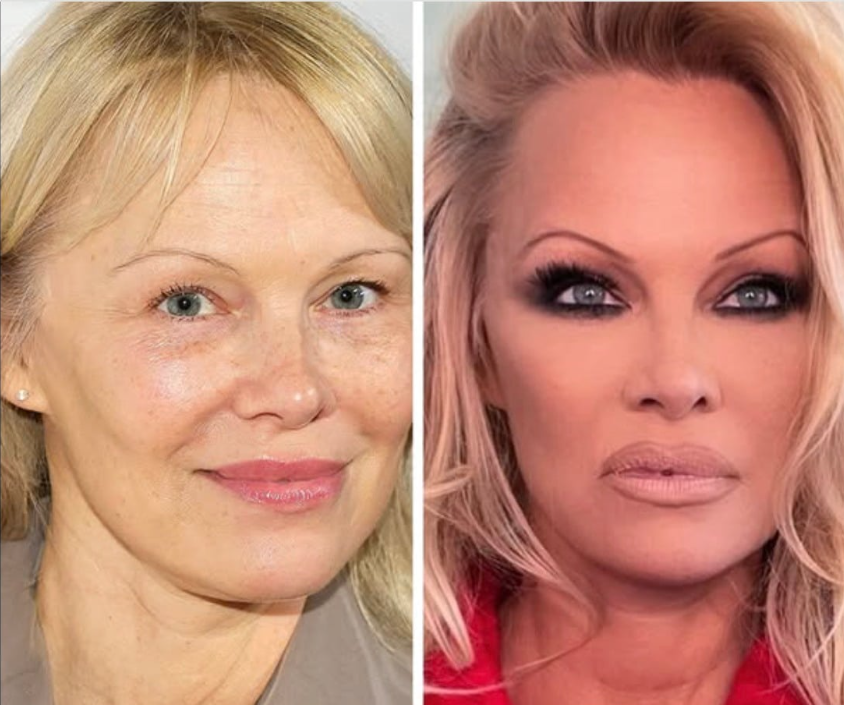
Pamela Anderson just reminded the world that reinvention can be as simple as a mirror, a makeup brush, and a decision.
One new photo was all it took.
After years of becoming known for her stripped-down, makeup-free appearances, Pamela suddenly reappeared in full glamorous 90s bombshell style: dramatic eyeliner, smoky eyes, heavy lashes, glowing skin, and the kind of voluminous blonde hair instantly associated with the era that made her one of the most recognizable women in the world.
And the internet froze for a moment trying to process it.
Fans reacted almost immediately, splitting into emotional camps. Some celebrated the return of the iconic glam look that defined an entire generation of pop culture. Others questioned why she would step away from the natural, makeup-free image she had embraced so publicly in recent years. Rumors spread quickly, speculation exploded, and people once again started trying to decode what Pamela Anderson’s face was supposedly “saying” about her identity.
But perhaps that reaction reveals more about the public than it does about her.
Because Pamela’s transformation is not really about makeup.
It is about freedom.
For years, the world treated her appearance almost like public property. During the height of the 1990s, her image became one of the most consumed celebrity aesthetics on the planet. The blonde hair, dramatic makeup, and hyper-glamorous style turned into cultural shorthand for an entire era. People projected fantasies, assumptions, criticism, and desire onto her constantly.
Then, years later, something shifted.
Pamela began appearing publicly without makeup at all. No dramatic contouring. No heavy eyeliner. No attempt to recreate the old bombshell image people expected from her. Instead, she stepped into red carpets and interviews with a bare face and quiet confidence that surprised many people more than any glamorous transformation ever had.
That decision carried enormous symbolic weight.
In an industry built around preserving illusion at all costs, especially for women aging under public scrutiny, Pamela choosing simplicity felt almost rebellious. She openly discussed exhaustion with beauty expectations and the emotional relief that came from no longer performing glamour every single moment she existed in public.
Many people interpreted the makeup-free era as a rejection of the “old Pamela.”
But now, this new glam appearance complicates that narrative beautifully.
Because her return to full 90s-inspired makeup does not feel like surrender or regression. It feels like reclamation. The difference is subtle but powerful. Years ago, the glamorous bombshell image often felt like something demanded from her by the culture surrounding her. Now it feels chosen entirely on her own terms.
That changes everything.
She is no longer trapped inside one version of herself.
She can be the woman walking barefaced through interviews discussing activism, aging, and personal healing. She can also be the glamorous icon stepping into smoky eyes and blonde volume without apology. The power lies in the fact that neither version appears forced anymore.
And that freedom unsettles people more than they realize.
Because celebrity culture often prefers women to remain emotionally consistent symbols rather than complicated human beings. Once the public embraces a certain “authentic” version of someone, they begin resisting anything that disrupts that narrative. Pamela without makeup became symbolic to many people—natural, liberated, rejecting Hollywood standards.
So when she suddenly embraced glam again, some fans reacted almost as though she had betrayed an expectation they placed onto her.
But Pamela Anderson has spent decades surviving projection.
People projected fantasies onto her beauty.
Projected assumptions onto her intelligence.
Projected judgment onto her relationships and body.
Now, perhaps for the first time, she appears entirely uninterested in organizing herself around anyone else’s expectations at all.
That may be the real transformation people are sensing.
Not the eyeliner.
Not the hair.
Not the nostalgic 90s aesthetic.
But the emotional shift underneath it.
There is something strikingly confident about someone moving freely between identities without needing to explain or justify them. Pamela no longer seems interested in proving she is “naturally beautiful” or “still glamorous” or “different now.” She simply appears to be existing comfortably inside all versions of herself simultaneously.
And that complexity feels surprisingly radical in a culture obsessed with forcing women into fixed categories.
Barefaced or glamorous.
Aging naturally or performing beauty.
Serious or sensual.
Soft or iconic.
Pamela’s latest appearance quietly rejects the idea that she must choose only one.
In the end, the internet may keep debating the makeup, analyzing the photos, and projecting meaning onto every eyeliner stroke. But beneath all the reactions, Pamela Anderson keeps sending the same unmistakable message:
She no longer belongs to the image the world created for her.
Whether she wears mascara or not, the real power now comes from one simple fact:
Every version of her is finally her own choice.