He stumbled through the front door covered in mud, breathing hard, his eyes carrying a look I had never seen before.
Not guilt exactly.
Not fear.
Something heavier.
The kind of hollow exhaustion that makes a parent instantly understand something serious has happened before a single word is spoken. My stomach tightened the second I saw him standing there. Dirt streaked across his jeans and arms. His shoes were soaked. He wouldn’t fully meet my eyes.
I asked him where he had been.
He only muttered, “I’m tired,” before disappearing into his room.
That silence terrified me more than shouting would have.
All night my mind spiraled through possibilities. Twelve-year-old boys do reckless things sometimes, but there was something different about the way Leo moved through the house that evening—quiet, withdrawn, almost older somehow. I barely slept, replaying every worst-case scenario I could imagine.
Then the phone rang the next morning.
The principal’s voice sounded strained and unusually formal. She told me I needed to come to the school immediately. Right now. No explanation over the phone. Just urgency.
And then she added the sentence that made my blood run cold:
“There are officers here.”
By the time I hung up, my hands were shaking.
The drive to the school felt endless even though it only took minutes. My brain clawed desperately through nightmare after nightmare. Had Leo hurt someone? Was he arrested? Had he vandalized something? Stolen something? Was this the moment that permanently changed his future before he was even old enough to understand consequences fully?
Every terrifying possibility felt real.
When I pulled into the parking lot and saw uniformed men standing outside the building, panic settled deep into my chest. I walked toward the office preparing myself to defend my son before I even knew what he had done. I was ready to beg for leniency, to apologize, to fight for him if necessary.
Instead, I walked into something I never could have imagined.
The room fell quiet when I entered.
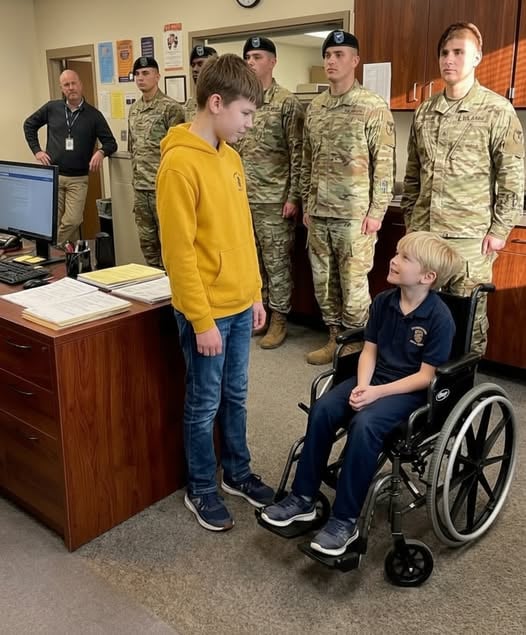
Leo sat stiffly in a chair looking pale and deeply confused, as though he still believed he was about to be punished. Around him stood five men in military uniforms. Not police officers. Soldiers.
Battle-worn men with faces carved by grief, exhaustion, and years of carrying things most civilians never see.
And then something happened that shattered every fear I carried into that room.
One by one, those men stood at attention for my twelve-year-old son.
The movement was so sharp, so immediate, that the room itself seemed to change. Leo looked startled. I know I did. No one spoke for a second.
Then one of the men stepped forward holding something carefully in his hand.
A patch.
Worn but preserved.
He spoke my late husband’s name softly, almost reverently, and suddenly I understood this had something to do with Leo’s father—the man we had buried years earlier after he never came home from deployment.
The soldier explained that Leo had spent the previous evening helping a homeless veteran he found near the edge of town. The man had apparently been disoriented, intoxicated, and stranded in the rain near a drainage ditch. While other people walked past or avoided him, Leo stayed.
For hours.
He gave the man his jacket. Helped him walk. Sat with him in the mud until emergency services arrived. And when responders recognized the veteran’s unit insignia and name, word eventually reached these men—the surviving members of my husband’s old military unit.
The patch they placed over Leo’s heart that morning had belonged to his father.
Not as punishment.
As recognition.
The soldier told Leo quietly, “Your dad would know exactly why you stopped.”
And suddenly everything inside me cracked open.
All the anger from the night before disappeared. All the fear, suspicion, and imagined accusations collapsed under the weight of what my son had actually done. I had spent hours terrified he had destroyed his future when, in reality, he had revealed the kind of person he was becoming.
Not reckless.
Not broken.
Compassionate.
The soldiers spoke to him not like a child who caused trouble, but like someone who instinctively understood loyalty and human dignity in a way many adults forget. They told stories about his father I had never heard before—small moments of kindness during deployment, times he refused to leave struggling people behind.
And while they spoke, I realized something quietly overwhelming:
Leo was not trying to imitate his father.
He was simply carrying forward the same instinct to stop when someone else was hurting.
That night, after the house finally became quiet again, I passed Leo’s room and saw the patch resting carefully on his desk beneath the fading orange light of sunset. He sat staring at it silently, still trying to process why grown men hardened by war had nearly cried because of something he thought was ordinary.
But it wasn’t ordinary.
The world teaches people constantly to look away from suffering. To keep moving. To protect themselves emotionally by pretending not to notice pain that doesn’t belong to them.
Leo noticed.
And he stopped.
As I stood there watching him, something shifted inside me too. Since losing my husband, part of me had quietly feared the future all the time—feared raising a boy alone, feared whether grief had damaged us both in ways we couldn’t fully see.
But in that moment, watching my son sit beside the patch his father once wore, I felt something I hadn’t felt in years.
Not certainty.
Not perfection.
Just hope.
Gentle, stubborn hope that maybe goodness survives longer than loss does.
And for the first time since my husband died, the future no longer looked like something waiting to break us.
It looked possible.