That afternoon, the silent desperation taking place in the bread aisle stood in stark contrast to the fluorescent lights of the grocery store, which hummed with a clinical indifference. I was going about my daily business, mentally figuring up how little money was in my checking account, when I noticed him. He was an old man standing with a heavy immobility, his body slightly hunched beneath a tattered coat. From a distance, I observed his hand shaking as he slipped one loaf of bread into his pocket. It was the desperate, awkward gesture of a man who had reached the end of his rope, not the perfected move of an experienced thief.
The space between us appeared to freeze as I got closer to him. He made no attempt to flee or provide a complex justification. Rather, his whole body slumped, and he started apologizing in a voice that broke from the weight of a thousand humiliations. He informed me that his pension had disappeared a few days prior, forcing him to choose between his hunger and his dignity. I saw my own grandfather when I looked at him, not a criminal. In the shadows of a grocery store aisle, I saw a guy who had dedicated his life to helping a world that was now willing to let him perish. I came to the realization that hunger is a predator that damages dignity long before it starts wasting the body.
Something changed inside of me, a clarity that triumphed over my own worries about money. I instructed him to return the bread to the basket as the start of a trip together rather than as a sign of surrender. Together, we moved slowly and deliberately through those aisles. I loaded the cart with necessities like milk, meat, cereal, and warm soups, and I also included a few minor indulgences that he was reluctant to touch until I persuaded. His eyes were searching mine for a catch that didn’t exist, and he kept questioning how he would ever pay me back. He owed me nothing, I informed him. In actuality, I had less than $200 left over at the end of the month. I realized a basic truth: compassion only matters when it costs you something tangible. Every item processed at the cashier felt like a wager against my own rent and utilities. Other than that, it’s just a cozy theory.
The man identified himself as Walter by the time we got to the exit. He was shedding the silent, fiery tears of a man who had anticipated a blow and instead received a hand, not the loud, theatrical mourning of the desperate. After we parted ways in the parking lot, I drove home with a peculiar mixture of calm and a persistent concern about my own expenses. Our experience seemed to me to be a closed chapter, a tiny ripple in the huge ocean of New York life that would be forgotten by morning.
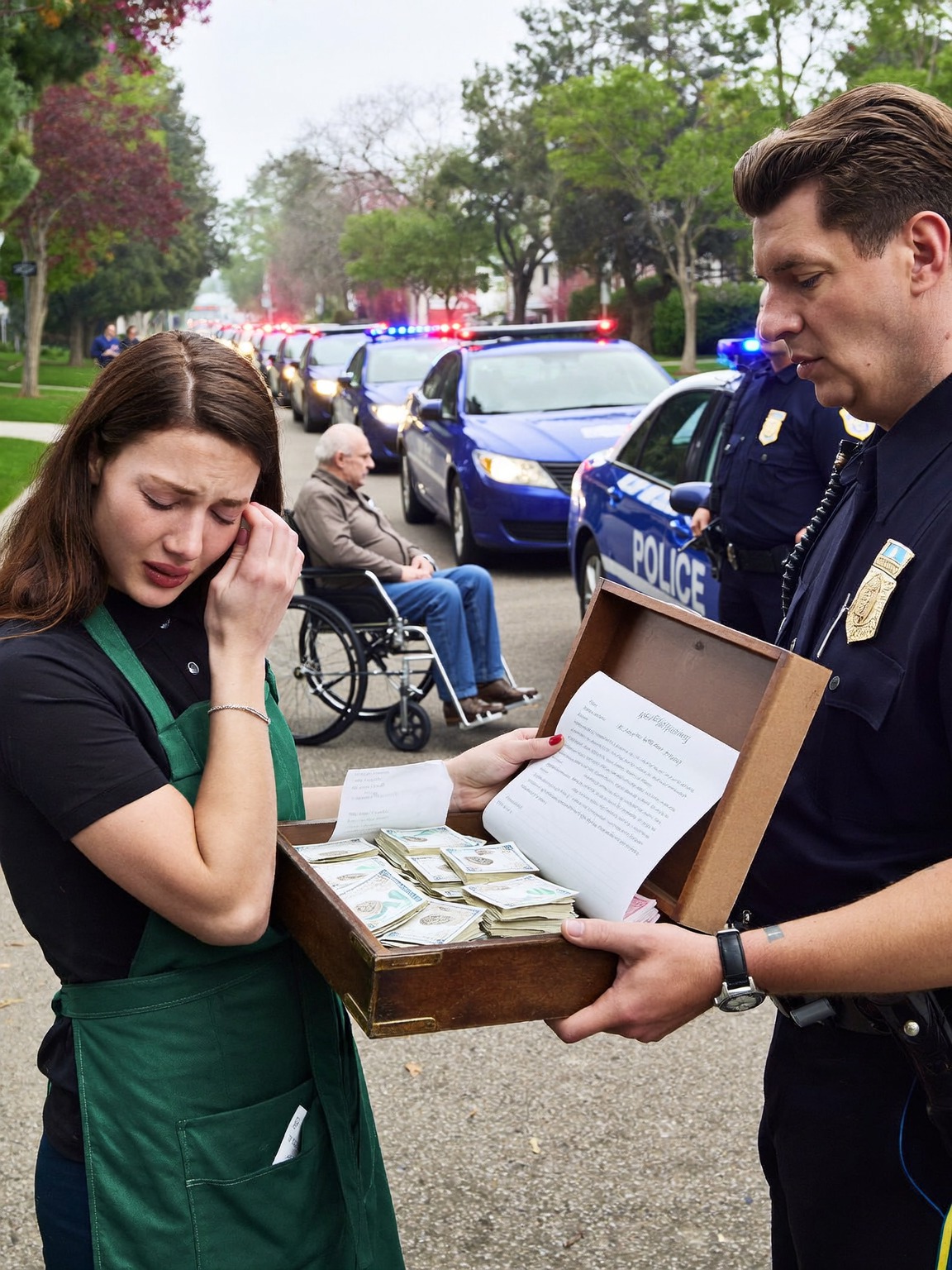
I was mistaken. The sound of sirens and the steady throbbing of red and blue lights against my bedroom walls woke me up the following morning. I could see twelve police cars lined my street through the blinds, and my heart pounded against my ribs. My thoughts raced through all the mistakes I could have made. Had I unintentionally breached the law by purchasing those groceries? Was I being pursued? A number of officers appeared on my porch when I opened the door, their faces sad but non-aggressive. The lead cop gave me a little, worn wooden box when they inquired whether I was Rebecca and I nodded.
My breath caught as I opened it. There was an ancient gold police badge that caught the morning light inside, along with a large, well-banded stack of $100 bills. I could never have predicted the reality that the officer described. Walter Higgins was a legendary figure in the department, a former Chief of Police who had spent decades defending the very streets we stood on. He was more than just a hungry stranger. He had strayed off from a specialized care facility a few days prior and was currently suffering from acute memory loss. In his bewilderment, his thoughts had returned to a period decades ago when he felt impoverished and incapable of navigating the contemporary world that had progressed without him.
His family had been searching the city in complete terror, including his son, who succeeded him as a senior officer. Walter couldn’t stop raving about the “angel in the grocery store” who had shown him respect when he felt like a ghost after he was eventually found and safely returned home. The Higgins family and the police department had combined their resources to provide a reward for any information that led to his return, but after hearing the tale of how I had accompanied him through the aisles, they concluded that I was the only owner of the reward.
That package had twenty thousand dollars, a sum of money that would change my life by paying off my debt and giving me a safety net I had never known. But it wasn’t the cash that captured my interest when the cops departed and the sirens subsided. Tucked inside the box’s corner was a handwritten message. In a few short phrases, Walter thanked me for treating him like a person rather than an issue. I was more affected by that one sentence than by the weight of the money. It was a biting critique of a culture that frequently sees the old and the suffering as problems to be solved rather than as individuals deserving of attention.
My life was stabilized by the award, which made it possible for me to pay my rent and, at last, breathe without the oppressive strain of financial disaster. However, the more profound change took place inside. We are frequently encouraged to be wary of the outside world and to protect our hearts and resources against potential exploitation. Kindness, we believe, is a luxury only available to the wealthy. In actuality, people who truly understand what it’s like to have nothing frequently perform the most meaningful acts of charity.
I was hoping for a windfall, so I didn’t assist Walter. I assisted him because, at that very moment, another person’s pain felt like a physical burden in the room, and ignoring it would have diminished my own spirit. True compassion is about having the will to see, not about having the resources to give. After our meeting, Walter’s son informed me that his father had briefly regained some of his clarity and felt secure and appreciated during that time.
The cold machinery of poverty and aging can quickly shatter a person’s frail dignity. The memory of our treatment persists long after the items have been consumed and the money has been spent. We only really have it with us. A tiny act of kindness can occasionally pay off in unexpected ways, but even in those cases, the act itself is the reward. It is a reminder that there is still space for a little grace in the bread aisle, even in a society that feels more hurried and guarded. It is the gentle restoration of faith in one another.