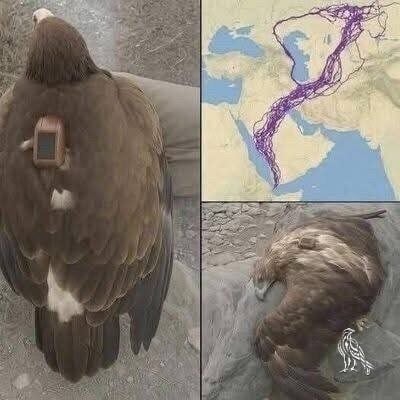
For years, the eagle’s movements frustrated everyone watching the blinking GPS signal crawl across digital maps. Researchers had expected elegance — the kind of clean migration path printed in textbooks, a graceful arrow stretching predictably from one season to the next. Instead, what appeared on their screens looked chaotic, almost irrational. The bird crossed oceans only to double back days later. It drifted far off expected routes, hovered for long stretches above empty mountain ranges, disappeared into remote valleys, then suddenly reappeared hundreds of miles away moving in the opposite direction.
Every new GPS ping seemed to raise more questions instead of answering them.
At first, the scientists assumed something must be wrong with the equipment. The routes looked too messy, too inefficient, too inconsistent with what humans believed migration should look like. Some researchers blamed technical errors. Others wondered if the eagle was sick, disoriented, or unusually inexperienced. The data refused to fit neatly into the clean patterns they expected.
Yet the bird survived year after year.
Not only survived, but thrived.
That fact slowly forced the researchers into an uncomfortable realization: perhaps the problem was not the eagle’s behavior. Perhaps the problem was the human assumption that nature should move in straight, predictable lines understandable at a glance.
What began as a standard wildlife tracking project gradually transformed into something far more humbling.
The deeper scientists studied the eagle’s route, the more they discovered hidden layers of logic woven inside what initially looked like confusion. Those strange loops over mountain ridges coincided perfectly with rising thermal currents — invisible columns of warm air allowing the bird to glide enormous distances without wasting energy flapping its wings. The abrupt detours around open terrain aligned with dangerous wind patterns capable of exhausting even powerful birds mid-flight.
The eagle was not wandering aimlessly.
It was reading the sky.
Each movement reflected an intimate awareness of forces humans rarely notice at all. Tiny pressure shifts. Seasonal wind changes. Storm systems forming hundreds of miles away. Invisible corridors where prey became temporarily abundant. Areas where air currents could lift a massive bird effortlessly for hours without consuming precious energy reserves.
The bird moved through a landscape far more complex than the flat maps humans stared at on computer screens.
As researchers layered weather models, terrain data, temperature patterns, and wind simulations over the GPS trails, the eagle’s seemingly chaotic journey slowly transformed into a breathtaking map of adaptation. Every pause revealed purpose. Every curve contained strategy. Every delay increased survival odds in ways too subtle for human intuition to immediately recognize.
What looked like randomness was actually intelligence operating at a scale humans barely understood.
That realization changed the scientists themselves.
Many entered the project expecting to confirm existing theories about migration. Instead, they found themselves confronting the limits of human perspective. Nature, they realized, does not organize itself according to the neat diagrams hanging in classrooms or simplified arrows printed in textbooks. Real survival is rarely linear. It is fluid, responsive, and constantly adjusting to changing conditions moment by moment.
The eagle’s route reflected that living complexity.
A straight line may appear efficient on paper, but nature values survival more than elegance. The bird understood this instinctively. It did not care about human expectations of order. It cared about wind resistance, food availability, weather timing, predator avoidance, and energy conservation. Every apparent “mistake” in its path often represented a sophisticated decision invisible until viewed through the correct lens.
In some ways, the eagle became a symbol of something larger than migration itself.
Its journey exposed how often humans mistake misunderstanding for disorder. When people cannot immediately recognize a pattern, they tend to label it chaos. But complexity is not the same as confusion. Sometimes intelligence becomes visible only after patience strips away arrogance.
For the researchers, the project became deeply personal over time.
Many spoke about the strange emotional shift that occurred while following the bird year after year. At first they watched it like analysts studying data points. Eventually they began feeling as though they were witnessing a kind of ancient conversation between a living creature and the atmosphere itself. The eagle seemed connected to the planet in ways modern humans rarely experience anymore — responding continuously to subtle environmental signals most people move through completely unaware of.
There was something almost haunting about that realization.
A creature without language, technology, or maps navigating thousands of miles through invisible systems more accurately than many human predictions could manage. Not because the eagle possessed magic, but because evolution had shaped it into a master listener of the natural world.
And perhaps that became the project’s greatest lesson.
The living world does not always reveal its logic immediately. Sometimes what appears messy or irrational from a distance contains extraordinary intelligence once viewed with enough humility. The eagle’s tangled path reminded scientists that survival is not about following perfect straight lines. It is about adaptation, responsiveness, and learning how to move with forces larger than yourself instead of against them.
By the end of the study, the researchers no longer looked at the migration trail as a collection of confusing detours.
They saw something far more beautiful.
A life woven carefully into wind, weather, terrain, instinct, and time itself — not lost in the sky, but deeply fluent in it.