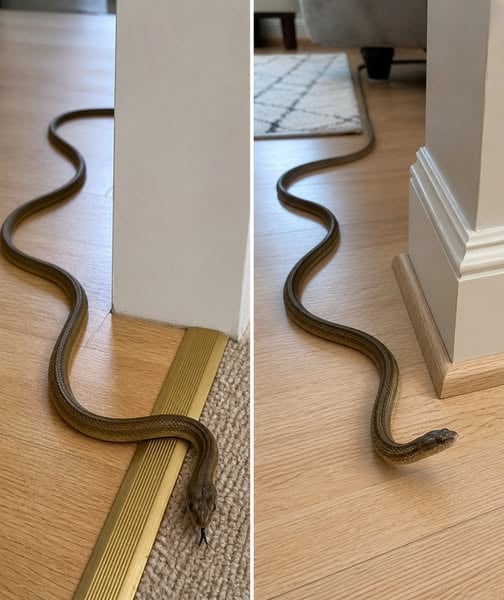
The first time you see it, your brain almost refuses to process what your eyes are telling you. A strange curve near the wall. A dark shadow stretched across the floor. Then suddenly — movement. Smooth, silent, alive. In an instant, the safety of your own home feels shattered. The hallway you walked through a hundred times becomes unfamiliar. Every dark corner suddenly feels dangerous. Your heart pounds harder, panic rushes through your body, and a primitive survival instinct takes over before logic has time to catch up. For a split second, it feels less like a house and more like a hunting ground where you are no longer certain what is hiding around you.
But for the snake, none of this is personal.
It did not enter your home to stalk or terrorize you. It came searching for the same things every wild creature searches for: food, water, shelter, and survival. What feels like a horror movie to a human is often just an animal following instinct. Snakes slip under doors, through tiny foundation cracks, gaps around pipes, dryer vents, garages, or openings so small most people never notice them. Once inside, they seek quiet, dark, protected places where they can hide undisturbed.
And unfortunately, many homes accidentally provide exactly what they need.
Basements, laundry rooms, garages, storage spaces, cluttered closets, and crawl spaces create ideal hiding spots. If a home also has rodents, insects, standing water, or cool shaded areas during extreme heat, it becomes even more attractive. In many cases, the snake itself is not the original problem at all. It is simply following prey already living inside or around the house. Mice, rats, and insects quietly act like invitations, turning parts of the property into a ready-made hunting ground.
That realization can feel unsettling because it changes the story completely. The snake is not invading randomly. It is responding to an environment that unintentionally supports it.
Still, understanding the reason does not erase the fear. Human beings are deeply wired to react strongly to snakes. Even people who logically know most snakes are harmless often experience immediate panic when they encounter one unexpectedly indoors. Sudden movement, unpredictable behavior, and the instinctive association with danger trigger adrenaline almost instantly. Darkness amplifies that fear even further. After a snake is discovered, many people admit they begin checking every blanket, shoe, hallway, and shadow for days afterward.
In moments like that, the safest response is not aggression — it is distance and calm.
Wildlife experts strongly advise people not to try catching or killing a snake themselves unless they are properly trained. Many bites happen not because snakes attack humans, but because frightened people attempt to handle them recklessly. The safest first step is to slowly back away, keep children and pets out of the area, and if possible, isolate the snake inside a room without cornering it. Closing doors carefully and watching from a safe distance helps professionals locate the animal more quickly when they arrive.
Identification also matters. Many harmless snakes are mistaken for venomous ones during moments of panic. Trying to get too close for a better look can increase risk unnecessarily. Wildlife removal specialists or animal control officers are trained to safely identify and relocate snakes while minimizing harm to both the animal and the people inside the home.
Once the immediate danger passes, attention usually turns toward a bigger question: how did it get inside in the first place?
That is where prevention becomes crucial. Small cracks around doors, loose weather stripping, openings near plumbing, vents, and foundation gaps often serve as entry points. Overgrown grass, wood piles, cluttered yards, bird feeders attracting rodents, and standing water can also create environments snakes prefer. Even something as simple as leaving garage doors open for long periods can increase the chances of wildlife wandering inside.
Decluttering becomes especially important because snakes love hidden, undisturbed spaces. Piles of boxes, old furniture, storage containers, and debris create perfect shelter not only for snakes, but for the rodents they hunt. Removing those conditions changes the environment completely. A clean, sealed, well-maintained property becomes far less appealing to wildlife searching for survival.
Ironically, snakes themselves often help control dangerous pest populations. Many species quietly reduce rats, mice, and insects around homes and farms. Ecologically, they play an important role. But understanding that role feels very different when you unexpectedly find one stretched across your kitchen floor or coiled behind a washing machine.
What lingers after encounters like this is often not just fear, but awareness. People begin noticing how connected homes really are to the surrounding environment. A house may feel sealed off and protected, yet nature constantly searches for tiny openings. Heat, drought, flooding, food shortages, and seasonal changes all push wildlife closer to human spaces in ways many people never consider until something suddenly appears where it should not.
In the end, the snake was never truly there to haunt you. It was following instinct, hunger, and opportunity. But the shock of seeing it inside your home taps into something ancient in the human mind — the terrifying realization that even familiar places can suddenly feel wild again.
And while you cannot stop snakes from existing, you can make sure your home stops feeling like an invitation.