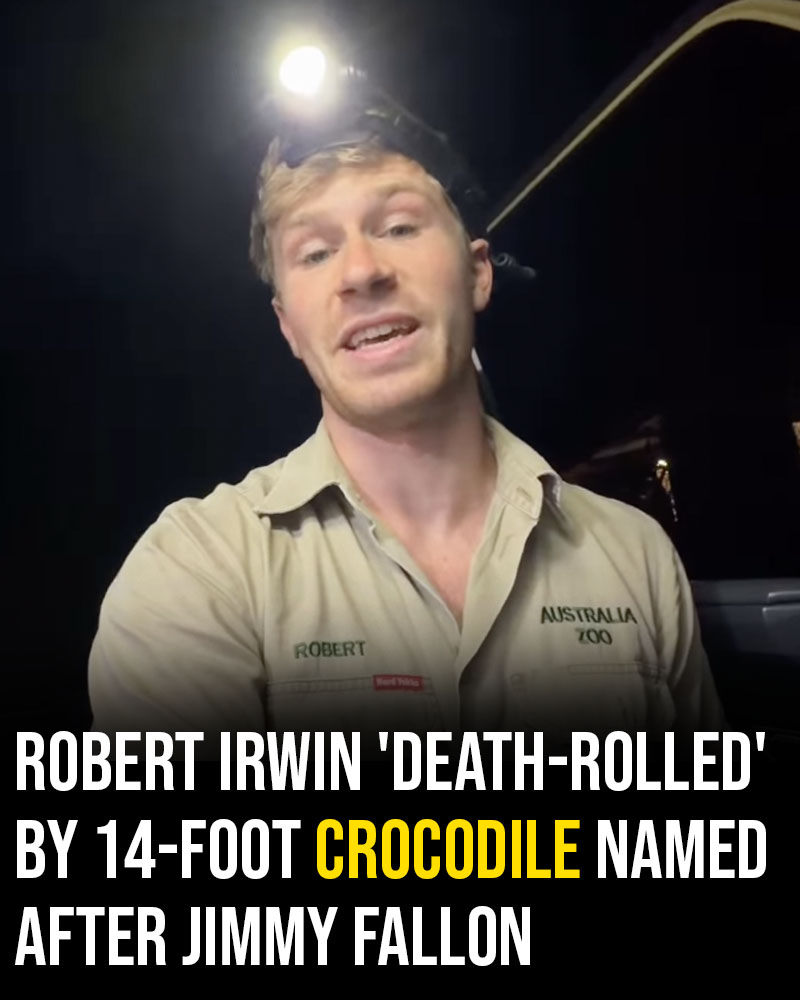
Robert Irwin thought he was in control. Years of training, experience around dangerous animals, and a lifetime spent inside the world of wildlife conservation had taught him how to stay calm under pressure. But in one terrifying instant, all of that confidence nearly disappeared beneath 700 pounds of muscle, teeth, and instinct. The 14-foot crocodile known as “Jimmy Fallon” suddenly exploded into motion, dragging Robert into a violent death roll that left him pinned and disoriented. For a split second, the son of the late Steve Irwin believed he might not survive.
The attack unfolded with the kind of speed that makes crocodiles so deadly. One second Robert was handling the massive reptile with practiced focus; the next, the animal reacted on pure instinct. The crocodile twisted violently, using its body weight and rotational force in the brutal maneuver known as a death roll, a technique designed to overpower prey and tear it apart underwater. Suddenly trapped beneath hundreds of pounds of thrashing reptile, Robert had almost no time to think. Every movement became survival instinct.
Moments like that expose the razor-thin line between expertise and disaster in wildlife work. Crocodiles are not trained performers following scripts. No amount of familiarity fully removes the danger. Even experienced handlers understand that wild animals remain unpredictable, governed by instinct powerful enough to turn routine interactions catastrophic in seconds. As the crocodile rolled, Robert later admitted that the situation felt horrifyingly real. Beneath the chaos and adrenaline came the brief but unmistakable realization that this could be the moment everything ended.
For many watching afterward, the story carried an eerie emotional weight because it echoed memories of his father, Steve Irwin. Steve built his global reputation on fearless encounters with some of the world’s most dangerous animals, turning conservation into something energetic, emotional, and unforgettable. His death in 2006 shocked millions and left a permanent shadow over the family’s public life. Since then, every close call involving Robert inevitably reminds people of the risks that come with carrying forward that legacy.
But Robert’s encounter was not a reckless stunt designed for attention. Those close to the Irwin family insist that moments like this are part of the reality of conservation work. Handling large predators carries unavoidable danger, even under controlled conditions. The Irwins have long argued that allowing people to see these animals up close creates emotional connections strong enough to inspire conservation efforts worldwide. That philosophy shaped Steve’s life, and Robert has embraced it in his own way.
What makes Robert especially compelling to audiences is not simply his resemblance to his father, though the similarities are impossible to ignore. It is the familiar energy in his voice, the enthusiasm when discussing wildlife, and the mixture of humor and fearlessness that instantly reminds people of Steve. Yet Robert is not merely copying a legacy frozen in time. He represents a new generation of conservationists using modern media, science, and global platforms to continue the mission in ways adapted for a different era.
In interviews after the crocodile incident, Robert handled the story with the same mix of tension and humor that once defined his father’s storytelling. He spoke about the danger honestly, acknowledging how close things came to disaster, but he also emphasized respect for the animal rather than anger or fear. That attitude lies at the core of the Irwin philosophy: wild animals are not villains. They are powerful creatures acting according to nature, deserving both caution and protection.
The emotional impact of the story extended far beyond the physical danger itself. Many fans saw the incident as proof that Robert fully understands the risks he inherited by choosing this life. He could have stepped away from the spotlight after Steve’s death, distancing himself from dangerous wildlife work entirely. Instead, he chose to continue entering the same unpredictable world that made his father famous—and ultimately cost him his life. That decision carries enormous emotional weight because it reflects not recklessness, but commitment to a cause deeply tied to family identity.
Every close call now becomes part of a larger narrative surrounding the Irwin family. The world watches Robert not only because of who he is, but because he represents continuity after tragedy. Each television appearance, conservation project, or dangerous encounter reminds audiences that the Irwin legacy did not end with Steve. It evolved. Robert brings his own personality, humor, and scientific focus to the mission while still carrying the emotional echoes of the man millions grew up watching.
And perhaps that is what lingers most after the terrifying moment with “Jimmy Fallon.” Not just the image of a young conservationist nearly crushed beneath a crocodile, but the realization that the spirit driving him forward remains remarkably unchanged from the one that inspired his father decades earlier. The danger is real. The fear is real. But so is the passion. And through Robert Irwin, the legacy of Steve Irwin continues not as a memory trapped in the past, but as something still alive, still evolving, and still brave enough to stand face-to-face with the wild.