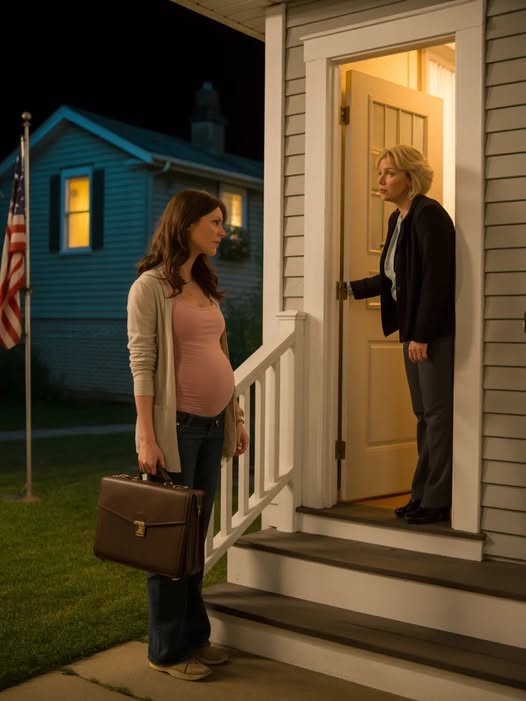
I was eighteen years old when I told my mother I was pregnant, and I can still remember every detail of the moment my life split into a before and an after. We were standing in the kitchen of her immaculate four-bedroom house, the kind of home that looked perfect from every angle. White shutters. Fresh flowers on the porch. Neighbors who smiled and waved whenever they passed by, as if everyone on our quiet suburban street lived inside some polished version of happiness.
From the outside, our family looked respectable, stable, untouchable.
Inside that kitchen, my mother stared at me for a very long time without saying anything. Her face did not crack with shock or sadness. She looked almost calm, which somehow made it worse. I remember standing there with my hands shaking slightly, trying to explain that I was scared, that I didn’t know what I was going to do yet, that I needed her. Instead, she folded her arms and told me I had exactly two hours to pack my things and leave.
She said I had made my decision, so now I could live with the consequences by myself.
There was no argument. No screaming. No desperate attempt to understand me. Just cold finality.
By sunset, I was sitting outside on the front steps with two black garbage bags full of clothes beside me, watching the house where I grew up become inaccessible in real time. I heard the locks click while I was still sitting there. My own mother changed them before I had even left the porch.
I remember staring at the front door afterward, waiting for some last-minute mercy that never came.
My daughter’s father was barely more than a memory by then. His name was Alex — or at least that’s what he told me. We met during freshman orientation at college. One random night. One conversation that lasted longer than it should have because he laughed at my terrible jokes in a way that made me feel seen and interesting and wanted. He was visiting from Switzerland, traveling with friends before starting school somewhere else.
After that night, he disappeared back into his own life, and I disappeared into mine.
I never got his last name. I never had his number saved. I didn’t know where he studied or how to contact him afterward. All I had left was a first name attached to a blurry memory and a child growing inside me.
You cannot build stability out of almosts.
Within months, I dropped out of school completely. I moved into a shelter carrying more fear than belongings. When my daughter Janna was born in a county hospital, I held her alone in that sterile room while my mother told relatives and neighbors that I had “run off to Vegas” and destroyed my own future. It was easier for her to invent a scandal than admit her teenage daughter needed compassion.
The years that followed were not dramatic in the cinematic sense. They were simply exhausting.
Five years of survival stretched endlessly in front of me. I worked double shifts at a diner where customers barely looked at my face unless they needed more coffee or wanted to complain. People spoke around me, through me, over me. Some days I felt less like a person and more like part of the furniture.
Janna and I lived in a tiny studio apartment with damp walls that smelled faintly of mildew no matter how much I cleaned. Roaches hid in the cabinets. The heater worked only when it felt like cooperating, which meant winters were brutal. In the beginning, I could not even afford a crib, so my daughter slept inside a dresser drawer lined carefully with folded blankets beside my bed.
I used food stamps. I attended WIC appointments carrying paperwork that always made me feel strangely ashamed even when I knew I was trying my hardest. Some mornings I walked four miles to work before sunrise because the bus schedule didn’t run early enough for my shift. I would arrive exhausted before the day had even started.
And the hardest part wasn’t poverty itself.
It was knowing my mother lived only twenty minutes away the entire time.
Close enough to help. Close enough to visit. Close enough to know exactly how hard things were becoming for me. Yet she never once called to ask whether we were okay. Never showed up at the apartment. Never met Janna as a baby. To most relatives, she acted as though I no longer existed at all.
My sister Denise was the only thread connecting me to my old life.
She would secretly meet me at parks sometimes, pretending she was simply out for a walk. She brought bags of tiny clothes she found at consignment shops, children’s books, shoes Janna could grow into later. She always looked nervous during those meetings, glancing over her shoulder like someone might see us together.
Eventually she admitted why.
Our mother had threatened to cut her off financially too if she helped me openly.
Even knowing that, Denise still came when she could. Quietly. Carefully. In stolen moments between fear and loyalty.
And somehow, despite everything, I kept going.
Not because I felt strong all the time. Most days I felt terrified, exhausted, and painfully alone. But every time I looked at Janna sleeping beside me, tiny fingers curled against her cheek, I understood something important: nobody else was coming to save us.
So I learned how to save us myself.