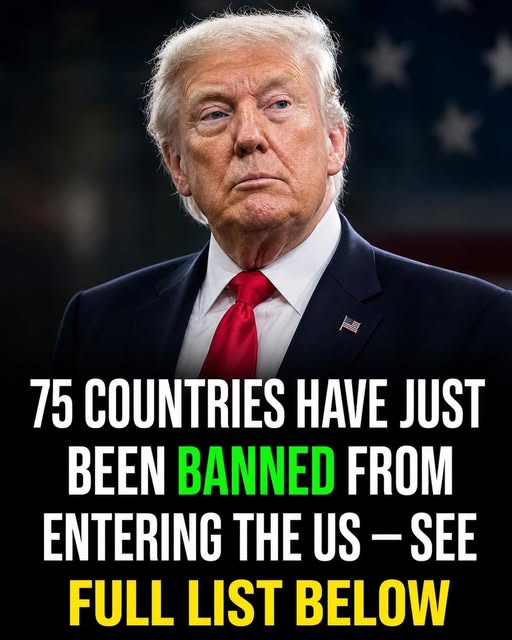
Within a few phrases from the nation’s capital, an ordinary immigration procedure turned into a worldwide drama. With stakes ranging from consulates in Lagos and Manila to embassies in Istanbul and Bogotá, what was once predictable, although occasionally plodding, now feels like a cliffhanger written in real time. Families that had painstakingly planned for a life-changing relocation—selling houses, quitting long-term positions, pulling kids out of school, and closing chapters in one nation in the hopes of beginning over in another—are now left in a state of perpetual uncertainty. A “pause” in processing to allow for further security checks and financial scrutiny is the official message, which is conveyed through succinct government messages. However, the human reality that lies behind that neutral wording is much less structured. Important family milestones have been missed, weddings have been delayed, and doctor’s appointments have been rescheduled. Children eagerly await reunions with parents who are unable to contact them, elderly parents are left without caregivers, and expecting parents must deal with births that occur while immigration permission is tantalizingly elusive.
For many impacted families, the disturbance is deeply emotional rather than just logistical. Think about the stories coming out of Manila, where a mother who sold her flat and quit her job as a teacher is waiting for the go-ahead to move to the US with her spouse. Her little son’s school year started months ago, but she is still in a state of uncertainty because she can’t be there to comfort him face-to-face while he navigates this important educational phase. An engineer in Istanbul across the Atlantic who left a secure job to pursue a U.S. assignment discovers that his visa has been permanently postponed due to the financial examination. Not only can uncertainty make every day feel more burdensome, but everyday life’s routines—birthdays, anniversaries, and work deadlines—cannot be put on hold indefinitely. These are people whose entire lives have been upended by a decision made thousands of miles away, conveyed through official documents and brief web postings; they are not abstract statistics.
Supporters of the new policy frame the pause as overdue caution. Proponents contend that the US is merely enforcing acceptable protections in a world where economic demands are severe and concerns about global security are constant. Background checks, proof of self-sufficiency, and increased security measures are offered as means to guarantee that newcomers may successfully integrate and make constructive contributions without placing unanticipated strain on local systems or taxpayers. According to this viewpoint, the pause is a deliberate action meant to safeguard the interests of both newcomers and the society they intend to join, rather than being punitive.
Critics, on the other hand, perceive a distinct narrative that is colored with fear and frustration. They see the strategy as a broad, nationality-based dragnet that penalizes rule-followers while mainly ignoring the underlying issues of illegal entrance. Attorneys for families impacted by the pause characterize the system as unpredictable, unfair, and opaque. Applications for visas are halted without specified deadlines or standards for completion. Emails are not responded to. Calls are returned with automated alerts or ambiguous promises. For those caught in the middle, it feels more like bureaucratic lethargy and, in certain situations, active obstruction than due diligence. Lawsuits challenging whether the pause goes beyond the president’s power and if it unfairly discriminates against particular groups have already started.
There are also important societal ramifications. Children are being withdrawn from school or must wait months for their parents to relocate, causing disruptions to schools on several continents. Due to the inability of new personnel to enter the nation lawfully, companies—especially those in the tech and engineering sectors—face delays in important projects. Healthcare systems are impacted as understaffed hospitals struggle to fill critical roles while foreign-trained physicians and nurses wait for permits. Even weddings, which were always private events, are now diplomatic and administrative processes that require travel authorization and visa approval. Every delay has a cascading effect, stressing not only the people who are immediately impacted but also local infrastructures, employers, and communities that depend on their prompt arrival.
In the meanwhile, the public conversation surrounding the pause has become more divisive. Media outlets portray it through conflicting perspectives: one emphasizes the need for vigilance in national security and immigration enforcement, while the other focuses on the human cost and issues of equity. In an effort to expedite settlement, nervous applicants share updates, pictures, and appeals to politicians or influencers on social media channels. The human drama turns into a worldwide stage that takes place in living rooms and offices from Lagos to Los Angeles, in addition to courtrooms and embassies. Every flight cancellation, postponed school enrollment, or postponed medical visit becomes a microcosm of the policy’s broader effects, making abstract government actions tangible in ways that are impossible to ignore.
Legal scrutiny is becoming more intense. Judges are debating the rights of those who have complied with all legal requirements as well as the boundaries of governmental authority. Legislators are debating whether the suspension is a politically useful tactic with far-reaching human repercussions or if it advances long-term security objectives. Scholars and analysts point out that the policy is at a crossroads between preserving the fundamental values of immigration law—fairness, transparency, and equal treatment—and safeguarding national interests. It is anticipated that court rulings in the upcoming months could influence U.S. immigration policy for years to come, possibly redefining the limits of presidential discretion in the process.
However, the abstract arguments provide little solace to millions of families. They worry if this is a short-term setback or the start of a longer-term closure as they anxiously watch the calendar move closer to 2026. Every week that goes by, the emotional and practical stress increases. Carefully prepared plans for employment, education, and relocation are in limbo, and nobody can predict when or even if the doors will reopen. The pause has evolved from a policy measure to a lived reality of suspended life, a worldwide test of patience, and a silent reminder of how process and power interact to form human experience.
The postponement also highlights the fact that contemporary immigration procedures are much more than just paperwork and red tape. The rhythm of families’ lives, the course of careers, and the health and wellbeing of youngsters and older relatives are all influenced by these processes. The ramifications of abrupt policy changes reach well beyond government buildings and embassies, affecting even the most private aspects of people’s lives. Children left without parents for months, grandparents waiting for visits that might never happen, and professionals compelled to postpone or give up chances are examples of the tangible disruption. What should be a standard administrative procedure becomes a crisis of timing, trust, and individual preparation with each delay carrying emotional weight.
Ultimately, the immigration suspension is both a human story and a policy; decisions made in Washington have an impact on people all around the world in ways that are sometimes impossible to quantify or lessen. It serves as a reminder that there are people whose lives are changing behind every visa number, security check, and administrative pause—sometimes in ways that cannot be undone. While governments and courts debate how to strike a balance between individual rights and national security, families, employers, and communities continue to traverse these issues in the hopes of clarity and resolution. The current state of affairs continues to be a global cliffhanger that tests the fortitude, tolerance, and optimism of millions of people who are waiting for answers—not just for their documents, but also for the continuation and stability of their lives.