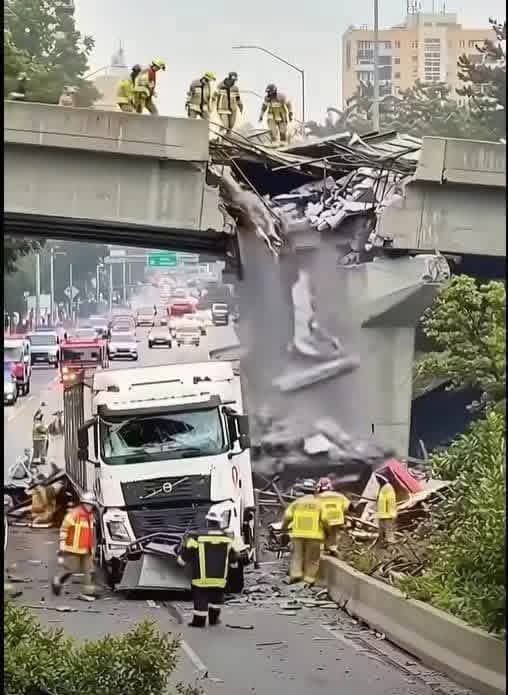
On what appeared to be a typical Friday, Richmond, British Columbia, woke up to commotion. A commercial truck crashed into the Cambie Road overpass on Knight Street at 7:15 a.m., shattering the peace of the early morning. Due to the truck’s inability to clear the span while carrying a dump trailer in an elevated position, the trailer became dangerously trapped against the bridge. The truck skidded across the road after the impact was strong enough to separate the cab from its trailer. Fortunately, nobody was hurt, but the incident immediately raised questions about the stability of the bridge and resulted in the closure of all southbound lanes.
Provincial engineers and city authorities raced to the area to assess any possible structural damage. Making sure the overpass could safely handle traffic loads once more was their top priority. Richmond’s municipal engineers helped with the probe even though the highway is under provincial jurisdiction. The trailer remained forced up against the span far into the morning as workers put in endless effort to clear debris and stabilize the situation. In anticipation of severe traffic, police recommended drivers to look for alternate routes.
In close collaboration with the Ministry of Transportation and Infrastructure, the investigation has been taken over by the Richmond Road Safety Unit. Knowing that even if the bridge looks intact, hidden deterioration could jeopardize its long-term endurance, structural engineers are closely examining it for cracks, joint displacement, and weakening support beams.
There have previously been truck-overpass collisions in British Columbia. Raised truck beds, incorrectly estimated loads, and a lack of knowledge about height regulations have all contributed to an increase in these events in the Lower Mainland and Fraser Valley over the past few years. The ninth such crash on provincial highways in a single year occurred in Langley last year. Although driver error is a major factor, other factors include outdated infrastructure and uneven signage. Resurfacing work may unintentionally lower vertical clearance, and some overpasses have unclear or absent clearance signs.
Industry associations have raised awareness of the issue. Advanced safety measures including over-height detection systems, which alert drivers to low overpasses using lasers or infrared sensors, have been demanded by the British Columbia Trucking Association. They emphasize that fleet managers should place a high priority on driver education, making sure that drivers inspect trailer heights and tighten hydraulic systems before departing. Data-driven surveillance of overpass events and GPS-based fleet monitoring can assist pinpoint persistent issues and direct infrastructure spending.
Engineers note that impacts from collisions can cause joints to loosen and internal reinforcements to be strained. Before reopening the road, every incident necessitates a comprehensive inspection and occasionally calls for temporary reinforcing. The Knight Street team stressed that the assessment is essential for both public safety and averting future, more expensive mistakes.
The transportation system in the area was affected by Knight Street Bridge’s shutdown. Richmond serves as a major commercial trucking center that links the Fraser Valley, Delta, and Vancouver. Logistics activities were affected, fuel prices went up, and deliveries were delayed as a result of the shutdown. Businesses that depended on daily deliveries had short-term supply shortages, and residents faced lengthier journeys that forced them to use minor highways. The event brought to light the logistical and financial ramifications of a single overpass collision.
To stop similar incidents in the future, experts recommend using both technology and instruction. A proactive safety approach includes over-height detection technologies, real-time GPS tracking, driver education, and routine infrastructure evaluations. These systems must function within a larger “safety ecosystem” where drivers, fleet operators, and authorities share accountability, according to Dr. Steven Fong of the University of British Columbia.
Since the Richmond disaster, policy debates have become more heated. Canada’s infrastructure is deteriorating, and the need to update bridges and overpasses is growing as freight loads rise. In order to lessen the need for handwritten signs, proposals include requiring over-height detection devices on important commercial arteries and incorporating clearance databases into truck GPS navigation. In order to preserve confidence in transportation networks, public safety advocates call for openness in collision reporting and reopening schedules.
An entire region can be disrupted by a single error or oversight, as demonstrated by the Knight Street incident. These catastrophes have substantial administrative, logistical, and financial impacts; repair estimates frequently exceed the millions. Proactive prevention is significantly more economical for municipal and provincial officials than post-event reconstruction. It serves as a warning to the trucking sector to invest in risk-reducing technologies, enforce maintenance inspections, and improve training.
In the end, cooperation between drivers, businesses, engineers, and governmental organizations is necessary to guarantee safety on critical roads like Knight Street Bridge. Even if the event was swiftly contained, the lessons learned from it are valuable in the long run. Maintaining the integrity of vital infrastructure, preventing accidents, and safeguarding lives and livelihoods all depend on vigilant inspection, contemporary detection technologies, and continuous education. Heavy-haul vehicles are essential, but their interaction with old infrastructure necessitates systematic attention, preventative measures, and a shared commitment to safety across all levels of transportation. The Richmond incident serves as a wake-up call.