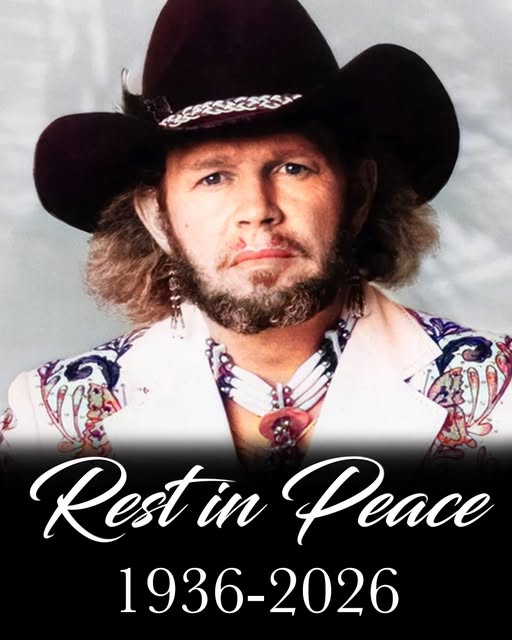
The passing of one of the most divisive and unique voices in the history of the genre is being mourned by the country music community and fans worldwide. At the age of 86, David Allan Coe, a pioneering musician who pushed the limits of conventional music and resolutely refused to conform to Nashville’s refined standards, passed away. Although his agents did not immediately reveal the cause of his death, his departure was formally verified on April 29. For millions of devoted admirers, this devastating news marks the end of an incredible and stormy chapter in a career that nearly entirely contributed to the formation of the gritty, rebellious edge of the outlaw country movement during the crucial 1970s.
An Outlaw Identity and a Difficult Start
Coe, who was born in the industrial city of Akron, Ohio, on September 6, 1939, did not take the conventional, family-oriented route taken by the majority of country music performers of his period. His early years were marked by extreme upheaval and hardship, which ultimately resulted in him spending a large amount of his childhood in several prisons. These difficult and formative events were the basis of his songwriting and the lifeblood of his fiercely independent public character, rather than merely a distant footnote in his past. In a genre of music that is frequently based on conventionalism and mainstream respectability, Coe carved out a distinct niche for himself by embracing a true outsider persona.
The Climb to Nashville
Success was far from certain when he finally moved to Nashville in 1967 with a guitar and a desire. Coe had to battle valiantly for every bit of acknowledgment. Like many creative musicians of his time, he first worked behind the scenes as a gifted and perceptive songwriter before gradually establishing his formidable name. When the renowned Tanya Tucker sang his stirring song Would You Lay With Me in a Field of Stone in 1973, it was his big break. The song shot to the top of the charts, demonstrating Coe’s unmatched narrative ability that struck a deep chord with listeners. A large, broad audience and a significant recording deal were made possible by this enormous success.
Entering the Spotlight
With the release of his debut album, The Mysterious Rhinestone Cowboy, in 1974, Coe was no longer satisfied with being in the background. It was an audacious and unreserved opening that highlighted his unorthodox magnetism and raw talent. He published the highly regarded album Once Upon a Rhyme in 1975, just a year later. You Never Even Called Me by My Name, which would go on to become his most famous and well-known hymn, was included in this production. The song, which famously refers to itself in the lyrics as the ideal country and western song, was a remarkable fusion of humor, profound self-awareness, and great narrative.
Composing Anthems and Discovering His Voice
Coe’s voice was instantly identifiable, fusing parts of southern rock, raw blues, and traditional country. A rich, raspy baritone that demanded the listener’s undivided attention was used to deliver all of this. His reputation as one of the most unusual voices in the genre was further solidified with songs like Willie, Waylon, and Me and Longhaired Redneck. His impact went well beyond his discography. He wrote the iconic anthem Take This Job and Shove It, which turned into a huge smash that defined Johnny Paycheck’s career. The song developed into a timeless cultural anthem that encapsulated the profound dissatisfaction and weariness of the American working class.
Profitability and Long-Term Durability
Coe demonstrated that his talent had extraordinary durability, even though the 1970s marked the pinnacle of his commercial power. In the 1980s, as pop-country took over the music scene, he refused to become forgotten. Castles in the Sand, his 1983 album, signaled a spectacular comeback to the spotlight. The album included the stirring and eerie song “The Ride,” which struck a deep chord with both critics and fans, proving that his storytelling skills had not deteriorated with time and bolstering his continuing popularity.
The Debates and the Price of Rebellion
Coe left behind a legacy that was never clear-cut, despite his evident musical brilliance. His inflammatory songs from albums like Nothing Sacred in 1978 and the Underground Album in 1982 drew harsh criticism and popular outrage. He was condemned for the remainder of his life because to the extremely graphic and obscene language used in these endeavors. Many listeners and critics were not persuaded by Coe and his supporters’ claims that the content was only humorous or exaggerated for shock value, which permanently damaged his reputation in the eyes of the mainstream media.
Legal Issues and Individual Conflicts
His contentious lyrics weren’t the end of the controversy. In the last years of his life, legal problems also arose. Coe’s personal finances and ethics were called into doubt when he entered a guilty plea to violating IRS statutes in 2015. A sobering reminder of the turbulent life he led both on and off stage, he was later placed on probation and punished with a substantial financial penalty for unpaid taxes.
Individual Life and Last Years
Coe persisted in creating music despite personal and legal difficulties. He maintained a fervently devoted fan base that valued his unvarnished, unadulterated approach to the realities of American life as he performed and recorded far into his older years. When he wed Kimberly Hastings in 2010, he had some stability on a personal level. His devoted wife and children survive him and carry on his complicated memories.
In conclusion
Contradictions are part of David Allan Coe’s legacy. He was a talented songwriter, a pioneer of country music, and a real renegade who defied Nashville’s refined conventions. However, he was also a figure characterized by considerable debate and internal conflicts. In the end, his life served as evidence that genuine art need not always be courteous. His music will continue to have an impact on future generations of musicians that don’t conform to preconceived notions since he lived life on his own.