The steady, reassuring pulse of our small house for six months was the metallic, repetitive sound of coins falling into a clear glass jar. Dilan, my fourteen-year-old son, had a single, quiet aim. Dilan spent every weekend working hard in the neighborhood while his peers were bent over glowing computer displays or wandering the streets in packs. I would watch from the kitchen window as he lifted heavy grocery bags for the older people on our street, raked heaps of obstinate fall leaves for the Parkers, and struggled with Mrs. Colton’s hyperactive golden dog. He never once complained, even though he was exhausted and his hands were developing excruciating blisters. He had been saving assiduously for his first real bicycle, a goal that had sustained him for months.
Since my husband, Simon, died nine years ago, things have not been easy for us. Both the financial burden and the emotional toll weighed heavily on us. Bullies at his former school frequently targeted Dilan because of his minor limp, which was a tangible reminder of a serious childhood accident. However, we decided to start over six months ago. Dilan met Mr. Wallace in this new area. His history instructor spotted the kind, compassionate, and lonely soul beneath my son’s reserved appearance and did more than just teach dates and historical conflicts. After Simon’s death, I thought Dilan would never feel like he belonged, but Mr. Wallace provided him a deep sense of belonging.
The delicate pattern of our lives broke on a Tuesday afternoon. Dilan appeared to have barely escaped a terrible hurricane when he returned home. His breathing was labored, his eyes had a troubled, faraway expression, and his clothes were covered in thick, dark dirt. He mumbled something about needing a hot shower and made his way directly to the stairs without saying his customary upbeat greeting.
A tiny, crumpled piece of paper fell from his pocket and fluttered onto the wooden flooring as he struggled upward. I smoothed it out, fully prepared to discover a failing mark from a challenging test or a detention slip. Rather, I was staring at a retail receipt for a size 11 pair of men’s sneakers that had been fully paid for with cash. Like a trapped bird, my heart pounded against my ribs. I was positive that Dilan was a size 9.
“Dilan, hold on,” I said, my voice shaking.
He came to a halt on the landing, gripping the wooden banister with white knuckles. I pointed a trembling finger at the living room shelf where his cherished savings jar was always kept as he turned to face me. The glass was completely transparent. Hundreds of hours of arduous work had disappeared.
“Dilan, the jar is empty. “What did you do?”
His eyes were fixated on the ground as he slowly descended the stairs, speaking in a scarcely audible whisper.
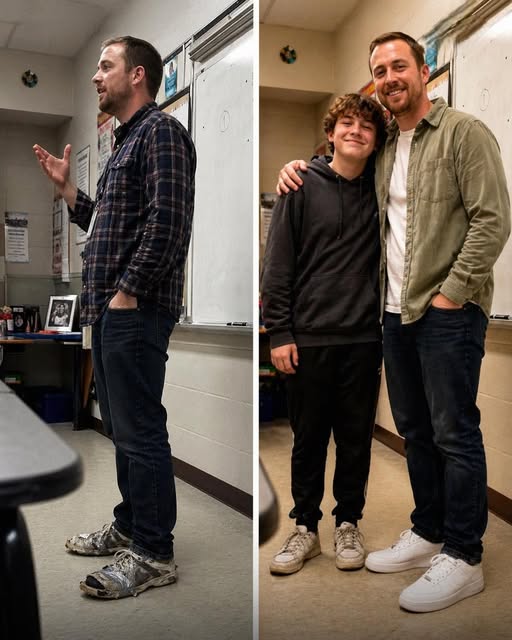
“Mom, these weren’t for me. They were intended for Mr. Wallace. In the hallway, I heard the other children making fun of him and noticed the holes in the soles of his shoes. Mom, he’s done so much for me. I could no longer just watch him go around in that manner.
His sacrifice was so heavy that it struck me like a physical blow. In order to preserve the dignity of a teacher who had been good to him, he had given up his greatest desire—the freedom and joy that a bicycle would provide. I drew him into a close, sobbing hug. I mumbled into Dilan’s hair, “You have your father’s heart.” I stood by myself with the empty jar and a wave of recollections of my late husband after he leaned into me for a brief moment before retreating to the shower.
However, the warmth of that lovely moment was sadly fleeting. The telephone on the wall rang that same evening as the sun began to set.
Through the receiver, a harsh, commanding voice inquired, “Is your son Dilan home?”
It was the department of the county sheriff. In an instant, my blood became icy. The police merely wanted to make sure my son was secure inside the house; they wouldn’t tell me why they were phoning. An hour later, there was another call, this time from an old woman who was crying and asked the same question before slamming the receiver. Paralyzed by a mother’s greatest worries, I paced the floorboards and stared at the front door all night long.
The nightmare finally appeared in our driveway at eight in the morning. Even though the patrol car’s emergency lights were off, it was still very noticeable in the still morning air. A sheriff entered our porch, his expression opaque and stern. He had Dilan’s favorite white hoodie in a clear evidence bag in his big hand. It was covered in filthy grime and had been torn at the sleeve.
“Paula, you have no idea what your son has done,” the officer stated sadly. I have to take you both down to the station right away.
It was a terrible swirl of silence on the way to the station. In the passenger seat next to me, Dilan’s face was a mask of pale, unwavering stone. He refused to look at me. I gripped the ripped hoodie tightly in my lap as my thoughts raced through all the sinister and perilous scenarios. Had he been involved in a violent altercation? Had he really stolen the cash for the shoes?
We weren’t shown to the holding cells when we eventually arrived at the station. Rather, we were led into a confidential briefing room. Inside was an elderly woman in a wheelchair who was holding a little bundle wrapped in cloth as if it were made of pure gold, and Mr. Wallace, who appeared tired and frightened.
Mr. Wallace stood up to greet us, looking tired, and said, “Paula, I am so sorry.” “Everything should have been explained over the phone by the sheriff.”
The room fell hushed as the story unfolded. Dilan had insisted on taking Mr. Wallace to the shoe store the day before after school. He had thrown his hard-earned earnings on the counter to purchase the much required footwear because he would not accept no. Three men had attacked them as they passed via a tiny, dark shortcut behind the mall. Instead of pursuing the shoes, the attackers grabbed for Mr. Wallace’s worn-out leather bag.
Mr. Wallace gasped out, tears welling up in his eyes, “I tried to just let the bag go, but Dilan did not.” Leaping between them, he tackled the man who was carrying the bag. Even when they attempted to take advantage of him, he would not let go. His hoodie was damaged in this way. Until a cop car turned the corner and the cowards ran away, he hung on with everything he had.
I was shocked as I stared at my son. Why would you put your life in danger for a briefcase, Dilan? Nothing inside is worth your safety!
The woman in the wheelchair, Mr. Wallace’s mother, started crying. She carefully opened the packet of fabric. There was a tiny, elaborate, and exquisite urn within.
Mr. Wallace’s voice cracked with grief as he muttered, “My daughter’s ashes.” “I was taking her to my mom so we could bury her by her grandmother this weekend. I would have lost the last remnant of my child if Dilan had given up that bag. Paula, he did more than just save a briefcase. My soul was saved by him.
There was a deep stillness in the room. Dilan’s face became a deep red with embarrassment as he glanced down at his shoes. “I had no idea what was inside,” he whispered. “I simply knew it was yours, and they had no right to take it.”
The sheriff cleared his throat, revealing unmistakable, sincere adoration beneath his professional mask. “We were still processing the situation and wanted to make sure Dilan was not being followed, so we were unable to notify you over the phone. Ma’am, he truly is a hero.
Mr. Wallace requested us to accompany him to the parking lot as we got ready to leave. A brand-new, deep blue mountain bike with thick, durable tires and silver embellishments leaned against a metal lamppost. Compared to what Dilan had been looking at in the secondhand classifieds, it was both more expensive and much superior.
Mr. Wallace put a soft hand on Dilan’s shoulder and remarked, “The officers and I went in together.” “A boy should never have to walk if he sacrifices his greatest dream to support his teacher.”
Dilan reached out to touch the handlebars, his hands shaking. He glanced first at Mr. Wallace and then at the teacher’s feet. Mr. Wallace continued to wear his worn-out, crumbling sneakers.
“Mr. Wallace, why aren’t you wearing the new ones I bought you?” Dilan said in a low, perplexed voice.
With a warm, bittersweet smile on his lips, the instructor gazed down. Years ago, my daughter chose these vintage items for me. They made me appear cool, she said. Dilan, I’ll wear the new ones tomorrow. I swear. However, I needed to feel her beside me one final time today.
We left the police station as a family that had been reminded of the enormous power of a single, unselfish deed rather than as a group under suspicion. I looked at the vacant passenger seat and sensed my late husband’s reassuring presence as I drove carefully behind Dilan as he pedaled his gorgeous new bike down the sidewalk. Not only had our kid matured, but he had developed into the kind of man the world really needs. He had discovered that although money could provide bicycles and shoes, the things that are genuinely precious could only be safeguarded by kindness and courage.