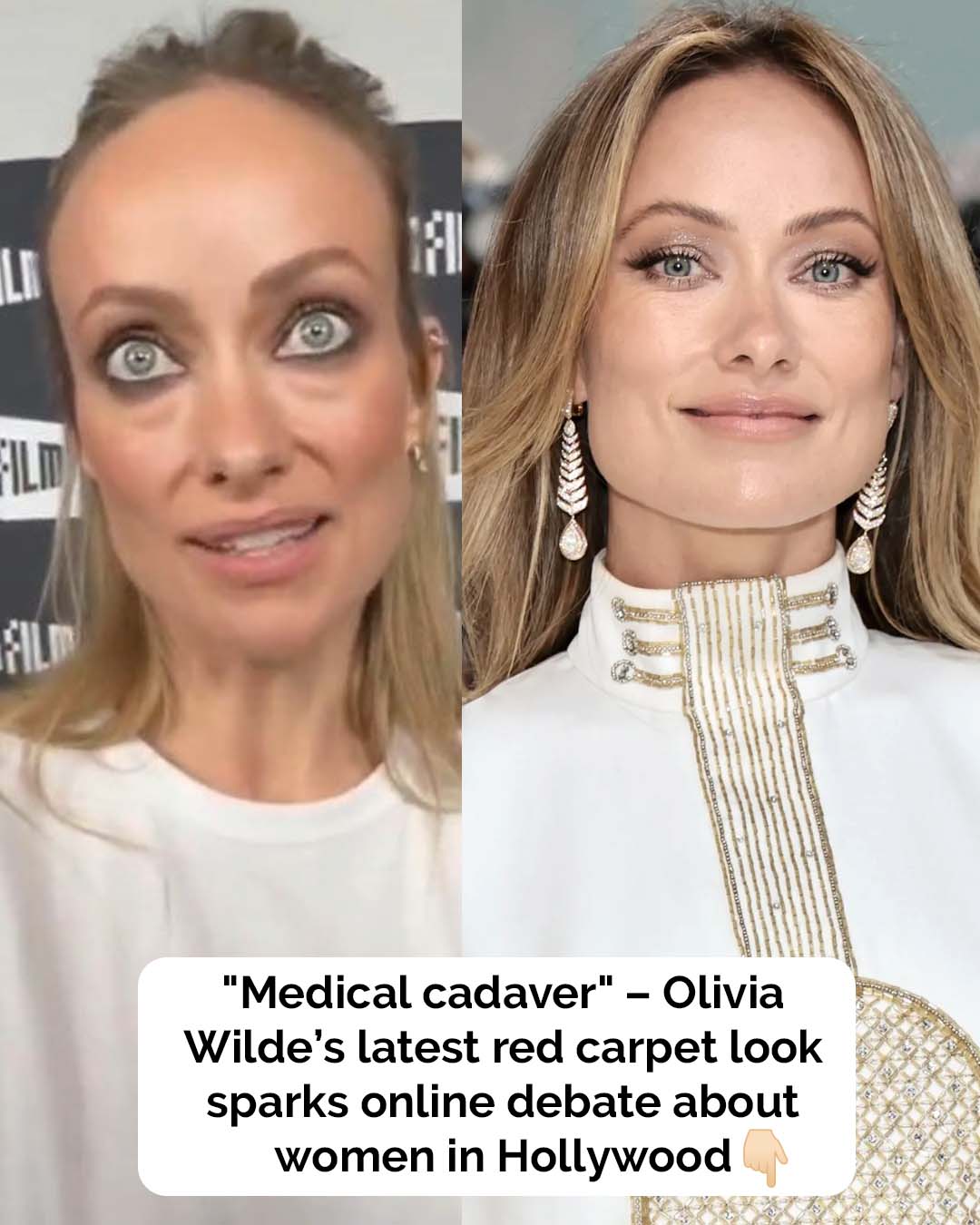
Olivia Wilde sat down to talk about her new film, The Invite. The internet, however, chose a different subject. Within hours, a short clip from that interview spiraled across platforms—not as discussion about her work, but as a microscope turned on her face. Speculation spread fast, filling the gaps with guesses dressed up as concern. Was she sick? Was it weight-loss drugs? Was it simply age? As strangers debated her appearance in real time, one unsettling truth surfaced: the conversation was never really about her film.
What began as a routine promotional moment quickly became something harsher—a kind of public dissection. A single viral post, comparing her to something clinical and lifeless, opened the floodgates. Comments multiplied, some framed as worry, others openly cruel, many pretending to diagnose from a few seconds of footage. At the same time, another group pushed back, arguing that what people were reacting to wasn’t reality at all—just unfiltered lighting, an unfamiliar angle, and the jarring effect of seeing a public figure without the usual layers of polish.
That tension—between projection and perception—sits at the center of what happened. Because the clip didn’t just show a face; it disrupted expectations. Audiences are so accustomed to carefully curated images that anything more real can feel wrong, even alarming. And in that gap, speculation thrives.
Wilde herself has spoken about this before. She has warned that celebrity images are often engineered illusions, shaped by lighting, angles, editing, and expectation. She has also been clear about the cost of that illusion—that visibility is often mistaken for permission, and that public figures, especially women, are still treated as if their bodies are open for commentary at all times.
The reaction to this moment reveals something deeper than a single viral clip. It exposes a culture that still struggles with the idea of women aging naturally, without apology or disguise. A face that doesn’t match a fixed, idealized version becomes a problem to solve, a mystery to explain, or worse, a flaw to criticize.
While Wilde continues promoting a film about relationships and hidden tensions, a different kind of story is unfolding in parallel—one not scripted or directed, but crowdsourced in real time. It’s a reminder that, for women in Hollywood, the conversation rarely stays where it begins. The work may open the door, but the scrutiny always finds its way in.